The Fitties Journal
Yuhasz Body Fat Calculator
Key Takeaways
Here's what matters most if you're short on time.
- The Yuhasz method uses six skinfold sites (tricep, subscapular, suprailiac, abdomen, thigh, calf) and was specifically designed for athletes and highly fit populations.
- Unlike most caliper formulas, it includes a calf measurement, which helps capture fat distribution in trained individuals who may carry less subcutaneous fat in the upper body.
- The formula uses a simple linear equation with separate coefficients for males and females. No logarithms, no body density conversion.
The Yuhasz method is a six-site skinfold formula designed specifically for athletes and highly fit individuals. The Yuhasz equations are widely used in research on athletes, from male combat-sport athletes (Dimitrijevic et al., 2022) to female rugby players (Escrivá et al., 2021). Two honest caveats are that the derivation was never formally published, so there is no openable primary source, and published versions of the formula disagree with each other, with at least one peer-reviewed study using chest in place of calf (Dimitrijevic et al., 2022). Treat it as a consistent tracking tool rather than an authoritative number.
The formula uses a simple linear equation that directly calculates body fat percentage from the sum of six skinfold measurements. There is no body density conversion step, no logarithms, and no age variable. Separate equations are provided for males and females.
For a complete overview of all body fat measurement methods and how to use calipers, see our guide to measuring body fat.
If you don't have calipers, the US Navy body fat formula estimates body fat from simple tape-measure circumferences instead.
Who Is This Method For?
The Yuhasz method is best suited for athletes and highly fit individuals who want a body fat formula designed for their population. Formulas built on general-population samples are applied outside the range they were derived from when used on very lean people, which is the usual argument for reaching for an athlete-specific equation instead. The Yuhasz coefficients came from work on trained populations.
If you are of average build and not highly trained, the general-population formulas will likely produce more accurate results for you. Good starting points include the Jackson-Pollock 3-site method for simplicity, the JP 7-site method for accuracy, or Durnin-Womersley if you want age-specific equations.
FitNutrients+
A premium multivitamin/mineral formula, four capsules a day, with metabolically active B vitamins such as methylcobalamin and methylfolate, 12.5 mcg (500 IU) of vitamin D3 and Albion mineral chelates. It contains no iron.
Shop FitNutrients+Skinfold Measurement Locations (Males and Females)
All six measurement sites are the same for both males and females.
| Site | Location | Fold Direction |
|---|---|---|
| Tricep | Halfway between the top of the shoulder and the elbow, on the back of the arm | Vertical |
| Subscapular | Approximately 2 cm below the lower tip of the shoulder blade, at a 45-degree angle roughly parallel to the inner angle of the shoulder blade | Diagonal (45°) |
| Suprailiac | Approximately two inches above the iliac crest (upper protrusion of the hip bone), at a 45-degree angle going up and away from the body | Diagonal (45°) |
| Abdomen | One inch to the right of the belly button | Vertical (preferred) or Horizontal |
| Thigh | Front of the quadriceps, halfway between the top of the knee and the fold at the top of the thigh. Skin here tends to be firmer; a consistent, firm pinch is important. | Vertical |
| Calf | The largest part of the calf, on the inside (medial side) of the leg | Vertical |
Yuhasz Body Fat Formula for Males
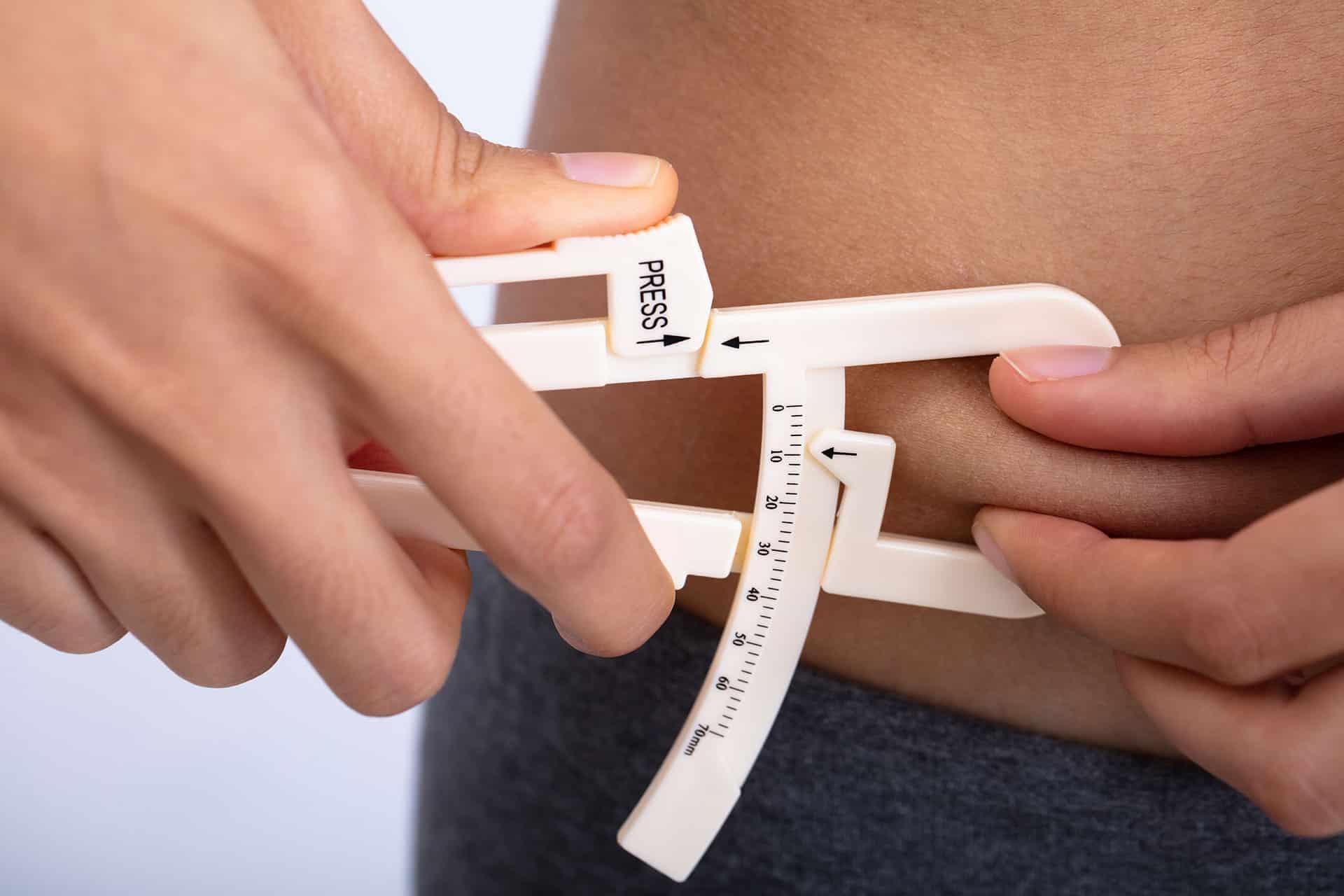
Measure the following skinfolds in millimeters with body fat calipers. They are Tricep, Subscapular, Suprailiac, Abdomen, Thigh, and Calf.
| Step | Formula |
|---|---|
| Body Fat % | (0.1051 x sum of skinfolds) + 2.585 |
Yuhasz Body Fat Formula for Females
Measure the following skinfolds in millimeters with body fat calipers. They are Tricep, Subscapular, Suprailiac, Abdomen, Thigh, and Calf.
| Step | Formula |
|---|---|
| Body Fat % | (0.1548 x sum of skinfolds) + 3.580 |
Example Calculation
Here is a worked example for a male athlete with the following skinfold measurements.
| Site | Measurement |
|---|---|
| Tricep | 7 mm |
| Subscapular | 9 mm |
| Suprailiac | 8 mm |
| Abdomen | 12 mm |
| Thigh | 10 mm |
| Calf | 6 mm |
| Sum of Skinfolds | 52 mm |
Calculate Body Fat Percentage (Male)
Body Fat % = (0.1051 x 52) + 2.585
Body Fat % = 5.4652 + 2.585
Body Fat % = 8.1%
This result is consistent with a lean, trained male athlete. For comparison, the same sum of skinfolds using the female equation would produce the following.
Body Fat % = (0.1548 x 52) + 3.580 = 8.0496 + 3.580 = 11.6%
The higher female result reflects the fact that women carry higher essential body fat levels. Both results fall within expected ranges for trained athletes.
Tips for Accurate Results
Measure before training, not after. Exercise temporarily increases blood flow to muscles, which can alter skinfold thickness. Take measurements before a workout or on a rest day for consistent readings.
Pay extra attention to the thigh site. Skin and fat in the quadriceps area tend to be firmer in athletes, making pinching more difficult and potentially leading to inconsistent readings. A firm, consistent pinch across sessions is important. If this site gives you variable results, take three measurements routinely and average the two closest.
Take two to three readings at each of the six sites. Average the results. With six sites, small measurement errors at each location compound in the final number.
Always measure from the right side of the body. Standard practice for all caliper-based formulas.
Have a partner take all measurements. The subscapular (upper back) and calf sites are very difficult to self-measure accurately. Consistency in who takes the measurements matters as much as consistency in technique.
Track monthly, not weekly. Body composition changes in athletes are often gradual, even during intense training blocks. Monthly measurements provide the most meaningful data for detecting real trends.
Compare against your own baseline. The Yuhasz formula's greatest value for athletes is in tracking personal trends over time. Comparing your results to generic body fat charts is less useful than comparing against your own historical measurements taken under consistent conditions.
How Yuhasz Compares to Other Methods
| Method | Sites | Best For |
|---|---|---|
| JP 3-Site | 3 | Quick estimate, beginners, solo measurement |
| JP 4-Site | 4 | Same sites for both genders, good accuracy-to-effort ratio |
| JP 7-Site | 7 | Most comprehensive JP method, general population |
| Durnin-Womersley | 4 | Broad age range (16-72), age-specific equations |
| Yuhasz (this article) | 6 | Athletes and highly fit individuals |
| Parillo | 9 | Most measurement sites, simplest formula |
Where do supplements fit?
The Yuhasz method gives athletes a sport-specific body fat baseline. Your training and your diet are what move that number. If you use a multivitamin to cover gaps that food alone may not, FitNutrients+ is one example, a four-capsule daily formula with metabolically active B vitamins such as methylcobalamin and methylfolate, 12.5 mcg (500 IU) of vitamin D3 and Albion mineral chelates. It contains no iron.
Conclusion
The Yuhasz method fills a gap that most caliper formulas leave open, a body fat equation designed for people who are already fit. Six measurement sites, a simple linear formula, and calibration for trained populations make it the go-to choice for athletes who want accurate, repeatable body fat tracking.
If you are not highly trained, the general-population formulas will serve you better. The JP 3-site method is the quickest option. The JP 7-site method offers the best accuracy for the general population. And if you want the most measurement sites possible, the Parillo method uses nine.

FitNutrients+
A premium multivitamin/mineral formula, four capsules a day, with metabolically active B vitamins such as methylcobalamin and methylfolate, 12.5 mcg (500 IU) of vitamin D3 and Albion mineral chelates. It contains no iron.
Shop FitNutrients+