The Fitties Journal
Leg Workouts That Build Real Strength
Key Takeaways
Here's what matters most if you're short on time.
- Compound movements like squats, deadlifts, and lunges should anchor every leg session because they recruit the most muscle.
- Progressive overload, not exercise variety, is the primary driver of leg strength and size gains over time.
- Post-workout protein intake plays a direct role in supporting muscle repair and adaptation from leg training.
- Training legs 2-3 times per week with adequate recovery between sessions supports consistent progress.
Most gym floors tell the same story of crowded bench stations, busy curl racks, and an eerily quiet squat rack in the corner. Leg day gets skipped more than any other training day, and the excuses are always creative. But here is the thing. Your legs contain the largest muscle groups in your body. Training them is not optional if you are serious about strength, performance, or body composition.
Strong legs support everything you do, from sprinting and jumping to carrying groceries up three flights of stairs. They also drive higher calorie expenditure per session than upper body work, simply because you are recruiting more total muscle tissue. This guide covers the key movements, programming principles, and recovery strategies that make leg training effective, not just hard.
Whether you are new to strength training or looking to push past a plateau, the principles here apply. No filler exercises, no gimmicks, just what works.
The Muscles You Are Training
Your legs are not one muscle group. They are several, and each one plays a specific role in how you move, stabilize, and generate force. Understanding the basics helps you choose the right exercises and spot imbalances before they become problems.
The quadriceps sit on the front of your thigh and are responsible for knee extension. Every time you stand up from a chair, climb stairs, or push out of the bottom of a squat, your quads are doing the heavy lifting. The hamstrings run along the back of your thigh and handle knee flexion and hip extension, which is critical for running, jumping, and decelerating.
Your glutes, particularly the gluteus maximus, are the most powerful hip extensors in your body. They drive movements like standing up from a squat, sprinting, and climbing. Because they drive hip extension, they matter for anything involving sprinting, jumping or standing up under load. The calves (gastrocnemius and soleus) control ankle movement and play a role in balance, walking, and explosive push-off in running and jumping.
A complete leg training program hits all four groups. Neglecting any one of them leaves an obvious gap in lower-body strength.
FitWhey+
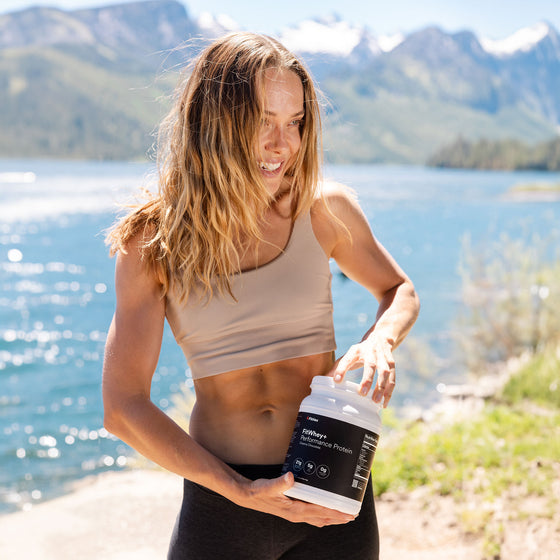
FitWhey+ delivers 21g of grass-fed New Zealand whey protein per serving, plus Aminogen, a protease enzyme system. Zero added sugar, zero stevia, sweetened with monk fruit.
Shop FitWhey+Compound Movements: The Foundation
If you only have time for a few exercises on leg day, make them compound movements. These recruit multiple muscle groups across multiple joints, which means more muscle activation, more strength development, and more efficient use of your training time.
Back Squat
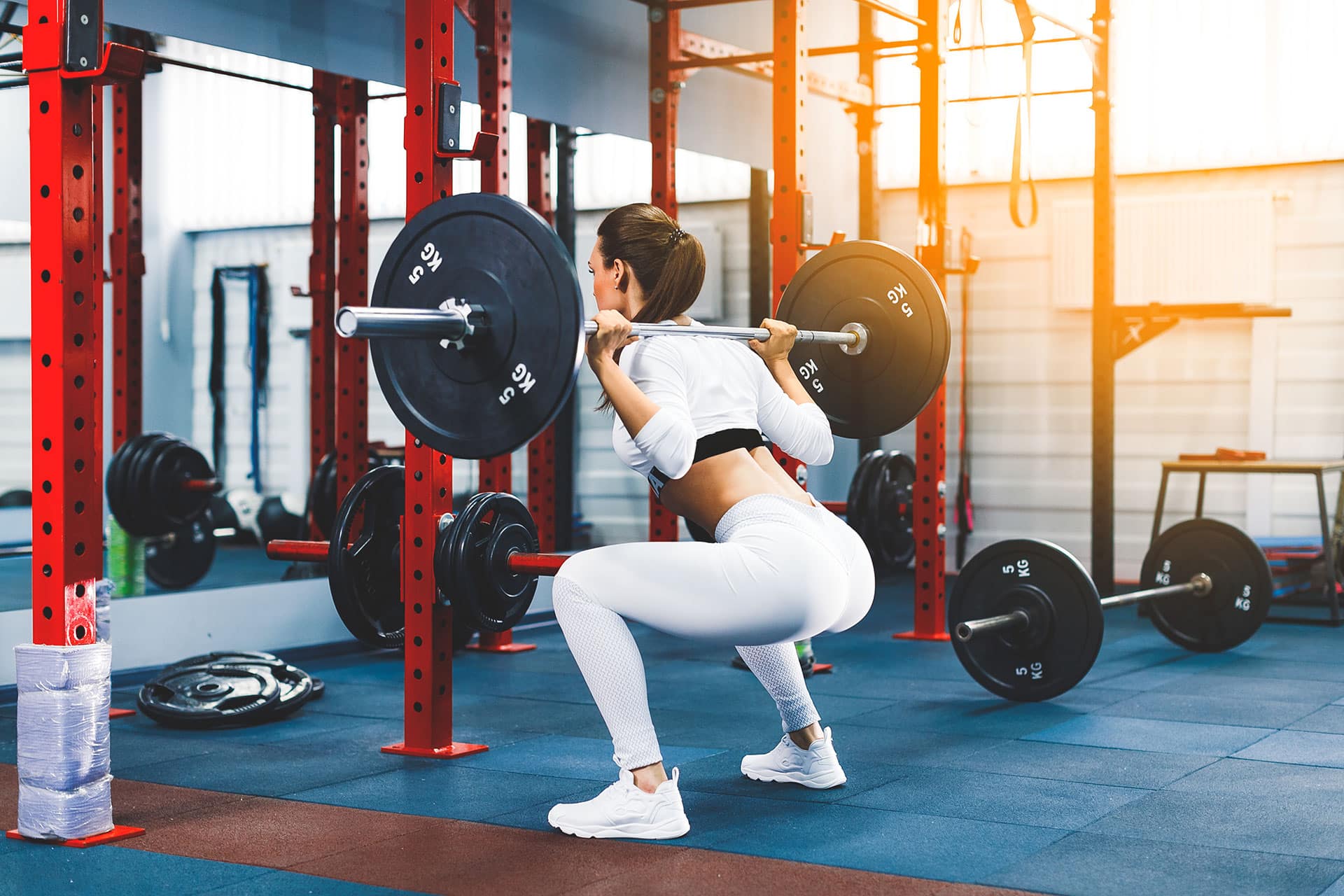
The back squat is the cornerstone of leg training. It loads the quads, hamstrings, glutes, and core simultaneously through a full range of motion. Stand with feet shoulder-width apart, barbell across your upper back. Lower your hips until your thighs are at least parallel to the floor, keeping your chest up and the bar tracking over your mid-foot. Drive through your feet to stand. If you are new to squatting, start with goblet squats (holding a dumbbell or kettlebell at chest height) to build confidence with the movement pattern before loading a barbell.
Deadlift
Deadlifts emphasize the entire posterior chain of hamstrings, glutes, and lower back. Stand with feet hip-width apart, barbell over mid-foot. Hinge at the hips and grip the bar just outside your knees. Brace your core, flatten your back, and drive the floor away from you. The bar should travel in a straight vertical line. Romanian deadlifts (starting from the top, lowering to mid-shin) are a good variation for emphasising the hamstrings. Worth being clear that this is still a loaded hip hinge with a long moment arm, so treat it as a hamstring emphasis rather than a back-friendly alternative.
Lunge Variations
Lunges build single-leg strength and expose imbalances between your left and right sides. Forward lunges, reverse lunges, walking lunges, and Bulgarian split squats all fall under this umbrella. Bulgarian split squats deserve special mention, though not for the reason usually given. The closest biomechanical comparison found both it and the back squat are hip-dominant, but that the split squat produced less knee joint demand, not more. It is a hip extension exercise that spares the knee rather than a squat substitute that matches it.
Isolation Work: Filling the Gaps
Compound lifts should dominate your leg sessions, but isolation exercises have a role. They allow you to target specific muscles that may be lagging or to accumulate extra volume without taxing your central nervous system as heavily.
Leg press is quad-dominant and a useful high-volume finisher after squats. One thing to know if you are using it as a squat substitute is that EMG work found the squat generates roughly twice the hamstring activity of the leg press, so it does not replace the posterior chain work a squat gives you. Hamstring curls (lying or seated) isolate the hamstrings through knee flexion, which the big compound lifts do not emphasize as directly. Calf raises (standing or seated) are the primary way to develop calf size and strength; the idea that calves need unusually high reps is gym lore rather than a finding. In an 8-week trial, calf muscle growth was similar whether lifters progressed by adding reps or adding weight (Plotkin et al., 2022), and the 2026 ACSM position stand attributes hypertrophy to higher weekly volumes and to eccentric overload, not to any particular rep range. Glute bridges and hip thrusts isolate the glutes and are particularly useful for people who struggle to feel their glutes working during squats and deadlifts.
Programming Your Leg Workouts
Knowing the exercises is the easy part. Programming them effectively is where most people go wrong. The two non-negotiable principles are frequency and progressive overload.
Frequency and Volume
Research supports training each muscle group at least twice per week for strength. An overview of 137 systematic reviews found two or more sessions a week enhanced strength gains (Currier et al., 2026). For size, the 2026 ACSM position stand reports that few resistance-training prescription variables affected the primary adaptations at all, but that hypertrophy was enhanced by higher weekly volumes, at ten or more sets per week, and by eccentric overload. For legs, this could mean two dedicated leg days, or an upper/lower split where legs get hit twice. Each session should include 3-5 exercises, with 3-4 working sets per exercise. Start your sessions with the heaviest compound movements when you are freshest, then move to isolation work.
Progressive Overload
Your muscles adapt to the demands you place on them. If those demands never change, neither will your muscles. Progressive overload means systematically increasing the challenge over time. The most straightforward method is adding weight to the bar. When you can complete all prescribed reps with good form, add 2.5-5 pounds the following session. You can also progress by adding reps (going from 8 to 10 at the same weight), adding sets, or decreasing rest periods. The method matters less than the consistency of progression.
Sample Routines
Here are two routines scaled to different experience levels. Both follow the same principles. Compound movements first, isolation second, progressive overload always.
| Beginner (2x/week) | Sets x Reps |
|---|---|
| Goblet Squat | 3 x 10 |
| Romanian Deadlift | 3 x 10 |
| Walking Lunge | 3 x 10/leg |
| Leg Press | 3 x 12 |
| Standing Calf Raise | 3 x 15 |
| Intermediate/Advanced (2-3x/week) | Sets x Reps |
|---|---|
| Back Squat | 4 x 6-8 |
| Romanian Deadlift | 4 x 8-10 |
| Bulgarian Split Squat | 3 x 10/leg |
| Lying Hamstring Curl | 3 x 12 |
| Hip Thrust | 3 x 10 |
| Seated Calf Raise | 4 x 15-20 |
Rest 2-3 minutes between heavy compound sets. Be wary of very short rests even on isolation work. In a controlled trial, one minute between sets produced less strength and less anterior thigh growth than three minutes, with everything else held constant. Adjust weights so the last 1-2 reps of each set are genuinely challenging while maintaining form.
Warming Up the Right Way
Jumping straight into heavy squats is a fast track to pulled muscles and underwhelming performance. A proper warm-up takes 10 minutes and pays dividends for the entire session.
Start with 5 minutes of low-intensity movement to raise your core temperature, such as cycling, brisk walking, or light jogging. Then transition to dynamic stretches that target the hips, quads, hamstrings, and ankles. Leg swings (10-15 per leg), walking lunges with a torso twist (8 per side), hip circles (10 each direction), and ankle circles (10 each direction) cover the major areas. Finish with 1-2 warm-up sets of your first exercise at 40-60% of your working weight.
Static stretching before lifting gets more blame than the evidence supports. The review most often cited for it found small to moderate effects that are dose-dependent, about 1 percent for stretches under 60 seconds per muscle group, and no clear performance effect at all when dynamic activity follows the stretching. Its actual recommendation is to include stretching in a warm-up that finishes with dynamic work, which is what the sequence above already does.
Recovery: Where the Gains Actually Happen
Your muscles do not grow during the workout. They grow in the hours and days after. The mechanism is not what most training advice says. A 2018 review concluded that muscle damage is not the process that mediates or potentiates training-induced hypertrophy, and that protocols causing little damage produce similar growth to those causing a lot. Skip the recovery side of the equation and you are leaving results on the table, no matter how hard you train.
Sleep
Growth hormone release peaks during deep sleep. Aim for 7-9 hours per night. If you are training hard and sleeping poorly, you are undermining your own progress.
Protein Timing and Quality
Protein supplies the amino acids your muscles need to repair and rebuild. Research suggests getting protein within a few hours either side of training (Aragon and Schoenfeld, 2013), though total daily protein intake matters more than precise timing (Schoenfeld et al., 2013). For people doing regular resistance training, a 2018 meta-analysis of 49 trials (Morton et al., 2018) found that extra protein stopped adding to gains in fat-free mass at about 1.6 grams per kilogram of body weight a day, and suggested up to 2.2 g/kg for people trying to maximize gains. That works out to roughly 0.7 to 1.0 grams per pound.
Not all protein sources are equal in terms of amino acid profile, digestibility, and absorption. Whey protein is one of the most studied supplemental proteins around training. The International Society of Sports Nutrition calls whey hydrolysates and isolates the most extensively researched for pre- and post-workout use, likely because of their essential amino acid and leucine content. FitWhey+ uses New Zealand-sourced whey protein concentrate from grass-fed, rBST/rBGH hormone-free cattle and includes Aminogen®, a protease enzyme system. It is sweetened with monk fruit extract, with zero added sugar and zero stevia.
Supporting Muscle Health Beyond Protein
Beyond protein, other nutrients play a role in the muscle recovery process. HMB (beta-hydroxy-beta-methylbutyrate) is a metabolite of the amino acid leucine, and the International Society of Sports Nutrition position stand (Wilson et al., 2013) lists increased protein synthesis and reduced protein breakdown among its mechanisms of action. FitRestore combines 3 g of calcium HMB monohydrate with 12.5 mcg of vitamin D3 in each six-capsule serving.
Adequate hydration and balanced nutrition, including sufficient carbohydrates to replenish glycogen stores and healthy fats that play a role in the body's recovery processes, round out the picture. For a deeper look at protein intake recommendations, check out our guide to protein intake for men and women.
Common Mistakes to Avoid
Even experienced lifters make these errors. If your leg development has stalled, one of these is probably why.
Skipping depth on squats. Half-squats build half-results. If mobility is the limitation, work on ankle and hip flexibility rather than loading up weight you cannot move through a full range of motion. Neglecting hamstrings and glutes. Quad-dominant programming creates imbalances that can compromise knee and hip health over time. Every leg session should include at least one posterior chain exercise. Ignoring calves. They are small and stubborn, but visible calf development requires direct work at higher rep ranges. Chasing weight over form. Adding plates to the bar is satisfying, but not at the expense of range of motion, joint integrity, or injury risk. Progress means the same quality of movement with more load, not more load with worse movement.
Putting It All Together
Building strong legs is not complicated, but it does require consistency. Pick 4-6 exercises that cover all four major muscle groups, train them 2-3 times per week, apply progressive overload, and support the work with adequate protein and recovery. That is the entire formula.
The exercises in this guide are not new or secret. They are the same movements that have been building strong legs for decades. The difference is in execution. Full range of motion, controlled tempo, progressive loading, and intentional recovery. Do those things consistently and your legs will respond.
If you are looking for nutrition strategies to complement your training, our guide to macronutrients for performance covers the full picture. And as always, consult a healthcare professional before making significant changes to your exercise or nutrition routine, particularly if you have existing health concerns.
FitWhey+
FitWhey+ delivers 21g of grass-fed New Zealand whey protein per serving, plus Aminogen, a protease enzyme system. Zero added sugar, zero stevia, sweetened with monk fruit.
Shop FitWhey+