
The Fitties Journal
How Much Protein Per Day? Targets for Women and Men by Weight
Key Takeaways
Here's what matters most if you're short on time.
- The RDA of 0.8 g/kg per day is a population adequacy figure, not a training target.
- Most adults who train fall between 1.4 and 2.0 grams of protein per kilogram of body weight per day.
- Per kilogram of body weight, no national body sets a different protein requirement for men and women.
- No menopause society or government body publishes a menopause-specific protein target.
- In postmenopausal women, a 2022 meta-analysis in Nutrients found whey protein added nothing to strength or lean mass without resistance training.
- US adults average 89.3 grams of protein a day for men and 65.6 grams for women, well below the training range.
Skip to the Protein Calculator
For most adults who train, the target is 1.4 to 2.0 grams of protein per kilogram of body weight per day, or roughly 0.64 to 0.91 grams per pound, according to the International Society of Sports Nutrition's position stand. For a 160 pound person, that is about 100 to 145 grams a day. The federal RDA of 0.8 g/kg (0.36 g/lb) is a different number doing a different job. It is a population adequacy figure for healthy adults, not a target built around training.
Per kilogram of body weight, men and women land in the same range. Your body weight, how hard you train, and whether you are cutting or gaining move your number far more than your sex does. Below are the actual figures, the per-meal split, and a straight read on which of the popular claims about protein hold up and which do not.
How much protein do you need per day?
Three numbers matter, and they answer three different questions.
The RDA is 0.8 g/kg per day, which works out to 56 grams for a reference adult man and 46 grams for a reference adult woman, according to the National Academies' Dietary Reference Intakes. That is the intake judged sufficient to meet the requirements of nearly all healthy people. It is an adequacy threshold for a population, not a performance target for an individual. Using it as a training number is like reading the minimum oil line as the recommended service interval.
The training range is 1.4 to 2.0 g/kg per day. The ISSN position stand concludes that this range is sufficient for most exercising individuals to build and maintain muscle. The NIH Office of Dietary Supplements cites a similar band of 1.2 to 2.0 g/kg for athletes.
The cutting range is higher. The same position stand notes that intakes of 2.3 to 3.1 g/kg per day may be needed to maximize retention of lean body mass in resistance-trained subjects during hypocaloric periods. Protein needs go up, not down, when calories come down.
| Who you are | Grams per kg | Grams per lb |
|---|---|---|
| Sedentary adult (RDA) | 0.8 | 0.36 |
| Active adult or athlete | 1.2 to 2.0 | 0.55 to 0.91 |
| Training to build muscle | 1.4 to 2.0 | 0.64 to 0.91 |
| Resistance-trained, in a calorie deficit | 2.3 to 3.1 | 1.05 to 1.41 |
| Healthy adult over 65 | 1.0 to 1.2 | 0.45 to 0.55 |
| Adult over 65 who exercises | 1.2 or more | 0.55 or more |
Sources for the table: the RDA row from the National Academies' Dietary Reference Intakes; the active and athlete row from the NIH Office of Dietary Supplements; the training and deficit rows from the ISSN position stand; the over 65 rows from the PROT-AGE Study Group, which puts healthy older adults at 1.0 to 1.2 g/kg per day and older adults who exercise at 1.2 g/kg or above.
FitWhey+
21 grams of whey protein per serving from 100% New Zealand grass-fed, rBST/rBGH hormone-free cattle, with 2,350 mg (Vanilla) or 2,400 mg (Chocolate) of leucine and fungal proteases (Aminogen). Sweetened with monk fruit. No added sugar, no stevia.
Shop FitWhey+What is your daily protein target by body weight?
If you would rather read your number off a chart than do the arithmetic, here it is, at 1.6 and 2.0 grams per kilogram.
| Body weight | At 1.6 g/kg | At 2.0 g/kg |
|---|---|---|
| 120 lb (54 kg) | 87 g | 109 g |
| 140 lb (64 kg) | 102 g | 127 g |
| 160 lb (73 kg) | 116 g | 145 g |
| 180 lb (82 kg) | 131 g | 163 g |
| 200 lb (91 kg) | 145 g | 181 g |
| 220 lb (100 kg) | 160 g | 200 g |
Why 1.6 as the lower column? A meta-analysis of 49 randomized controlled trials estimated a plateau in resistance-training gains in fat-free mass at about 1.62 g/kg per day. Worth knowing that this estimate did not reach statistical significance (p = 0.079) and its confidence interval ran from 1.03 to 2.20 g/kg, so treat it as a reasonable landmark rather than a hard cutoff. Most of the internet quotes it as settled. It is not.
How much protein per day for women?

The same per-kilogram numbers apply. This is the part the internet keeps getting wrong, so it is worth being precise about what is actually established.
No national or international body sets a different per-kilogram protein requirement for women. The Dietary Reference Intakes apply the same 0.8 g/kg to both sexes, and the familiar 56 grams versus 46 grams gap reflects nothing more than reference body weight. Direct measurement points the same way. Studies using the indicator amino acid oxidation method put the requirement at 0.9 g/kg as an average requirement and 1.2 g/kg as an RDA, with no difference on a gender basis or on a per kilogram basis between younger and older adults. Note that this method lands well above the current 0.8 g/kg RDA, and the authors argue the recommendation may need re-assessing.
So a 140 pound woman who lifts four days a week is looking at the same 102 to 127 grams a day as a 140 pound man who trains the same way. Her absolute total is lower than his only because she weighs less. The same logic decides which tub she buys, and choosing a protein powder as a woman comes down to five label specs, not a pink label.
Where the numbers do climb for women is in sport. The ISSN position stand on nutritional concerns of the female athlete recommends that daily protein fall in the mid to upper range of 1.4 to 2.2 g/kg for women at all stages of menstrual function, with peri and post-menopausal athletes aiming for the top of that band. Read the scope carefully. That stand covers female athletes, and its authors describe it as based on limited research. It is not a general-population requirement, and anyone quoting 2.2 g/kg as what every woman over 45 needs has stretched the source past what it says.
Does menopause change how much protein you need?
Here is the honest answer. No menopause society, government body, or academy publishes a menopause-specific protein target. There is no validated number, which is exactly why you see so many confidently invented ones.
What the trials do show is that protein is not the lever most people are selling it as. A meta-analysis of studies in postmenopausal women found that whey protein improved biceps curl strength and lower-limb lean mass only in combination with resistance training, and that without training it had no significant benefit for muscle strength or lean mass. A 2026 systematic review of strength-training interventions in postmenopausal women examined protein intake across nine of its 34 included trials and found no significant additional effect on muscle strength or lean body mass above a minimal intake of about 0.8 g/kg.
The practical read is to get to the training range and then spend your effort on the resistance training, because that is the variable carrying the result. Protein is the raw material. Training is the signal. Supplementing one without the other is the most expensive way to stay exactly where you are. If building muscle is the goal, our guide to female muscle growth covers the training side.
How much protein should you eat per meal?
Spreading intake probably edges out stacking it, though the long-term evidence is thinner than the headlines suggest. Schoenfeld and Aragon concluded that to maximize anabolism, a practical approach is roughly 0.4 g/kg per meal across at least four meals, reaching a minimum of about 1.6 g/kg per day. For a 160 pound person that is about 29 grams per meal, four times a day.
Two caveats most articles skip. That 0.4 g/kg figure is a coverage number, not a measured ceiling. It was reached by adding two standard deviations to a finding that 0.25 g/kg per meal maximally stimulated muscle protein synthesis in young men (Schoenfeld and Aragon, 2018). And the authors themselves note that longitudinal body composition studies have not consistently corroborated the acute results. Hitting your daily total is the thing that matters most. Distribution is a refinement, not a requirement. Age shifts that per-meal number upward, which we break down in protein powder for seniors.
Leucine is the amino acid that does the signalling. The ISSN position stand recommends that an acute protein dose strive to contain 700 to 3,000 mg of leucine alongside a balanced array of essential amino acids. Age shifts this. Clinical work summarised in a 2024 review in Frontiers in Nutrition found adults over 60 required meals with at least 2.8 g of leucine, about 30 g of protein, to stimulate muscle protein synthesis, a requirement not observed in adults under 30, whose response rises roughly in proportion to the protein in the meal. If you are over 60, that is a real argument for bigger protein servings rather than more of them, and a conversation worth having with your healthcare provider before you rebuild your diet around it.
How much protein do most people already eat?
More than they assume, and less than they need if they train. In the USDA's most recent What We Eat in America survey covering August 2021 to August 2023, US adults aged 20 and over averaged 89.3 grams of protein a day for men and 65.6 grams for women.
Set that against the table above. A 180 pound man training for muscle needs about 131 grams; the average intake is 89.3. A 140 pound woman doing the same needs about 102; the average is 65.6. Both clear the RDA comfortably. Neither is close to the training range. The gap is not exotic, it is just breakfast and one other meal running light on protein.
Is too much protein bad for you?
The kidney claim is the one that will not die. A systematic review and meta-analysis of 28 randomized controlled trials in 1,358 adults without kidney disease looked at exactly this. Post-intervention glomerular filtration rate was modestly higher in the higher-protein groups, but the change in GFR from baseline did not differ between higher-protein and control diets, with higher protein defined as at least 1.5 g/kg or 100 g per day. The authors concluded that higher protein intakes do not adversely influence kidney function on GFR in healthy adults.
Two limits on that. It applies to people without kidney disease. PROT-AGE specifically carves out those with severe kidney disease, who may need to limit protein. And appetite claims are weaker than advertised. A review of controlled feeding trials found higher-protein meals produced greater perceived fullness and elevated satiety hormones, but did not support an effect on energy intake at the next eating occasion. Protein makes a meal more filling. Whether that quietly shrinks what you eat later is not settled.
If you have kidney disease, are pregnant or nursing, or take medication that interacts with diet, talk to your healthcare provider before making a large change to your protein intake.
What if you cannot hit your target from food?

Whole food first. Lean meat, poultry, fish, eggs, dairy, legumes and soy all deliver high-quality protein, and food brings micronutrients and fiber a powder does not. What to look at on any label is grams of protein per serving, what is doing the sweetening, how many servings are actually in the tub, and what the allergen line says. Most of the industry is happy to sell you a scoop that looks impressive on the front panel and thin on the back.
At 130 or 160 grams a day, though, protein stops being a nutrition question and becomes a logistics question. That is the gap a powder is for.
FitWhey+ provides 21 grams of whey protein per two-scoop serving from New Zealand grass-fed, rBST and rBGH hormone-free cattle, and the Chocolate label lists 2,400 mg of leucine per serving, the Vanilla 2,350 mg. The vanilla is 130 calories with 11 g of carbohydrate and 6 g of fiber; the chocolate is 170 calories with 13 g of carbohydrate and 3 g of fiber. It is sweetened with monk fruit extract, with no added sugar, no stevia and no artificial sweeteners, and it includes Aminogen®, a fungal protease complex. It contains milk, and both flavors are formulated to exclude wheat, gluten, yeast, soy protein, fish, shellfish, peanuts, tree nuts, egg, sesame, artificial colors and artificial sweeteners.
From the label, worth reading rather than skipping: Very low calorie protein diets (below 400 calories per day) may cause serious illness or death. Do not use for weight reduction in such diets without medical supervision. Not for use by infants, children, or pregnant or nursing women.
If dairy is out, a plant protein comparison is the place to start. If you are over 60 and reading this for muscle preservation, HMB dosing and who the research covers is the companion piece. And if you are wondering whether the timing of your shake matters as much as the total, we covered that separately.
Putting it together
Take your body weight in kilograms. Multiply by 1.6 if you train and want a floor the evidence reasonably supports, or up to 2.0 if you are pushing hard. Divide across four meals. Track it honestly for one week, because almost nobody eats what they think they eat. Then stop optimizing the decimal places and go train, because that is the half of the equation doing the heavy lifting.

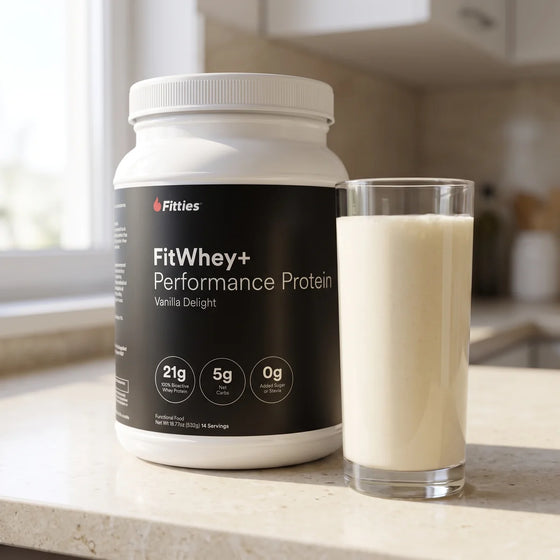
FitWhey+
21 grams of whey protein per serving from 100% New Zealand grass-fed, rBST/rBGH hormone-free cattle, with 2,350 mg (Vanilla) or 2,400 mg (Chocolate) of leucine and fungal proteases (Aminogen). Sweetened with monk fruit. No added sugar, no stevia.
Shop FitWhey+