The Fitties Journal
Collagen Supplements: Benefits, Types, and How to Choose
Key Takeaways
Here's what matters most if you're short on time.
- Collagen accounts for ~30% of your total protein and provides structural support to skin, hair, nails, bones, joints, and connective tissues.
- Production starts declining in your late teens and accelerates to ~1% per year by age 40, with steeper losses for women post-menopause.
- Supplements come in hydrolyzed peptides, powders, and capsules from bovine, marine, or poultry sources, each providing different collagen types.
- Instead of consuming collagen directly, you can support your body's own production with compounds like ch-OSA® (choline-stabilized orthosilicic acid) and biotin.
- When choosing a supplement, match the collagen type to your goal, prioritize bioavailability, and look for cGMP-compliant manufacturing.
Collagen is the protein your body relies on more than any other. It forms the structural scaffolding for skin, hair, nails, bones, cartilage, tendons, and ligaments. It accounts for roughly 30% of your total protein and makes up about three-quarters of the dry weight of your skin.
The problem? Your body starts producing less of it earlier than most people realize. Collagen synthesis begins declining in your late teens and early twenties. Collagen levels fall gradually with age, and research in women links the menopausal transition to a measurable decline of roughly 1 to 2% per year. In women, skin thickness and collagen fall sharply around menopause. One 2025 review reports skin thickness declining by about 1.13% per year in the first two decades after menopause, and skin elasticity by roughly 0.55% per year.
This is why collagen supplementation has drawn so much research. A 2026 umbrella review gathered 16 meta-analyses covering 113 randomized trials (Ravindran et al., 2026). But the category is crowded, the claims are often inflated, and the differences between products matter more than most brands want to admit.
This guide breaks down what collagen actually does, what the clinical research supports, and how to choose a supplementation strategy that fits your goals.
What Is Collagen and Why Does It Matter?
Collagen is a family of fibrous proteins that give tissues their structure, strength, and resilience. Scientists have identified at least 28 distinct types, and type I alone accounts for over 90% of the collagen in the human body.
Type I is the most abundant. It's the primary collagen in skin, bones, and tendons, where it provides tensile strength and durability. In skin specifically, type I collagen maintains firmness and elasticity.
Type II is concentrated in cartilage, where it forms the structural framework that cushions joints, absorbs shock, and enables smooth movement.
Type III works alongside type I in skin, blood vessels, and internal organs. It contributes to tissue elasticity and structural integrity throughout the body.
Types II and III make up most of the remainder. Understanding which types you're targeting is important when choosing a supplement.
FitRenew
FitRenew features ch-OSA (choline-stabilized orthosilicic acid) complemented with biotin. Rather than delivering pre-formed collagen, each capsule provides 5 mg of silicon and 100 mg of choline as ch-OSA, plus 5,000 mcg of biotin. Vegetarian, manufactured in a GMP compliant facility, with the full exclusion list on the label.
Shop FitRenewWhat Collagen Supplementation Supports
Skin Elasticity and Hydration
Skin is one of the main areas studied, alongside joints, bone, and muscle (Ravindran et al., 2026). In a 2025 meta-analysis of 23 randomized trials, collagen supplements improved skin hydration, elasticity, and wrinkles overall, but studies without pharmaceutical-company funding and high-quality studies showed no significant effect (Myung and Park, 2025). One study found that participants who supplemented with hydrolyzed collagen daily for eight weeks showed measurable improvements in skin elasticity compared to a placebo group. Another found that 12 weeks of daily supplementation supported improvements in hydration and wrinkle depth.
The idea rests on collagen's structural role. In skin, collagen supports elasticity and firmness (StatPearls), but whether collagen peptides taken by mouth help maintain it is still unsettled, and most skin trials carry a high risk of bias (Bassila et al., 2026).
Hair Strength and Nail Health
Collagen provides amino acid building blocks for keratin, the primary structural protein in hair and nails. It also plays a role in supporting blood circulation to the scalp, which influences how well hair follicles receive nutrients for growth and maintenance.
Clinical evidence on collagen peptides and hair is still limited, and much of it comes from short, industry-funded studies of multi-ingredient products (Biełach-Bazyluk et al., 2026). Nail health research is further along. Biotin supplementation has improved nail thickness (by about 25% in one study) and reduced splitting in people with brittle nails, though the clinical evidence is limited to small studies.
Joint Comfort and Mobility
Type II collagen is a critical component of joint cartilage. As collagen production declines with age, cartilage gradually loses its cushioning ability, which may contribute to joint stiffness and discomfort. Collagen hydrolysate supplementation has been studied for joint comfort, particularly in physically active people and older adults (Zdzieblik et al., 2017; Honvo et al., 2020).
Research suggests that supplemental collagen peptides may help support comfortable joint function in active people. In two randomized, placebo-controlled trials in young, physically active adults with activity-related knee discomfort, 5 g a day of specific collagen peptides for 12 weeks eased knee discomfort during activity more than placebo (Zdzieblik et al., 2017; Zdzieblik et al., 2021).
Bone Density and Strength
Type I collagen makes up about 90% of bone's organic matrix (Boskey, 2013), and the National Institute of Arthritis and Musculoskeletal and Skin Diseases notes that this collagen framework gives bone the flexibility to resist breaking. The collagen fibers in bone also serve as binding sites for calcium and other minerals that contribute to bone density.
As collagen production declines, this matrix weakens. Research into collagen supplementation has explored whether it can help support healthy bone mineral density, particularly in post-menopausal women and older adults, including a 12-month randomized, placebo-controlled trial of collagen peptides in 131 postmenopausal women (König et al., 2018).
Forms of Collagen Supplements: What's Available
Not all collagen supplements are created equal. The form, source, and processing method all affect bioavailability and what the supplement can do for you.
Hydrolyzed collagen (collagen peptides) is collagen that has been enzymatically broken down into smaller peptide chains. This process increases bioavailability, making it easier for your body to absorb and utilize. Hydrolyzed collagen is also the form studied most. A 2020 scoping review of joint and cartilage research counted 28 studies of collagen hydrolysate against 9 of undenatured collagen (Honvo et al., 2020).
Collagen protein powder typically consists of hydrolyzed collagen in a format designed to mix into beverages, smoothies, or recipes. It's a convenient way to add collagen to your daily routine.
Collagen capsules offer pre-measured doses in a portable format. They usually contain hydrolyzed collagen or collagen peptides and are the simplest option for consistent daily supplementation.
Sources matter too. Bovine-derived collagen is rich in types I and III, making it a common choice for skin, hair, and bone support. Marine collagen (from fish) is predominantly type I and is often touted for its smaller peptide size. Collagen from chicken sternum cartilage provides type II (Lugo et al., 2013), the principal collagen of joint cartilage (Eyre, 2002).
A Different Approach: Supporting Your Body's Own Collagen Production
Most collagen supplements work by delivering pre-formed collagen peptides. There's another approach. Instead of consuming collagen, you can support the biological pathways your body uses to produce its own.
This is where silicon enters the picture. Silicon is a trace element with a role in connective tissue, particularly in forming collagen and glycosaminoglycans (Carlisle, 1988). The challenge is that regular orthosilicic acid (OSA), silicon's soluble form, is highly unstable. It tends to polymerize into larger molecules that your body can't absorb efficiently.
Choline-stabilized orthosilicic acid (ch-OSA) solves this problem through its stabilization technology. Choline prevents the polymerization process, keeping the silicon in a form your body can actually use. Lab research suggests orthosilicic acid can stimulate collagen production. In human bone-forming cells, it increased type 1 collagen synthesis at concentrations similar to those normally found in blood (Reffitt et al., 2003). In placebo-controlled trials, ch-OSA was linked to smoother skin in women with sun-damaged skin and to stronger, thicker hair in women with fine hair (Barel et al., 2005; Wickett et al., 2007).
Biotin is the other half of this approach, and its evidence is thinner than its reputation. According to the NIH Office of Dietary Supplements, hair, skin, and nail claims for biotin rest, at best, on a few case reports and small studies. The hair reports are only in children with a rare hair-shaft disorder, and the small brittle-nail studies that reported thicker, firmer nails had no placebo group.
FitRenew combines ch-OSA with biotin. Vegetarian, manufactured in a GMP compliant facility, with the full exclusion list on the label.
How to Choose the Right Collagen Supplement
The collagen supplement market is enormous and the quality variance is wide. Here is what to look for.
- Match the collagen type to your goal. Types I and III for skin, hair, and bone support. Type II for joint cartilage. If you want broad coverage, consider a collagen-generating approach like ch-OSA that supports your body's production of multiple collagen types.
- Prioritize bioavailability. Hydrolyzed collagen peptides are more easily absorbed than unprocessed collagen. For silicon-based approaches, stabilization technology (like ch-OSA's choline stabilization) is critical for absorption.
- Check how it is made. Look for a clear statement of where the product is manufactured and that the facility follows current Good Manufacturing Practice (cGMP) standards.
- Read the label for fillers and allergens. Premium formulations minimize unnecessary additives and clearly disclose allergen exclusions.
- Consult a healthcare professional. Especially if you take medications or have specific health concerns. Individual needs vary, and a qualified professional can help determine what's appropriate for you.
The Bottom Line
Collagen is fundamental to how your body looks, moves, and ages. Declining production is inevitable, but how you respond to it is a choice.
Whether you choose hydrolyzed collagen peptides, a type II supplement, or a silicon-based approach like ch-OSA, the research is promising in places but mixed overall. In skin studies, the benefit disappeared in high-quality and independently funded trials (Myung and Park, 2025). The key is choosing a product with clinical backing, transparent sourcing, and a formulation that matches your specific goals.
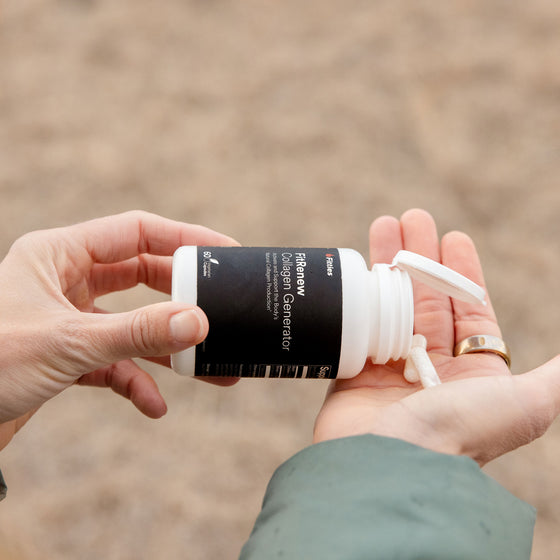
FitRenew
FitRenew features ch-OSA (choline-stabilized orthosilicic acid) complemented with biotin. Rather than delivering pre-formed collagen, each capsule provides 5 mg of silicon and 100 mg of choline as ch-OSA, plus 5,000 mcg of biotin. Vegetarian, manufactured in a GMP compliant facility, with the full exclusion list on the label.
Shop FitRenew