
The Fitties Journal
Hair, Skin, and Nails Vitamins: What Actually Works
Key Takeaways
Here's what matters most if you're short on time.
- Hair, skin, and nails vitamins help most when they fix a nutrient gap, and do little if your diet already covers the basics.
- Silicon as ch-OSA® has small placebo-controlled trials behind it for hair, nail, and skin measures (Barel et al., 2005; Wickett et al., 2007), and those results apply only to the form studied.
- Megadose biotin mainly helps brittle nails and only matters for hair if you are actually deficient.
- High-dose biotin can skew some blood tests, so tell your provider before bloodwork.
- Nails respond in weeks, skin in a month or two, and hair takes months because of its growth cycle.
Hair, skin, and nails vitamins work best when they fill an actual nutrient gap, and do very little when you are already well fed. That is the honest answer the gummy aisle would rather you not hear. The nutrients with real evidence behind them are silicon (especially as ch-OSA), biotin (mostly for brittle nails), vitamin C, zinc, and enough protein. Here is what the research actually supports, what is hype, and how to choose without overpaying.
Do hair, skin, and nails vitamins actually work?
It depends on where you are starting. Hair, skin, and nails are built from protein and maintained by a handful of vitamins and minerals, so if you are short on one of them, topping it up can genuinely help. If your diet already covers the basics, another beauty multivitamin mostly gives you expensive urine. Most major health references make the same point that these supplements help correct a deficiency, not exceed a healthy baseline.
The honest framing matters because hair, skin, and nail problems often have causes a vitamin cannot touch, such as genetics, thyroid issues, hormonal shifts, stress, rapid weight loss, or aging. A capsule is not a fix for those. It can support the raw materials your body uses, which is a smaller and more truthful promise than most labels make.
FitRenew
FitRenew pairs 5 mg of silicon from ch-OSA (choline-stabilized orthosilicic acid) with 5,000 mcg of biotin in each vegetarian capsule. Clear doses, no pixie-dust beauty blend.
Shop FitRenewWhich nutrients actually have evidence?
A few nutrients keep showing up in the research. Here is the short version, including the caveat each one comes with.
| Nutrient | What the evidence supports | The honest caveat |
|---|---|---|
| Silicon (as ch-OSA) | Two small placebo-controlled trials measured hair tensile strength, hair and nail brittleness, and skin roughness (Barel et al., 2005; Wickett et al., 2007) | The form matters. Silicon absorption varies widely by form (Sripanyakorn et al., 2009), and the studied form is choline-stabilized orthosilicic acid |
| Biotin | Small studies, none placebo-controlled, report firmer, less brittle nails (NIH ODS) | Little effect on hair unless you are actually deficient |
| Vitamin C | A required cofactor your body uses to build collagen | Helps most if your intake is low; more is not better |
| Zinc | Involved in tissue repair; deficiency is linked to hair shedding (NIH ODS; Almohanna et al., 2019) | Useful to correct a shortfall, not to megadose |
| Iron and vitamin D | Low levels are associated with hair shedding in some people (Almohanna et al., 2019) | Worth testing before supplementing; both can be overdone |
| Protein | The raw material hair and nails are made from | Food first; no capsule replaces eating enough |
Notice that a magic ingredient is missing. The pattern across the evidence is "cover your bases," not "take this one thing and transform."
Is biotin actually good for hair and nails?
Biotin is the headline ingredient in nearly every beauty gummy, usually at 5,000 to 10,000 mcg, which is hundreds of times the daily target. The catch is that biotin only helps when you are deficient, and true biotin deficiency is rare. Your body uses biotin to build keratin, so a genuine shortfall can show up as thinning hair and brittle nails, but most people are not short on it.
The strongest evidence is for nails. Three small studies, none with a placebo group, found that biotin supplementation made brittle nails firmer or thicker over several months, according to the NIH Office of Dietary Supplements. For hair growth in people who are not deficient, the evidence is thin, despite what the marketing implies.
One safety point that rarely makes the label is that high-dose biotin can throw off common lab tests, including some thyroid and heart (troponin) panels, which can lead to a wrong result. If you take a high-dose beauty supplement, tell your doctor before any bloodwork. The honest takeaway is that biotin earns a place for brittle nails, but it is not the hair miracle the gummy aisle sells.
What about silicon and collagen?
This is where it gets more interesting, because silicon is the nutrient most beauty formulas ignore. Silicon appears to play a role in how your body forms collagen. In lab studies, orthosilicic acid stimulated collagen production in human bone-forming cells (Reffitt et al., 2003). ch-OSA (choline-stabilized orthosilicic acid), a stabilized form, is the one used in the skin, nail, and hair trials. In randomized, placebo-controlled trials, oral ch-OSA improved skin and nail measures in women with photo-damaged skin and, in a separate trial, improved hair tensile strength in women with fine hair.
Collagen is the other buzzword. The honest version is that when you swallow collagen, your gut digests it into amino acids like any other protein, so it does not travel intact to your skin. Some peptide studies show skin benefits, but a 2025 meta-analysis of 23 randomized trials found no significant effect when it looked only at high-quality or independently funded studies (Myung and Park, 2025). The other route is to supply what your body uses to build its own collagen, such as silicon and vitamin C, instead of paying a premium to eat collagen that gets broken down on the way in.
How long do hair, skin, and nails vitamins take to work?
Longer than the before-and-after photos suggest, because each tissue runs on its own clock. As a rough guide, nails tend to show changes first, then skin, then hair, which is slowest because it grows on a months-long cycle and a supplement mainly affects new growth, not the strands already on your head.
| Area | Typical timeframe to notice change |
|---|---|
| Nails | Around 2 to 4 weeks |
| Skin | Around 4 to 8 weeks |
| Hair | Around 3 to 6 months |
If a product promises dramatic results in days, that is a marketing claim, not biology. Give any honest formula a few months of consistent use before you judge it.
How to choose a hair, skin, and nails supplement
The category is full of pastel labels, megadose biotin, and "beauty blends" that hide the real amounts inside a proprietary blend. You can do better by checking a few things.
- Look for forms with actual human evidence. ch-OSA for silicon is a good example, because it has been tested in real clinical trials rather than ridden in on a trend.
- Weigh a big biotin number against the evidence. The NIH Office of Dietary Supplements finds hair, skin, and nail claims for biotin supported, at best, by a few case reports and small studies. It also notes that biotin can affect lab test results. A single 10 mg (10,000 mcg) dose has interfered with thyroid function tests.
- Demand transparent doses. You want to see each amount listed, not a "beauty complex" that hides how little of the good stuff is actually in there.
- Fix the basics first. Protein, iron, vitamin D, and zinc come from food and a sensible multivitamin. A targeted product is a complement, not a substitute.
If you want the silicon route specifically, FitRenew is built around ch-OSA plus biotin in vegetarian capsules. At the directed two capsules a day, it provides 10 mg of silicon as ch-OSA, along with 10,000 mcg of biotin. The amounts are printed in plain sight rather than hidden in a blend. Because it includes high-dose biotin, mention it to your provider before any bloodwork, and as with any supplement, check first if you are pregnant, nursing, or taking medication.
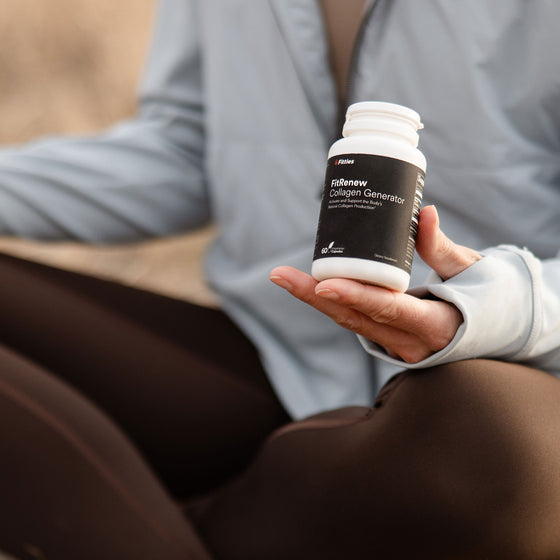
FitRenew
FitRenew pairs 5 mg of silicon from ch-OSA (choline-stabilized orthosilicic acid) with 5,000 mcg of biotin in each vegetarian capsule. Clear doses, no pixie-dust beauty blend.
Shop FitRenew