
The Fitties Journal
Multivitamin for Athletes: Do You Actually Need One?
Key Takeaways
Here's what matters most if you're short on time.
- Food comes first. A multivitamin fills dietary gaps, it does not replace a real diet.
- Hard training and restrictive or low-calorie eating raise the risk of falling short on key micronutrients, according to the 2016 joint position on nutrition and athletic performance (Thomas et al., 2016).
- The nutrients athletes watch most are vitamin D, magnesium, iron, zinc, selenium, and the B vitamins.
- Formulation beats hype. Look for bioavailable active forms, sensible doses, and no proprietary blends.
- Iron belongs in a multivitamin only when testing shows you need it, not by default.
Most athletes do not strictly need a multivitamin, and any brand that tells you otherwise is selling you fear. If your diet is genuinely dialed in, you can hit your micronutrient targets from food. The problem is that "dialed in" is rare. Hard training raises your body's demand for several vitamins and minerals, restrictive eating and weight-class phases shrink your intake, and national diet data shows most people fall short on the exact nutrients that matter for energy, recovery, and immune function. A well-built multivitamin is not a performance enhancer. It is cheap insurance against the gaps. The catch is that most multivitamins on the shelf are underdosed, poorly absorbed, and built for marketing, not for people who train hard.
What actually matters is which nutrients athletes tend to run low on, how to read a formula so you are not paying for fairy dust, and when a multi earns its place in your routine.
Do athletes actually need a multivitamin?

Food first. Always. A multivitamin does not replace calories, protein, carbohydrates, or a diet built on real food, and it never will. If you eat a varied, mostly whole-food diet with enough total energy, you are probably covering most of your micronutrient needs already. So why do so many athletes still come up short?
Two reasons. First, training changes the math. Sweat losses and higher energy turnover mean an athlete's diet has more work to do. The National Institutes of Health Office of Dietary Supplements puts vitamins and minerals alongside calories, fluids, carbohydrates, protein, and fat in the daily foundation athletes need, and is explicit that supplements can only add to that foundation, not substitute for it. Second, real diets are messier than spreadsheets. The Dietary Guidelines for Americans 2025-2030 note that Americans fall short on a range of nutrients including calcium, potassium, magnesium and vitamins A, D, E and B6. Athletes are not exempt from that, and low-calorie or restricted-food phases only widen the gap.
You benefit most from a daily multivitamin if you train at high volume, diet down or cut weight for a sport, eat plant-based or cut out whole food groups, are a female athlete (higher iron and specific needs), or get little sunlight and struggle with vitamin D. If your diet is genuinely excellent and varied, a multi is optional. For everyone else, it is a low-cost floor under the days your eating is not perfect.
FitNutrients+
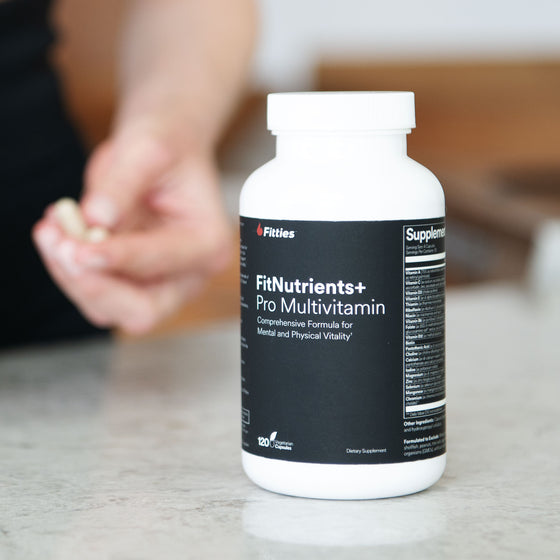
FitNutrients+ is a four-capsule daily multivitamin with metabolically active B vitamins, including methylfolate, methylcobalamin, pyridoxal 5'-phosphate and riboflavin 5'-phosphate, plus Albion chelated minerals. It carries vitamin D3, magnesium, zinc and selenium alongside vitamins C and E, and the formula contains no iron. Manufactured in a GMP compliant facility.
Shop FitNutrients+Which nutrients matter most for athletes?
A multivitamin is only worth taking if it delivers the nutrients that training actually taxes, in forms your body can use. These are the ones worth caring about, and the structure-and-function role each one plays.
| Nutrient | Why it matters when you train | Why athletes fall short |
|---|---|---|
| Vitamin D | Supports normal muscle function, bone health, and immune function | Indoor training, winter, and limited sun exposure |
| Magnesium | A cofactor in energy metabolism and normal muscle function | Commonly under-consumed; lost in sweat |
| Iron | Carries oxygen in the blood to working muscle | Higher risk in endurance and female athletes |
| Zinc and selenium | Support normal immune function and antioxidant defense | Depleted by heavy training loads and sweat |
| B vitamins | Help convert food into usable energy | Turnover rises with training volume |
| Vitamins C and E | Contribute to normal antioxidant activity | Low intake on limited-variety diets |
A few of these deserve a closer look. Vitamin D is the one most people underestimate. It supports normal muscle function and immune function, and the NIH vitamin D fact sheet notes that UVB does not pass through glass, so indoor sun does not produce it, and that people whose occupations limit sun exposure are among those unlikely to get enough. It is also the nutrient most often sold paired with K2, which we unpicked in vitamin D3 and K2. Magnesium is involved in more than 300 enzyme reactions in the body, including those that govern energy metabolism and muscle contraction, and the NIH magnesium fact sheet notes many people in the United States consume less than recommended. Iron is the exception that proves the rule, and we will come back to why more is not always better.
What makes a good athlete multivitamin (and what to skip)?
This is where most products fall apart, and where a discerning buyer separates a real formula from a bottle of expensive filler. The dose on the label means nothing if your body cannot absorb it. Judge a multivitamin on four things.
1. Bioavailable, active forms. The best formulas use nutrient forms your body can use directly. Look for methylated folate (5-MTHF) instead of plain folic acid, methylcobalamin instead of cyanocobalamin for B12, pyridoxal-5-phosphate for B6, and chelated minerals (names like bisglycinate) rather than cheap oxides. These forms are better absorbed, which is the entire point of taking a supplement. Our guide to reading supplement labels breaks down how to spot them.
2. Sensible, balanced doses. More is not better. A good multi covers a broad, balanced profile without megadosing one nutrient to look impressive on the label. Vitamins and minerals work cooperatively, and lopsided doses can work against you.
3. Real quality standards. If you are a drug-tested athlete, this one is non-negotiable. Look for third-party sport certification such as NSF Certified for Sport or Informed Sport, which screen for banned substances. That certification is separate from where and how a supplement is manufactured, so check for the specific sport logo if testing applies to you.
4. No proprietary blends or fairy dust. A "proprietary blend" hides the individual doses so you cannot tell whether the good ingredients are present in meaningful amounts. Skip them. The same goes for sugar-loaded gummies with a handful of nutrients at token doses. You are buying nutrition, not candy.
And a word on iron. A general multivitamin often leaves iron out on purpose, and that is a feature, not a flaw. Iron should be supplemented based on blood testing, not blanket-dosed, because too much is a real problem. If you are an endurance or female athlete concerned about iron, establish that you are actually low before supplementing. The Academy of Nutrition and Dietetics, Dietitians of Canada and the American College of Sports Medicine do not recommend routine iron supplementation except on a health care provider's instruction, and note it only helps if you are iron depleted (NIH fact sheet on dietary supplements for exercise and athletic performance).
How and when should you take a multivitamin?
Take it with a meal. Several vitamins (A, D, E, and K) are fat-soluble and absorb better alongside food that contains some fat, so a multivitamin taken with breakfast or lunch beats one taken on an empty stomach. Vitamin D is the fat-soluble one people most often get wrong here, so our guide to the best time to take vitamin D covers the timing and the right dose. Consistency matters more than timing. A multivitamin is foundational daily nutrition, not a pre-workout, so the goal is simply to take it every day. If your formula is a multi-capsule serving, splitting it across two meals is fine and can be gentler on an empty stomach.
One caution worth stating plainly. Vitamins and minerals can interact with medications, and some nutrients are not appropriate at high doses during pregnancy. If you take any medication, are pregnant or nursing, or manage a health condition, talk to your healthcare provider before adding a daily multivitamin. This is basic due diligence, not a disclaimer for its own sake.
Where FitNutrients+ fits

FitNutrients+ is the Fitties multivitamin, and here is its label rather than the pitch. It is a four-capsule daily formula with folate as methylfolate and calcium folinate, B12 as methylcobalamin, B6 as pyridoxal 5'-phosphate, B2 as riboflavin 5'-phosphate, and Albion chelated minerals such as zinc bisglycinate chelate. It carries 12.5 mcg (500 IU) of vitamin D3, 65 mg of magnesium, 2 mg of zinc, 17 mcg of selenium, 45 mg of vitamin C and 31 mg of vitamin E, alongside 500 mg of acetyl-L-carnitine, 100 mg of alpha-lipoic acid and 45 mg of green tea extract. It is iron-free by design, so you decide iron based on testing rather than a blanket dose. It is manufactured in a GMP compliant facility.
It is built for people who want their foundational daily nutrition handled without the fairy dust, so their attention can go to the training, where it counts. For the wider picture on which micronutrients athletes actually need, read our guide to micronutrients for athletes, and to build a smarter routine overall, see the supplement buyer's guide.
FitNutrients+
FitNutrients+ is a four-capsule daily multivitamin with metabolically active B vitamins, including methylfolate, methylcobalamin, pyridoxal 5'-phosphate and riboflavin 5'-phosphate, plus Albion chelated minerals. It carries vitamin D3, magnesium, zinc and selenium alongside vitamins C and E, and the formula contains no iron. Manufactured in a GMP compliant facility.
Shop FitNutrients+