
The Fitties Journal
Vitamin D3 and K2: Why They Pair, and 3 People Who Shouldn't
Key Takeaways
Here's what matters most if you're short on time.
- Vitamin D is required for calcium to be absorbed in the gut by active transport, while vitamin K is the coenzyme for carboxylating osteocalcin and matrix Gla-protein.
- In the AVADEC trial, 720 mcg of MK-7 plus 1,000 IU of vitamin D daily for two years did not significantly slow coronary artery calcium progression in participants without prior coronary disease (203 vs 254 Agatston units, p=0.089).
- A 2022 meta-analysis of 20 randomized trials, mostly in women, by Salma and colleagues linked vitamin K supplementation to fewer fractures, but reported insufficient evidence for an effect on femoral neck bone mineral density.
- The adult RDA for vitamin D is 600 IU, rising to 800 IU from age 71, with a Tolerable Upper Intake Level of 4,000 IU.
- Vitamin K has an Adequate Intake of 120 mcg for adult men and 90 mcg for adult women, and the Food and Nutrition Board set no Tolerable Upper Intake Level.
- Anyone taking warfarin or a similar anticoagulant needs a consistent vitamin K intake, so starting a K2 supplement is a conversation for the prescriber first.
Vitamin D3 and vitamin K2 do two different jobs on the same mineral. D3 helps your gut absorb calcium. K2 activates a family of proteins involved in where that calcium is deposited. Take both and you have covered both halves of the handoff, which is why the pair shows up on so many labels.
What the pairing does not do is rescue you from vitamin D. The loudest version of the pitch, that D3 on its own drives calcium into your arteries unless K2 escorts it to your bones, rests on a protective effect that did not show up when a randomized trial put K2 plus D to the test (Hasific et al., 2023). Here is what each vitamin does, what the research supports, how much of each the reference intakes call for, and the three situations where adding K2 is the wrong move.
What do vitamin D3 and K2 do together?
Vitamin D's headline job is calcium. The NIH Office of Dietary Supplements puts it plainly. Vitamin D "is required for calcium to be absorbed in the gut by active transport and to maintain adequate calcium levels in the blood." Absorption is not a fixed figure, either. It runs about 45% at intakes of 200 mg of calcium a day and falls to roughly 15% once intake climbs above 2,000 mg, and about 30% of the calcium in dairy and fortified foods is absorbed.
Vitamin K works one step downstream. It is a coenzyme for the enzyme that carboxylates a family of proteins, and two of those proteins matter here. Osteocalcin is "present in bone and may be involved in bone mineralization or turnover." Matrix Gla-protein "might help reduce abnormal calcification." Uncarboxylated, those proteins cannot do their job properly. Carboxylated, they can.
So the split is clean. D3 gets calcium in. K2 activates the proteins the body uses to handle it from there. That mechanism is real, and it is where the entire D3-plus-K2 category comes from.
It is also where the marketing runs a long way out ahead of the evidence.
FitNutrients+
FitNutrients+ is a four-capsule daily multivitamin and mineral formula built on metabolically active B vitamins, Albion chelated minerals and Quatrefolic® bioactive folate, with 12.5 mcg (500 IU) of vitamin D3 as cholecalciferol per serving. 120 vegetarian capsules, 30 servings, and no vitamin K in the formula.
Shop FitNutrients+Does vitamin D3 need K2 to work?

No. Vitamin D carries out its own job whether or not there is K2 in the bottle, and the protective effect K2 is sold on has been tested head on.
The AVADEC trial randomized 389 older men with calcified aortic valves to 720 mcg of vitamin K2 as MK-7 plus 25 mcg (1,000 IU) of vitamin D a day, or to placebo, for two years (Hasific et al., 2023). Among the 304 participants with no prior coronary disease, coronary artery calcium progressed in both groups and the difference did not reach statistical significance, with 203 Agatston units in the supplement group against 254 in placebo, p=0.089. A subgroup with the heaviest calcium scores at baseline (400 Agatston units or more) did separate out (Hasific et al., 2023), but a subgroup result sitting inside a non-significant primary comparison is a lead worth chasing, not a finding worth selling.
Bone is a similar picture. A 2022 systematic review and meta-analysis of 20 randomized trials in 3,950 people found vitamin K supplementation was associated with fewer fractures, with an odds ratio of 0.42 for vertebral fractures and 0.44 for clinical fractures. The same analysis reported "insufficient evidence... regarding the significant impact of VK on femoral neck BMD." The NIH Office of Dietary Supplements lands in a similar place, noting that randomized trials since a 2006 review have "found that vitamin K supplementation has no effect on bone mineral density in elderly men or women."
Read those together and the honest position is this. Vitamin K is genuinely involved in bone biology, the fracture signal is worth watching, and the protective effect the whole D3-plus-K2 pitch is built on did not show up in AVADEC, the trial that tested it (Hasific et al., 2023).
Which is the part the supplement aisle leaves out. Fear is a reliable way to sell a second ingredient at a premium, and an industry comfortable fairy-dusting an ingredient and calling it clinically dosed is not going to leave a scare story on the table. Pairing the two can be perfectly sensible. The scare story is not the reason it is sensible.
How much vitamin D3 and K2 do you need?
For vitamin D, the RDA for adults 19 to 70 is 15 mcg (600 IU) a day, rising to 20 mcg (800 IU) from 71, and the Tolerable Upper Intake Level for adults is 100 mcg (4,000 IU). Status is graded on serum 25(OH)D. Under 30 nmol/L (12 ng/mL) counts as deficiency, 30 to under 50 nmol/L (12 to under 20 ng/mL) as inadequacy, and 50 nmol/L (20 ng/mL) or above is generally considered sufficient. In 2011 to 2014 national survey data, 5% of Americans aged 1 and over were at risk of deficiency and 18% at risk of inadequacy, according to the NIH Office of Dietary Supplements.
Vitamin K has no RDA, only an Adequate Intake of 120 mcg a day for adult men and 90 mcg for adult women, counting every form of vitamin K together, per the NIH Office of Dietary Supplements. The Food and Nutrition Board "did not establish ULs for vitamin K because of its low potential for toxicity." That is not permission to take any dose of anything, but vitamin K is not the number most people need to be nervous about.
Worth noticing is the gap between reference intakes and research doses. AVADEC used 720 mcg of MK-7, six times the adult male AI. The 2022 meta-analysis (Salma et al., 2022) covered menaquinone doses running from 180 mcg all the way to 45 mg. Those are trial protocols, not recommendations, and nothing in the reference intakes listed by the NIH Office of Dietary Supplements asks for them.
| Vitamin D3 | Vitamin K2 | |
|---|---|---|
| Main job | Calcium absorption in the gut | Activating proteins involved in where calcium goes |
| Adult reference intake | RDA 600 IU, 800 IU from age 71 | AI 120 mcg men, 90 mcg women (all vitamin K) |
| Upper limit set? | Yes, 4,000 IU for adults | No UL established |
| Where food gives it to you | Oily fish, fortified dairy, sunlight on skin | Fermented foods, cheeses, egg yolk, some meats |
| Dose used in the AVADEC trial | 1,000 IU daily | 720 mcg MK-7 daily |
K1 or K2, and MK-4 or MK-7?

Vitamin K comes in two families. K1, phylloquinone, is "present primarily in green leafy vegetables and is the main dietary form of vitamin K." K2, the menaquinones, are "predominantly of bacterial origin" and turn up "in modest amounts in various animal-based and fermented foods." Fermented soy and aged cheeses are the usual examples.
Within K2, the two forms you will see on a label are MK-4 and MK-7. MK-4 "is unique in that it is produced by the body from phylloquinone via a conversion process," which is a technical way of saying your body already makes some of it out of the K1 in your salad. AVADEC used MK-7, but the fracture trials in a 2006 review described by the NIH Office of Dietary Supplements all used MK-4, at 15 or 45 mg a day.
There is a wrinkle worth knowing before you assume the salad has it handled. Vitamin K is fat-soluble and gets absorbed into mixed micelles in the small intestine the same way dietary fat does, and the NIH notes that the body absorbs only 4% to 17% as much phylloquinone from spinach as from a tablet. Eating greens with some fat on the plate improves that number, which is one more argument for dressing the salad instead of eating it dry.
Duration is the other thing separating the two K2 forms. The NIH notes that both phytonadione and MK-7 supplements are well absorbed, but MK-7 has the longer half-life, which is the practical case for it on a once-daily label. Vitamin K also has relatively low blood levels and tissue stores compared with the other fat-soluble vitamins, because the body retains only about 30% to 40% of an oral physiological dose (based on phylloquinone measurements) and excretes the rest, according to the NIH Office of Dietary Supplements. Consistency matters more here than any single large dose.
The practical read is that if you eat leafy greens most days with some fat alongside them, you are covering the main dietary form and converting a share of it into MK-4 yourself. If greens are genuinely rare in your week, that is the gap worth closing, and it is worth closing at the plate before it is worth closing at the capsule.
Who should skip K2?
Three groups. The first one is not a judgment call.
- Anyone on warfarin or a similar anticoagulant. The NIH is direct about it. People taking these drugs "need to maintain a consistent intake of vitamin K from food and supplements because sudden changes in vitamin K intakes can increase or decrease the anticoagulant effect." Starting a K2 supplement is a sudden change. That conversation goes to the prescriber first, not after.
- Anyone taking a high vitamin D dose on a guess. The adult upper limit is 4,000 IU, a blood test is the only way to know where you actually sit, and K2 is not a safety net for a dose nobody measured. Fix the measurement, then decide the dose.
- Anyone buying the combination because they were told D3 alone is dangerous. The protective effect behind that premise did not show up in the AVADEC trial that tested it (Hasific et al., 2023). Buy the pair if you want to cover your vitamin K intake. Do not buy it because someone frightened you into it.
How to cover both without overthinking it
Vitamin K first, because it is the easy half. Eat leafy greens regularly and you are covering the main dietary form, and fermented foods add menaquinones on top if you like them. For most people who eat this way, a separate K2 capsule is solving a problem they do not have.
Vitamin D is the harder half. Oily fish and fortified dairy carry some, sunlight on skin makes the rest, and that is exactly why intake falls short for people who train indoors, live at a northern latitude, or keep covered up. A daily multivitamin is the usual foundation here, and whether you need one at all is a fair question we worked through in our look at multivitamins for athletes. FitNutrients+ provides 12.5 mcg (500 IU) of vitamin D3 as cholecalciferol in its four-capsule serving, 63% of the Daily Value, alongside its vitamin and mineral base. It does not contain vitamin K, so if K2 is what you are after, that is a separate item. For the timing question, we covered it in the best time to take vitamin D.
One caveat carries more weight here than in most posts. If you take any prescription medication, are pregnant or nursing, or have a diagnosed condition, speak to your healthcare provider before adding vitamin K or changing a vitamin D dose. This article is information, not medical advice.
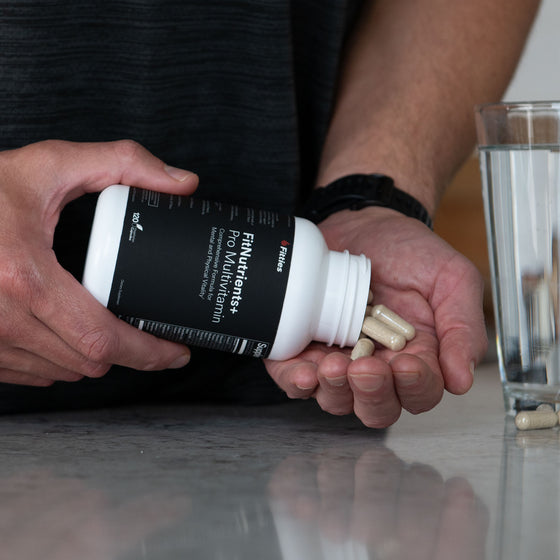
FitNutrients+
FitNutrients+ is a four-capsule daily multivitamin and mineral formula built on metabolically active B vitamins, Albion chelated minerals and Quatrefolic® bioactive folate, with 12.5 mcg (500 IU) of vitamin D3 as cholecalciferol per serving. 120 vegetarian capsules, 30 servings, and no vitamin K in the formula.
Shop FitNutrients+