
The Fitties Journal
Best Time to Take Vitamin D? 5 Rules for Timing and Absorption
Key Takeaways
Here's what matters most if you're short on time.
- Take vitamin D with a meal that contains fat; it is fat-soluble and absorbs far better with food.
- Morning or early afternoon is the low-risk default, mainly to avoid any effect on sleep.
- Consistency matters more than the exact hour you take it.
- Choose D3 (cholecalciferol); it raises blood levels more effectively than D2.
- Most adults need 600 IU a day, rising to 800 IU after age 70; a blood test tells you your real number.
The best time to take vitamin D is with a meal that contains some fat, ideally in the morning or early afternoon. Vitamin D is fat-soluble, so eating fat alongside it helps your body absorb it. A daytime dose also sidesteps the small chance that vitamin D nudges your sleep, and taking it at the same time every day matters far more than hitting a precise hour. Below are the five rules that decide how much vitamin D actually reaches your bloodstream, how much you need, and why the form on the label is not a detail.
When should you take vitamin D: morning or night?
The hour itself is not the lever; the meal is. The NIH Office of Dietary Supplements notes that fat in the gut at the same time enhances vitamin D absorption, although some vitamin D is absorbed even without dietary fat. What tips most people toward morning or early afternoon is sleep. The theory is that vitamin D can interact with melatonin, the hormone that runs your sleep cycle, and some people find a late dose leaves them wired at bedtime. In a 2022 systematic review of 19 vitamin D and sleep studies, the melatonin link was listed as a plausible theory and none of the studies compared morning with evening doses (Abboud, 2022), so keep a daytime dose as the low-risk default, not a rule handed down from on high.
If you already take yours at night and sleep fine, there is no reason to move it. The costly mistake is not taking it an hour too late. It is forgetting it entirely, or taking it in a way that leaves half of it unabsorbed. That second problem is the one worth fixing, and it comes down to what is on your plate.
FitNutrients+
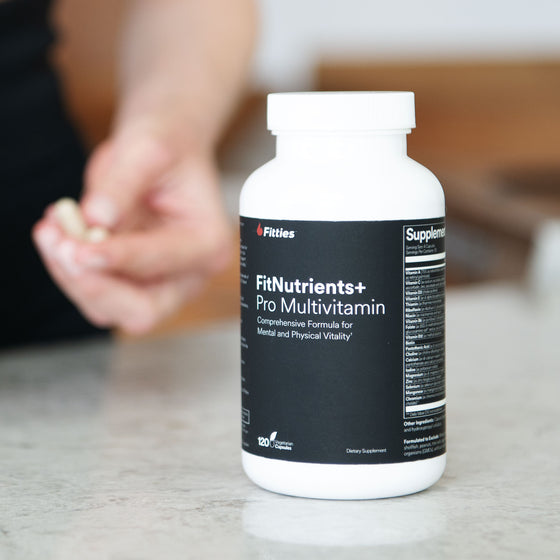
FitNutrients+ includes 12.5 mcg (500 IU) of vitamin D3 (cholecalciferol) per serving, alongside metabolically active B vitamins and Albion chelated minerals. Take four capsules with a meal and your daily vitamin D rides along with the rest of your foundation, no extra bottle to track. Manufactured in a GMP compliant facility.
Shop FitNutrients+Should you take vitamin D with food?

Yes, and this is the rule that matters most. Vitamin D is fat-soluble, which means your gut pulls it in far more efficiently when there is dietary fat in the same meal than when you swallow it on an empty stomach. In a small study of long-term supplement users, taking vitamin D with the largest meal of the day raised blood levels of 25-hydroxyvitamin D by roughly 50% over two to three months, as reported in the Journal of Bone and Mineral Research.
You do not need a bulletproof breakfast to get there. Eggs, yogurt, avocado, nuts, olive oil, cheese, or any ordinary meal with some fat in it is plenty. The version that quietly underdelivers is the one most people run, a capsule chased with black coffee and nothing else. Same pill, a fraction of the payoff. Pair it with a real meal and you have done the single highest-leverage thing on this list.
How much fat counts as enough? Less than you would think. A splash of whole milk, the oil your eggs cooked in, a handful of nuts, or a spoonful of yogurt is enough to do the job, because this is about having some fat present, not eating a high-fat meal. Vitamin D also sits happily next to the other fat-soluble vitamins, A, E, and K, so if any of those are in your routine, the same meal carries all of them. If you have seen D and K sold together as a package, we went through what vitamin D3 and K2 do together and where the pitch outruns the trial data. The only setup worth skipping is the fasted one. If your morning is black coffee and not much else, hold your vitamin D until you actually eat, and let lunch or dinner do the work instead of forcing it down on an empty stomach.
How much vitamin D do you actually need?
The Recommended Dietary Allowance set by the National Academies is 600 IU (15 mcg) a day for most children and adults, rising to 800 IU (20 mcg) after age 70. The safe daily upper limit for adults is 4,000 IU (100 mcg), and more is not better once your levels are where they should be. All of these figures come from the NIH Office of Dietary Supplements.
| Group | Vitamin D per day |
|---|---|
| Infants 0 to 12 months | 400 IU (10 mcg) |
| Children and adults 1 to 70 | 600 IU (15 mcg) |
| Adults 71 and older | 800 IU (20 mcg) |
| Safe upper limit, adults | 4,000 IU (100 mcg) |
The only way to know where you actually stand is a blood test for 25-hydroxyvitamin D. The NIH classifies a level below 12 ng/mL as deficient, 12 to under 20 ng/mL as inadequate, and 20 ng/mL or above as sufficient for most people. This is not a niche problem. Based on national survey data, about 18% of Americans are at risk of inadequacy and around 5% are at risk of deficiency, per the NIH Office of Dietary Supplements.
Vitamin D supplements may also interact with some medications, including orlistat, statins, steroids, and thiazide diuretics, according to the NIH Office of Dietary Supplements. If you take prescription medication, are pregnant or nursing, or have a health condition, talk to your healthcare provider before you start or change a vitamin D dose. This article is education, not a substitute for that conversation.
Is vitamin D3 or D2 better?
If you are choosing a supplement, pick D3 (cholecalciferol). A systematic review and meta-analysis in the American Journal of Clinical Nutrition found that D3 raises and holds blood levels of vitamin D more effectively than D2 (ergocalciferol). Both are sold as "vitamin D," which is exactly why the label is worth reading.
Most well-formulated supplements already use D3, so this is less about hunting for it and more about not getting the cheaper D2 by accident. It is the same story as the rest of the supplement aisle. The difference between a formula that respects your money and one that counts on you not checking is usually printed right there on the back, in the part nobody reads. The immune aisle runs on the same bet, which is why we put seven of its most-hyped ingredients, vitamin D included, against the primary research in our guide to immune support supplements.
Does the exact timing really change how well vitamin D works?

Less than the internet wants you to believe. Two things move your blood levels. Taking vitamin D with fat, and taking it consistently. Miss those and the perfect hour is irrelevant. Nail them and morning versus evening is a rounding error. This is the part the supplement industry loves to overcomplicate, packaging a "clinically timed" protocol when the honest instruction fits in five words. Same meal, most days, done.
The easiest way to make it stick is to anchor it to something you already do daily. If you take a multivitamin, that is your anchor. A daily multivitamin like FitNutrients+ includes 12.5 mcg (500 IU) of vitamin D3 (cholecalciferol) per four-capsule serving alongside its B vitamins and chelated minerals, so your daily vitamin D rides along with a meal in the same step as the rest of your foundation, instead of another bottle to remember. For the wider picture of what to take when, our supplement timing guide maps it out, and if magnesium is also in your stack, the same "with food, same time" logic runs through our guide to the best time to take magnesium. If you are still deciding whether a daily multi earns its place at all, we made the case in multivitamin for athletes.
Get the fundamentals right and vitamin D becomes one of the most boring, reliable habits in your routine. Take it with a meal that has fat in it, keep the time consistent, choose D3, and match the dose to what your blood work actually says. Everything past that is noise.
FitNutrients+
FitNutrients+ includes 12.5 mcg (500 IU) of vitamin D3 (cholecalciferol) per serving, alongside metabolically active B vitamins and Albion chelated minerals. Take four capsules with a meal and your daily vitamin D rides along with the rest of your foundation, no extra bottle to track. Manufactured in a GMP compliant facility.
Shop FitNutrients+