
The Fitties Journal
Immune Support Supplements: Grading the Evidence on 7 Ingredients
Key Takeaways
Here's what matters most if you're short on time.
- Regular vitamin C does not reduce how often the average person catches colds, but it shortens them by about 8% in adults.
- In a Cochrane review by Hemilä and Chalker, five trials of marathon runners, skiers and soldiers found 0.25 to 1 g of vitamin C daily roughly halved cold incidence. The review authors caution against generalising that beyond extreme-exertion groups.
- Zinc lozenges started at symptom onset may shorten a cold, on low-certainty evidence from a 2024 Cochrane review. The tolerable upper intake level for adults is 40 mg per day.
- A 2025 meta-analysis of 61,589 participants, published in The Lancet Diabetes and Endocrinology, found vitamin D supplementation did not significantly reduce overall respiratory infection risk, revising the widely quoted 2017 BMJ result.
- According to the National Center for Complementary and Integrative Health, evidence for elderberry is preliminary, and echinacea may slightly reduce the chance of catching a cold, with no clear effect on how long one lasts.
- The IOC lists reduced immunity among the potential consequences of low energy availability, which makes adequate fuelling and sleep the higher-leverage levers for hard trainers.
Most immune support supplements do very little. The honest summary of the evidence is that vitamin C does not stop the average person catching colds, though taken daily it does cut cold duration by roughly 8% in adults (Hemilä and Chalker, 2013). Zinc lozenges taken at the first symptom may shorten a cold, on low-certainty evidence (Nault et al., 2024). Vitamin D's reputation just took a hit, with a 2025 meta-analysis of 61,589 people (Jolliffe et al., 2025) finding no statistically significant protection against respiratory infection. Elderberry and echinacea are thinner than their marketing suggests. And for anyone training hard, the two things with the strongest claim on your attention are not on the supplement shelf at all. Sleep and eating enough.
Here is what each ingredient is worth, graded against the primary research rather than the label.
Do Immune Support Supplements Work?
Some do something. None do what the category implies. The immune aisle sells the idea of a shield, and no capsule delivers one. What the better-evidenced ingredients offer is narrower and less dramatic. A slightly shorter cold, or the correction of a nutrient shortfall you may not have.
The grading below reflects the strength and direction of the current evidence, not the enthusiasm of the marketing. Where a headline result has been superseded by newer work, the newer work wins.
| Ingredient | What the evidence supports | Evidence grade |
|---|---|---|
| Vitamin C | No reduction in how often you catch colds; about 8% shorter colds in adults taking it daily; roughly halved incidence in extreme-exertion and cold-stress groups only (Hemilä and Chalker, 2013) | Strong, and narrow |
| Zinc (lozenges) | May shorten cold duration when started at onset; does not prevent colds; probable increase in non-serious side effects | Low certainty |
| Vitamin D | 2017 analysis found modest protection; the 2025 update found no statistically significant effect overall | Downgraded |
| Probiotics | Fewer upper respiratory infections versus placebo, but graded low certainty, and the review excluded trials in athletes (Zhao et al., 2022) | Low certainty |
| Selenium | A role in immune cell function; evidence is conflicting on whether supplementing it improves immunity in humans (NIH ODS) | Role yes, benefit unclear |
| Echinacea | May slightly reduce the chance of catching a cold; does not appear to help treat one | Weak |
| Elderberry | A small number of preliminary studies; no firm conclusion (NCCIH) | Preliminary |
Two patterns are worth noticing. First, the ingredients that do something mostly shorten an illness rather than prevent one. Second, the strongest single result in this entire literature applies to a population most readers are not in, which is exactly the kind of nuance a label never carries.
FitNutrients+
Four capsules of FitNutrients+ provide 45 mg of vitamin C, 12.5 mcg (500 IU) of vitamin D3, 2 mg of zinc as zinc bisglycinate chelate and 17 mcg of selenium, alongside metabolically active B vitamins and Albion chelated minerals. Every active carries its own line and its own dose on the panel. No proprietary blends, nothing hidden behind a blend name.
Shop FitNutrients+Does Hard Training Weaken Your Immune System?

This is the premise the whole category is built on, and it is less settled than the marketing implies.
The traditional story is the "open window." After a hard session, immune function dips for a few hours and you are vulnerable. In 2018, Campbell and Turner published a direct challenge to it in Frontiers in Immunology, arguing that the sharp drop in circulating lymphocytes an hour or two after exercise "reflects a transient and time-dependent redistribution of immune cells to peripheral tissues, resulting in a heightened state of immune surveillance and immune regulation, as opposed to immune suppression." Their position is blunt. It is "a misconception to label any form of acute exercise as immunosuppressive."
That is one side. In 2020, both camps sat down together, and the resulting paper in Exercise Immunology Review is the fairest account of where things stand. They agree that regular moderate exercise is good for immune defence. They also agree that illness in elite athletes is a real and heavy burden, "second only to injury for the number of training days lost during preparation for major sporting events." What remains open, in their own words, is "whether exercise per se is a causative factor of increased infection risk in athletes."
So athletes do get sick more around heavy blocks. The disputed part is the cause. The candidates that the researchers themselves put forward are unglamorous. Travel, disrupted sleep, psychological stress, crowd exposure, and nutritional deficits. Training itself may be the least of it.
Which reframes the shopping question. If the mechanism is sleep debt and under-fueling, a capsule aimed at "immunity" is answering a question you did not ask.
Which Immune Ingredients Have the Best Evidence?
Vitamin C, with an important caveat
The Cochrane review by Hemilä and Chalker pooled 29 trial comparisons covering 11,306 people and found that regular vitamin C did not reduce the chance of catching a cold in the general population (relative risk 0.97, 95% CI 0.94 to 1.00). It did shorten colds by 8% in adults and 14% in children. Starting vitamin C after symptoms appear showed no consistent benefit.
Then there is the finding the supplement industry loves. In five trials of 598 marathon runners, skiers and soldiers on subarctic exercises, vitamin C roughly halved cold incidence (RR 0.48, 95% CI 0.35 to 0.64; Hemilä and Chalker, 2013), at unremarkable doses of 0.25 to 1 g per day. The NIH Office of Dietary Supplements summarises the same result as a 50% reduction in that group.
Read the review authors' own warning before you get excited. "Caution should be exercised in generalising this finding." Those were people under extreme physical exertion, severe cold stress, or both. A hard hour in a heated gym is not a subarctic military exercise. If you are doing something genuinely extreme in genuinely cold conditions, this is the most interesting result in the field. If you are not, it is somebody else's data.
The RDA is 90 mg for adult men and 75 mg for women, with a tolerable upper intake level of 2,000 mg.
Zinc, if you time it right
Zinc is required for the catalytic activity of hundreds of enzymes and plays a role in enhancing immune function, protein and DNA synthesis, and wound healing, per the NIH Office of Dietary Supplements. That is a structural role, not a promise.
On colds, the 2024 Cochrane review of 34 studies and 8,526 participants found zinc used as treatment "may" reduce mean cold duration (mean difference 2.37 days shorter, 95% CI 0.53 to 4.21), on low-certainty evidence. It found little or no reduction in the risk of catching a cold. It also found a probable increase in non-serious adverse events, things like taste disturbance and nausea.
Dose and form matter more than the pooled figure suggests, and Cochrane has been criticised on exactly this point. The review mixed lozenges with intranasal zinc across an enormous dose range. Hemilä and Chalker, writing in Frontiers in Medicine, report that in seven trials, zinc acetate and gluconate lozenges above 75 mg per day of elemental zinc shortened colds by about a third.
One number governs all of this. The tolerable upper intake level for zinc in adults is 40 mg per day. Lozenge protocols above 75 mg are short-term, acute-use interventions taken for a few days at the onset of symptoms. They are not a daily habit, and any product asking you to take that much every day has misread its own evidence.
Vitamin D, and a result that changed
This is where most immune content is now out of date. The famous 2017 BMJ meta-analysis of 25 trials found vitamin D reduced the risk of acute respiratory infection (adjusted odds ratio 0.88, 95% CI 0.81 to 0.96), with a much larger effect in people who started severely deficient (aOR 0.30). That is the study everyone still quotes.
It has been superseded. The 2025 update in The Lancet Diabetes and Endocrinology, covering 40 studies and 61,589 participants, reported that supplementation "did not statistically significantly affect overall ARI risk" (OR 0.94, 95% CI 0.88 to 1.00). The point estimate barely moved; the confidence interval now includes 1.00. The updated analysis also found no clear effect modification by baseline vitamin D status or dosing regimen.
The reasonable position is that vitamin D is worth attention if your status is genuinely low, which is a question for a blood test and a clinician, not a marketing claim. Treating it as infection insurance is no longer supported by the best current evidence (Jolliffe et al., 2025). If you want the practical detail on status and timing, we covered it in when to take vitamin D and why absorption depends on it.
Do Probiotics Help Prevent Colds?
The 2022 Cochrane review of 23 trials and 6,950 participants found probiotics beat placebo at preventing upper respiratory tract infections. Participants taking probiotics were less likely to have at least one infection episode (RR 0.76, 95% CI 0.67 to 0.87) and used fewer antibiotics (RR 0.58, 95% CI 0.42 to 0.81).
Two caveats keep this honest. Cochrane graded most of those outcomes low certainty. And the trials ran in children, general adults averaging 37 years, and elderly participants averaging nearly 85 years; the review excluded trials in athletes. Strains, doses and populations varied enormously, which matters because probiotic effects are strain-specific and do not transfer between products. If you want the groundwork on how strains and timing differ, start with the difference between prebiotics and probiotics.
Which Immune Supplements Are Mostly Marketing?
Elderberry and echinacea carry a marketing weight their evidence cannot support.
On elderberry, the National Center for Complementary and Integrative Health says only that "some preliminary research suggests that elderberry may relieve symptoms of flu, colds, or other upper respiratory infections," noting that "a small number of studies" have looked at it. Preliminary is the operative word, and it is doing a lot of work behind every elderberry gummy on the shelf.
On echinacea, NCCIH states that taking it "may slightly reduce your chances of catching a cold" while "it's still unclear whether echinacea can shorten the length of a cold." The NIH Office of Dietary Supplements puts a number on the prevention side, a 22% reduction in the risk of developing an upper respiratory infection, with no effect on duration.
Slight and unclear are not nothing. They are also not what the packaging says.
The bigger tell is the format the category has settled on. Megadose vitamin C at 1,000% of the daily value, when absorption drops at single doses of 500 mg or more, and immune cells are already saturated at about 100 mg a day (Levine et al., 1996). Proprietary blends that hide how little of each botanical is actually present. Gummies carrying a few milligrams of anything meaningful alongside several grams of sugar. This is an aisle optimised for the feeling of doing something.
What Moves the Needle More Than Any Supplement?

Eating enough, and sleeping enough. Neither is sold in a bottle, which is precisely why neither gets marketed to you.
The 2023 International Olympic Committee consensus statement on Relative Energy Deficiency in Sport lists reduced immunity among the detrimental outcomes of problematic low energy availability, alongside effects on energy metabolism, reproductive function, musculoskeletal health, glycogen synthesis, and cardiovascular and hematological health. In plain terms, chronically under-fueling a heavy training load is a recognized risk to how often you get ill. The IOC is careful to note that reproductive and bone health are the best-documented consequences and that standardised measures of immune impairment are still being established, so this is a flagged risk rather than a settled dose-response. It is still a more substantial finding than anything on the elderberry shelf.
The practical version is unromantic. Do not run a large chronic energy deficit through a hard training block. Hit your protein. Sleep seven to nine hours. Wash your hands. If you are travelling to compete, expect the travel, not the training, to be the thing that gets you.
Then, and only then, does the supplement question become interesting, and it turns out to be a smaller question than the category wants. Are you actually short of anything? The NIH Office of Dietary Supplements describes defined immune roles for several micronutrients. Vitamin C "helps maintain epithelial integrity, enhance the differentiation and proliferation of B cells and T cells, enhance phagocytosis, normalize cytokine production, and decrease histamine levels." Selenium "helps support both the innate and adaptive immune systems through its role in T-cell maturation and function and in natural killer cell activity," though the same page notes that evidence is conflicting on whether supplementing selenium enhances immunity in humans.
Covering a shortfall is a real and modest goal. It is not the same as buying protection, and a brand that tells you otherwise is selling you the feeling, not the function. FitNutrients+ is a four-capsule multivitamin and mineral formula. Each serving provides 45 mg of vitamin C, 12.5 mcg (500 IU) of vitamin D3, 2 mg of zinc as zinc bisglycinate chelate and 17 mcg of selenium as selenium glycinate complex, alongside its other vitamins and minerals. For the wider picture on where active people tend to fall short, see our guide to micronutrients for athletes.
How Do You Read an Immune Supplement Label?
Four checks separate a serious formulation from theater.
- Compare each dose to the upper limit, not the daily value. A percentage in the thousands is a marketing decision, not a nutritional one. Zinc's ceiling for adults is 40 mg per day; vitamin C's is 2,000 mg.
- Reject proprietary blends. If elderberry, echinacea and six botanicals share one number, you cannot tell whether any of them is present at a studied dose. That opacity is the point.
- Check the form, not just the name. Zinc lozenges and intranasal zinc are not interchangeable, and among lozenge trials, the lozenge's composition and the zinc dose largely explained which ones found an effect (Hemilä and Chalker, 2024). The same logic applies to probiotic strains.
- Count the sugar. A gummy delivering four grams of sugar per serving to carry a token dose of a botanical is a confection with a health halo.
If reading labels is new territory, our guide to reading supplement labels covers the rest of the panel.
The Honest Summary
The immune category sells certainty in a field that does not have any. What the evidence supports is narrower and duller. Vitamin C shortens colds slightly and does more in genuinely extreme conditions, zinc lozenges may shorten a cold if you start immediately and stay under the daily ceiling the rest of the time, probiotics show promise on low-certainty evidence, vitamin D's case has weakened, and elderberry and echinacea remain thin.
Meanwhile the two interventions with the most defensible claim on a hard trainer's attention are sleep and adequate fueling, and both are free.
Talk to your healthcare provider before starting any supplement, particularly if you take medication, are pregnant or nursing, or manage an existing condition. Nothing here is a substitute for individual medical advice.
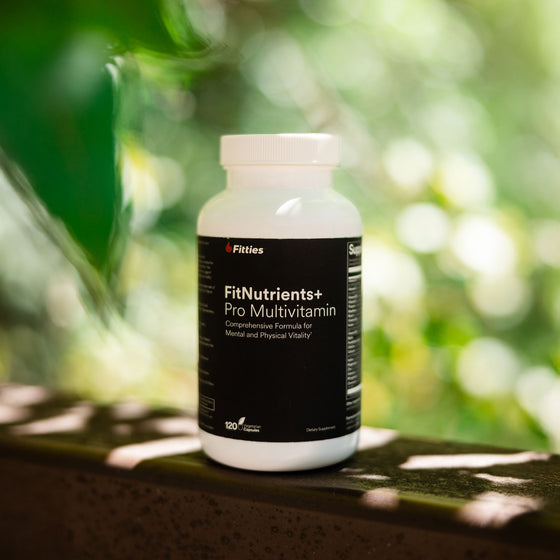
FitNutrients+
Four capsules of FitNutrients+ provide 45 mg of vitamin C, 12.5 mcg (500 IU) of vitamin D3, 2 mg of zinc as zinc bisglycinate chelate and 17 mcg of selenium, alongside metabolically active B vitamins and Albion chelated minerals. Every active carries its own line and its own dose on the panel. No proprietary blends, nothing hidden behind a blend name.
Shop FitNutrients+