
The Fitties Journal
What Is HMB? How Much to Take and the 4 People It Helps Most
Key Takeaways
Here's what matters most if you're short on time.
- HMB is a metabolite of the amino acid leucine, and only about 5% of the body's leucine is converted into it.
- The 2025 ISSN position stand puts the researched daily dose at 38 mg per kilogram of body weight, roughly 3 grams for a 175 lb adult.
- Most HMB research used calcium HMB (HMB-Ca); studies disagree on whether the free acid form (HMB-FA) reaches the blood faster.
- The ISSN is most positive about untrained people and sedentary or older adults, and calls results in trained athletes mixed.
- The ISSN says data suggest chronic HMB use is safe up to at least one year, and an 8-week trial found no adverse liver or kidney effects.
- HMB and creatine are different molecules with different mechanisms, so taking one does not replace the other.
HMB is beta-hydroxy-beta-methylbutyrate, a compound your body makes when it breaks down the amino acid leucine. As a supplement it is dosed by body weight, not by a flat scoop. The International Society of Sports Nutrition's 2025 position stand on HMB puts the researched daily amount at 38 mg per kilogram, which lands at about 3 grams for a 175 lb adult (Rathmacher et al., 2025). The position stand is most positive about people who are not already well trained, namely beginners, sedentary and older adults, and people losing muscle during a stretch of bed rest or inactivity. In trained athletes the performance results are mixed, and they tend to show up in studies that run longer than six weeks. Here is what HMB does, what myHMB® and the other forms are, how much to take, and whether you are in the group it helps.
What Is HMB, and What Does It Do?
HMB is what is left over when your body metabolizes leucine, one of the three branched-chain amino acids. The conversion is inefficient. The NIH Office of Dietary Supplements puts it at about 5% of the body's leucine, so a 3 gram dose would take roughly 60 grams of leucine, or more than 600 grams of high-quality protein, every day. That gap is the whole argument for supplementing HMB rather than simply eating more steak.
What it does once it is in you comes down to one mechanism pointed in two directions. The ISSN position stand describes the primary mode of action as a dual mechanism that enhances muscle protein synthesis and suppresses muscle protein breakdown. Nearly every tub on the shelf is selling you on the first half of that equation. The second half, protecting the muscle you already built, is the half nobody markets, and it runs through nearly three decades of human HMB research, from recovery after muscle-damaging exercise to muscle loss during bed rest (Rathmacher et al., 2025). One disclosure worth knowing is that the position stand's lead author has worked for companies that research and market HMB and is named on HMB patents, as the paper discloses.
FitRestore
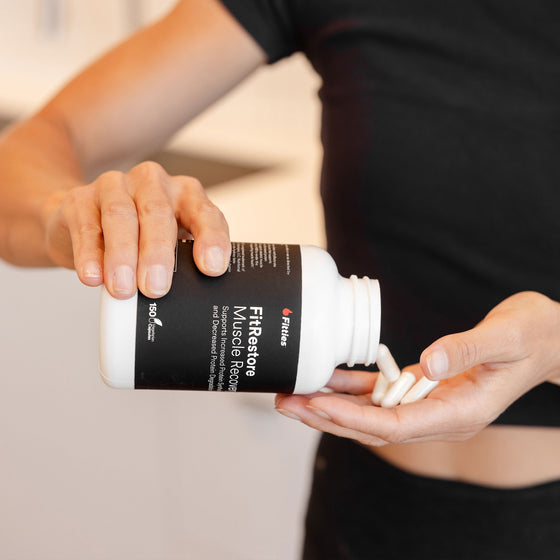
FitRestore lists 3 g of calcium HMB monohydrate (as myHMB) and 12.5 mcg of vitamin D3 as their own line items on the label, six vegetarian capsules, no proprietary blend hiding the dose. Consult your healthcare professional prior to use.
Shop FitRestoreWhat Is myHMB? Calcium HMB vs HMB Free Acid
Calcium HMB monohydrate is the calcium salt of HMB (HMB-Ca), and myHMB is a trademarked version of it. HMB-Ca is also the form most HMB research used. Every study published until 2011, when a free acid form (HMB-FA) was first described, used the calcium salt (Rathmacher et al., 2025). A trademark identifies a branded ingredient; the research describes the form.
The case for the free acid is speed. In two crossover studies of 8 adults each, a free acid gel peaked in the blood in about 38 minutes versus 128 for a 1 gram calcium HMB capsule, at nearly double the concentration (Fuller et al., 2011). A 2024 crossover in 16 young adults, by a university team declaring no conflicts of interest, found the opposite, with higher blood levels and better bioavailability from calcium HMB (Ribeiro et al., 2024). The ISSN calls the evidence mixed.
In tracer studies of 8 healthy young men each, a single 3.42 gram dose raised muscle protein synthesis and cut breakdown, by about 70% and 57% with the free acid form, and calcium HMB produced a comparable response in the second study (Wilkinson et al., 2013; Wilkinson et al., 2018). An HMB company supplied the HMB for both studies, part-funded the second, and employed one of its authors, and the ISSN notes this mechanistic evidence comes only from young, healthy men.
The practical difference is calcium. HMB-Ca is about 13% calcium by weight, so 3 grams adds roughly 400 mg of calcium a day, and the NIH Office of Dietary Supplements notes that people who want to limit calcium can use the free acid instead.
How Much HMB Should You Take Per Day?
Thirty-eight milligrams per kilogram of body weight, taken daily alongside training. That is the figure in the 2025 ISSN position stand, and it is a meaningful upgrade on the flat "3 grams" the internet has been repeating for a decade. Three grams is not wrong, it is just the dose most trials used (Rathmacher et al., 2025). It happens to be correct for someone around 175 lb and it is short for anyone much heavier.
That figure matches the lower dose in an 8-week trial in 37 untrained college-aged men doing resistance training. 38 mg per kg a day (about 3 grams) produced a larger gain in peak isometric torque than placebo or double the dose, while one-rep max strength did not differ between the groups (Gallagher et al., 2000).
| Body weight | Body weight (kg) | Daily HMB at 38 mg/kg |
|---|---|---|
| 130 lb | 59 kg | 2.2 g |
| 155 lb | 70 kg | 2.7 g |
| 175 lb | 79 kg | 3.0 g |
| 200 lb | 91 kg | 3.4 g |
| 225 lb | 102 kg | 3.9 g |
| 250 lb | 113 kg | 4.3 g |
The NIH Office of Dietary Supplements notes that trials have used anywhere from 1.5 to 6 grams a day, with 3 grams the most common because evidence suggested it matched 6 grams and beat 1.5 grams. These are research amounts, not directions. Follow the label on any product you use.
When Should You Take HMB?
Timing matters less than consistency. The position stand notes that taking HMB close to a training session may help increase muscle protein synthesis and blunt the inflammatory response, and the NIH relays earlier ISSN guidance of 1 to 2 grams of calcium HMB 60 to 120 minutes before exercise, and 3 grams a day for at least two weeks before high-intensity training. Think of it like creatine, not like caffeine.
Who Does HMB Help Most?

People new to lifting. The ISSN says HMB may improve strength and power in untrained individuals (Rathmacher et al., 2025), and a 2009 meta-analysis of 9 studies in 394 young men found small but clear strength gains in previously untrained lifters (Rowlands and Thomson, 2009). A 2020 meta-analysis of 11 trials in adults aged 18 to 45 found no significant gain in fat-free mass or strength (Jakubowski et al., 2020), though the ISSN disputes its methods. If you started lifting in the last few months, you are in the population where the data is cleanest.
Older and sedentary adults. The position stand notes HMB may be important in a non-exercising sedentary and aging population to improve muscle strength, functionality, and muscle quality.
Anyone facing a stretch of bed rest. In a randomized, double-blind trial, 24 healthy older adults took 3 grams of calcium HMB a day or a placebo, starting five days before 10 days of complete bed rest. Among the 19 evaluated (aged 60 to 76), lean mass fell by 2.05 kg on average with placebo and 0.17 kg with HMB (one participant excluded), with no measurable difference in physical function in a sample this small (Deutz et al., 2013). The ISSN calls this evidence limited, especially for younger people.
Endurance athletes. A quieter finding, and an odd one. The ISSN position stand reports HMB appears to have a potentially positive impact on aerobic performance, particularly in trained athletes, with mechanisms that are unknown. Honest uncertainty beats a confident guess.
And the group that should temper expectations is trained lifters. The position stand calls their results mixed, improving with study duration beyond six weeks. Other analyses are blunter. A meta-analysis of 6 trials in 193 trained and competitive athletes found no effect on strength or body composition (Sanchez-Martinez et al., 2018), and in a 12-week trial in 44 resistance-trained men eating at least 1.7 grams of protein per kg a day, neither form at 3 grams a day improved muscle growth, apart from a minor leg press gain with the free acid (Tritto et al., 2019). A 2017 review suggests why. Training itself suppresses the protein breakdown HMB targets (Holeček, 2017). Give it a real runway or give it a pass.
Is HMB Just Creatine?
No, and the two are not interchangeable. They are different molecules working on different systems. Creatine tops up the phosphocreatine your muscles burn through in short, maximal efforts. Supplementing raises muscle creatine and phosphocreatine stores by 20 to 40%, maintained at 3 to 5 grams a day after an optional 5 to 7 day loading phase (Kreider et al., 2017). HMB works on protein turnover, which is a slower and less visible process. A 2003 meta-analysis of 250 supplements found only six with more than two qualifying studies, and only creatine and HMB significantly increased net lean mass gains (0.36% and 0.28% a week) and strength gains (1.09% and 1.40% a week) (Nissen and Sharp, 2003).
| HMB | Creatine monohydrate | |
|---|---|---|
| What it is | A metabolite of the amino acid leucine | A compound the body makes from amino acids |
| Studied mechanism | Raises muscle protein synthesis, suppresses breakdown | Raises muscle phosphocreatine for short, maximal efforts |
| Typical daily dose | 38 mg per kg of body weight | 3 to 5 g |
| Time to effect | Weeks, and longer in trained athletes | Days to weeks, depending on loading |
They are also not mutually exclusive, though the ISSN counts nine studies of the two taken together with mixed results (Rathmacher et al., 2025). Our guide to creatine dosing by body weight and goal covers the other half of that pairing, and the roundup of muscle recovery supplements worth taking puts both in context.
Does HMB Have Side Effects?
The safety data are reassuring. The ISSN position stand concludes that chronic HMB-Ca and HMB-FA use appears safe in humans up to at least one year, with no adverse effects from short-term doses up to 6 grams a day for 8 weeks (Rathmacher et al., 2025). The NIH Office of Dietary Supplements describes HMB as well tolerated and safe at 3 grams a day for 3 to 8 weeks, with no adverse effects on blood chemistry or hematology, and notes that its safety has not been studied in adolescents.
None of that makes it universal. Talk to your healthcare provider before starting HMB if you are pregnant or nursing, managing an existing condition, or taking any medication, and never use a supplement as a substitute for medical advice. FitRestore's label adds its own caution. Consult your healthcare professional prior to use, and individuals taking medication should discuss potential interactions with their healthcare professional.
Is HMB Hard on Your Kidneys or Liver?
Not in the studies that measured it. In the 8-week trial of 37 untrained men above, 38 or 76 mg per kg a day had no adverse effects on liver enzymes, blood lipids, kidney function, or the immune system (Gallagher et al., 2000), and the ISSN reports no changes in kidney or liver function in two year-long studies of calcium HMB with other nutrients in older adults. If you have a kidney or liver condition, talk to your healthcare provider first.
Why Is Vitamin D in HMB Formulas?

Because the two have been studied together, and because vitamin D does its own work in muscle. The NIH Office of Dietary Supplements lists neuromuscular function among the processes vitamin D helps modulate, and in 103 college athletes, lower vitamin D status went with lower strength and power scores (Hildebrand et al., 2016). That was observational, and the NIH calls studies of supplemental vitamin D on muscle strength inconsistent.
In a year-long trial of 117 adults over 60 with insufficient but not deficient vitamin D, 3 grams of calcium HMB plus 2,000 IU of vitamin D3 a day improved lean mass at 6 months, knee strength at 3 months, and a combined function score through 12 months versus control, but only in those not exercising; in the resistance training group it added no further gain in function (Rathmacher et al., 2020). The National Institute on Aging funded the trial, and three authors work for companies tied to an HMB marketer.
An earlier post hoc analysis of a year-long trial in adults averaging 76, who took HMB with arginine and lysine, found muscle mass rose regardless of vitamin D status, but strength rose only in those with adequate vitamin D (Fuller et al., 2011).
Here is the part formula marketing tends to skip. The ISSN says an added or synergistic benefit from the pairing cannot currently be established, because studies comparing it against HMB and vitamin D3 alone are lacking (Rathmacher et al., 2025).
How Do You Choose an HMB Supplement?
Four things, and the first one does most of the work.
- The dose has to be its own line on the label, in grams. HMB buried inside a 2 gram "recovery matrix" alongside eight other ingredients is not a 3 gram dose, and the blend exists precisely so you cannot work out what it is. If a brand will not tell you how much of the expensive ingredient you are getting, that is the answer.
- Check the form. HMB-Ca is what the bulk of the research used (Rathmacher et al., 2025). HMB-FA is legitimate, just less studied.
- Do the servings math. HMB is a bulky ingredient, so a real dose means multiple capsules. Divide capsules per bottle by capsules per serving before you compare prices, or you are comparing a month against ten days.
- Read the free-from list if allergens matter to you, and read the one on that specific product rather than assuming it carries across a brand's range.
How Does FitRestore Use myHMB?
FitRestore lists 3 g of calcium beta-hydroxy-beta-methylbutyrate monohydrate (as myHMB) and 12.5 mcg of vitamin D3 (as cholecalciferol) per six-capsule serving, each on its own line, plus 390 mg of calcium from the calcium HMB itself. That vitamin D3 amount is lower than the 50 mcg (2,000 IU) used in the 12-month HMB and vitamin D3 trial above (Rathmacher et al., 2020), so that trial is not a test of this formula. A bottle holds 150 vegetarian capsules, or 25 servings, taken as six capsules daily or as directed by your healthcare professional. It is formulated to exclude wheat, gluten, yeast, soy, dairy products, fish, shellfish, peanuts, tree nuts, egg, sesame, ingredients derived from genetically modified organisms, artificial colors, and artificial sweeteners, and is manufactured in a GMP compliant facility. For the other ingredients we use, see all Fitties ingredient spotlights.
FitRestore
FitRestore lists 3 g of calcium HMB monohydrate (as myHMB) and 12.5 mcg of vitamin D3 as their own line items on the label, six vegetarian capsules, no proprietary blend hiding the dose. Consult your healthcare professional prior to use.
Shop FitRestore