The Fitties Journal
Muscle Recovery Supplements: The 6 Worth Taking (and 4 to Skip)
Key Takeaways
Here's what matters most if you're short on time.
- The six worth knowing are protein, creatine, omega-3s, magnesium, vitamin D, and HMB; protein and creatine have the most consistent evidence, per the International Olympic Committee's 2018 supplement consensus.
- Recovery is your body repairing the microscopic muscle damage from training, so the supplements that help support repair, replace what you lose, or protect sleep.
- Protein and creatine do most of the work. Aim for 1.4 to 2.0 g of protein per kg of bodyweight and 3 to 5 g of creatine daily.
- BCAAs, glutamine, and mega-dose antioxidant pills are largely redundant when your protein and diet are already dialed in.
- High-dose vitamin C and E can blunt training adaptations, so get your antioxidants from food, not megadoses.
- HMB is a targeted tool, most useful for people new to training, older, or in a hard cut or block, at 3 g per day.
The muscle recovery supplements worth a look are short and unglamorous. They are protein, creatine, omega-3 fatty acids, magnesium, vitamin D, and HMB, with protein and creatine on the firmest ground according to the International Olympic Committee's supplement consensus (Maughan et al., 2018). That is the list. Recovery is just your body repairing the microscopic damage that hard or unaccustomed training causes in muscle tissue (Peake et al., 2017), then adapting so the same work does less damage next time (Hyldahl et al., 2017). The supplements that help are the ones that feed that repair, replace what you sweat out, or protect the sleep that does the actual work. Everything else is a nice-to-have or a markup. Below are the six worth your money, the four that are mostly hype, and how to stack them without buying a cabinet full of powder.
What do muscle recovery supplements actually do?
Nothing magic, and that is the point. When you train hard, you create small amounts of muscle damage. The soreness that follows, delayed onset muscle soreness, or DOMS, typically peaks one to three days after the session and fades within five to seven days, according to a Cochrane review. Recovery is your body closing that gap. That means rebuilding tissue, refilling energy, calming the inflammatory response, and getting deep sleep so hormones do their job.
A recovery supplement can only help with one of those levers. Protein supplies the raw material for repair. Creatine refills the energy your muscles burn. Omega-3s sit inside the inflammation conversation. Magnesium and vitamin D keep the muscle and nervous system working the way they should. No capsule replaces food, sleep, and a training program that is not trying to bury you. The mainstream supplement aisle would rather you forget that, which is how a $50 tub of proprietary “recovery matrix” ends up being underdosed caffeine and food dye.
FitRestore
FitRestore is built around 3g of calcium HMB (as myHMB) paired with 12.5 mcg of vitamin D3 in a six-capsule serving. Manufactured in a GMP compliant facility. Formulated to exclude dairy products, gluten, soy, egg, peanuts and tree nuts.
Shop FitRestoreThe 6 muscle recovery supplements worth taking
“Worth taking” here means one thing. The ingredient is dosed at the level the research used, and that research is credible. These six clear that bar. Not every one is for every person, and you almost certainly do not need all six, but each earns its place for the right athlete.
| Supplement | What the research supports | Typical daily dose | Evidence |
|---|---|---|---|
| Protein | Muscle protein synthesis and repair | 1.4 to 2.0 g/kg bodyweight; 20 to 40 g per serving | Strong |
| Creatine monohydrate | Strength, cellular energy, recovery from muscle damage | 3 to 5 g | Strong |
| Omega-3 (EPA/DHA) | Inflammatory balance after training | 1 to 3 g EPA plus DHA | Moderate |
| Magnesium | Muscle and nerve function, sleep quality | 310 to 420 mg (RDA) | Moderate |
| Vitamin D | Skeletal muscle function | 600 to 800 IU (RDA) | Moderate |
| HMB | Muscle protein balance | 3 g | Moderate |
1. Protein: the one nobody should skip

If you take one thing on this list, take enough protein. Protein supplies the amino acids your body uses to rebuild muscle tissue after training. The International Society of Sports Nutrition puts the target at 1.4 to 2.0 g of protein per kg of bodyweight per day for people who train, with 20 to 40 g per serving to maximize the muscle-building signal at each meal. Spread it across three or four meals rather than saving it all for a post-workout shake, since your body can only use so much at once, and the post-training window is far more forgiving than old gym lore claimed.
Quality matters as much as quantity. Complete proteins like whey, eggs, dairy, meat, and fish carry the full set of essential amino acids and a strong hit of leucine, the one that flips the switch on muscle building, while most single plant sources need to be combined to get there. Whole foods should do most of the lifting. A powder is not magic, it is just a convenient way to hit your number on busy days. If your food already gets you there, you do not need one, and if it does not, a quality whey or a well-built plant blend closes the gap. We break down the intake math in our protein intake guide and settle the powder debate in whey vs plant protein.
2. Creatine monohydrate: the well-studied workhorse
Creatine is the rare supplement where the research is not ambiguous. The ISSN calls creatine monohydrate the most effective ergogenic nutritional supplement available for increasing high-intensity exercise capacity and lean body mass, and the same position stand notes it can reduce muscle damage and enhance recovery from intense exercise. The dose is boring and cheap. It is 3 to 5 g of monohydrate a day, every day, loading optional. Skip the fancy “advanced” forms at triple the price. Our creatine buyer's guide covers forms, timing, and the myths in full.
3. Omega-3 fatty acids: for the inflammation side
The EPA and DHA in fish oil sit on the anti-inflammatory side of the ledger. The NIH notes that higher concentrations of EPA and DHA than arachidonic acid tip the eicosanoid balance toward less inflammatory activity. If you rarely eat salmon or sardines, 1 to 3 g of combined EPA and DHA is a reasonable add. Manage your expectations on soreness specifically. Tart cherry, another popular anti-soreness pick, showed no significant effect on muscle soreness in a 2026 meta-analysis, even though it did help restore strength faster. Anti-inflammatory tools help you feel and perform a bit better, but they do not erase DOMS. More detail in our omega-3 guide for athletes.
4. Magnesium: the mineral most people run low on

Magnesium is a cofactor your muscles and nerves depend on. The NIH notes it plays a role in muscle contraction, nerve impulse conduction, and normal muscle and nerve function, with an RDA of 310 to 420 mg depending on age and sex. Hard training and heavy sweating do not help your levels, and low magnesium is common.
You lose some through sweat, so heavy training blocks and hot sessions quietly draw down your stores, and a diet light on leafy greens, nuts, seeds, beans, and whole grains rarely refills them. It also has a hand in sleep quality, which is where a lot of real recovery actually happens, so running low often shows up first as restless sleep and muscles that stay tight or cramp-prone longer than they should. Most people never get a formal test for it, which is part of why a modest daily dose is a common insurance policy.
Forms matter more than the marketing suggests. Magnesium citrate, aspartate, lactate, and chloride tend to be better absorbed than magnesium oxide (NIH Office of Dietary Supplements). A common daily dose is 200 to 400 mg of a well-absorbed form, and it is worth starting on the lower end, since a big dose at once can be gently laxative for some people. Many take it in the evening, since it plays into the wind-down that sets up deep sleep, though the timing is flexible. Read our magnesium guide before you buy, and see why we treat sleep as the most underrated recovery tool.
5. Vitamin D: the one you should test first
Vitamin D is not just a bone nutrient. The NIH notes it is needed for normal muscle fiber development and growth, and that low levels can lead to muscle weakness. The RDA is 600 to 800 IU for adults, though many people who train indoors or live in northern latitudes sit below optimal. This is the one supplement here worth testing before you dose, since your baseline decides whether you need a little or a lot.
6. HMB: for the specific case, not everyone
HMB (beta-hydroxy-beta-methylbutyrate) is a metabolite of the amino acid leucine that your body already makes in small amounts. It sits inside muscle protein balance, on the side of slowing breakdown. Only about 5% of the leucine you eat converts to HMB, so you would need over 600 g of high-quality protein a day to make the 3 g dose used in the research, which is the whole reason it gets supplemented (Wilson et al., 2013). The honest read on who benefits is that the effect is most convincing in people who are new to training, older, or pushing through a hard block or a calorie cut, and more modest in already-trained lifters. Most studies use around 3 g a day, split across meals rather than timed around the workout, and usually alongside resistance training. The ISSN position stand adds that HMB appears most effective when started about two weeks before a hard bout of training and taken close to your sessions (Wilson et al., 2013). Vitamin D is a sensible partner here, since it supports normal skeletal muscle function on its own. At that dose, HMB is a targeted tool, not a mass-market must-have. Our deep dive on HMB walks through the research. For the record, FitRestore lists 3 g of calcium HMB monohydrate (as myHMB®) and 12.5 mcg of vitamin D3 per six-capsule serving on its label.
The muscle recovery supplements that are overhyped
Now the other side. These are not scams, they are just oversold, and for most people they are money that should have gone to protein or sleep.
- BCAAs. Branched-chain amino acids are three of the nine essential amino acids already in a complete protein. If you hit your daily protein target, a separate BCAA tub is redundant. Whole protein wins on cost and completeness.
- Glutamine. Popular in recovery blends, thin on results for healthy, well-fed athletes. Your body makes it, and food supplies plenty. In a six-week resistance training trial in young adults, glutamine had no significant effect on strength, lean mass, or muscle protein breakdown (Candow et al., 2001), and a 2019 meta-analysis found no effect on athletes' body composition or aerobic performance (Ramezani Ahmadi et al., 2019).
- Mega-dose antioxidant pills. Here is the counterintuitive one. High-dose vitamin C and E can actually work against you. A review in the International Journal of Environmental Research and Public Health found that big antioxidant doses tend to blunt the very training adaptations you are chasing, because they suppress the exercise signal your muscles use to adapt. Get your antioxidants from fruit and vegetables, not a horse-pill.
- Proprietary “recovery blends.” The classic industry move is a long ingredient list, a “proprietary blend” label, and no individual doses shown. If a product will not tell you how much of each ingredient is inside, assume the answer is “not enough.” This is the exact game we refuse to play.
How to build a simple muscle recovery stack
You do not need all six. Start with the foundation and add only what your situation calls for. Here is the sane order of operations.
Base for almost everyone: enough protein, every day, and 3 to 5 g of creatine. Those two do the heavy lifting and cost very little. Add if it fits you: omega-3 if you rarely eat oily fish, magnesium if your intake or sleep is poor, and vitamin D if a test comes back low. Add for the specific case: HMB if you are new to training, older, or grinding through a demanding cut or block.
Timing matters less than consistency, but it is not nothing. We lay out when to take what in our supplement timing guide, and cover the non-supplement half of the equation in active recovery. One caveat is worth stating plainly. If you are pregnant or nursing, taking medication, or managing a health condition, talk to your healthcare provider before starting anything new. Supplements interact with the rest of your life, and a two-minute conversation beats a guess.
Recovery is not where you should be chasing exotic ingredients. Nail protein, creatine, sleep, and the basics, fill the specific gaps, and skip the pixie dust. That is the whole strategy, and it is cheaper than the tub promising to do it all.
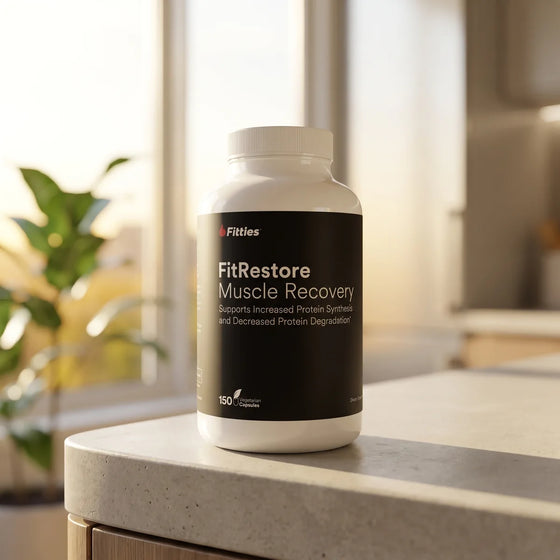
FitRestore
FitRestore is built around 3g of calcium HMB (as myHMB) paired with 12.5 mcg of vitamin D3 in a six-capsule serving. Manufactured in a GMP compliant facility. Formulated to exclude dairy products, gluten, soy, egg, peanuts and tree nuts.
Shop FitRestore