The Fitties Journal
BCAA vs EAA: Why 3 Aminos Can't Replace All 9
Key Takeaways
Here's what matters most if you're short on time.
- BCAAs are three of the nine essential amino acids. Leucine, isoleucine, and valine.
- Building muscle protein requires all nine essential amino acids, not three.
- In one 2017 trial in Frontiers in Physiology (Jackman and colleagues), 5.6 g of BCAAs raised myofibrillar protein synthesis 22% above placebo, roughly half the response reported for whey containing similar BCAAs.
- Complete proteins such as whey, eggs, dairy, meat, fish, and soy already supply all nine.
- A 2018 meta-analysis in the British Journal of Sports Medicine (Morton and colleagues) found no further training-induced gains in fat-free mass beyond 1.62 g of protein per kg of body weight per day.
BCAAs are three amino acids. EAAs are nine, and those nine already include the three. That single fact decides the BCAA vs EAA argument. Your body needs all nine essential amino acids on hand to build muscle protein, so a tub carrying three of them is handing your body an incomplete parts list. A review in the Journal of the International Society of Sports Nutrition put it about as plainly as research gets, concluding that dietary BCAA supplements alone do not promote muscle anabolism. EAAs clear that bar. BCAAs do not.
There is a better question hiding behind this one, though, and the supplement aisle would rather you never asked it. Do you need either tub? If you are already hitting your daily protein target with complete protein, you are paying a second time for amino acids you have already eaten.
What is the difference between BCAAs and EAAs?
Essential amino acids are the nine your body cannot manufacture, which is what makes them essential. MedlinePlus lists them as histidine, isoleucine, leucine, lysine, methionine, phenylalanine, threonine, tryptophan, and valine. They have to arrive through food.
Branched-chain amino acids are not a separate category. They are a subset, named for their molecular shape. Leucine, isoleucine, and valine. Every BCAA is an EAA. The reverse is not true. So "BCAA vs EAA" is less a matchup than a nesting doll, and the marketing that treats them as rival technologies is selling you a distinction that chemistry does not support.
| BCAAs | EAAs | |
|---|---|---|
| Amino acids supplied | 3: leucine, isoleucine, valine | All 9, including the 3 BCAAs |
| Can your body make them | No | No |
| Complete parts list for muscle protein | No | Yes |
| Already in whey, eggs, dairy, meat, soy | Yes | Yes |
| Already in a complete protein powder | Yes | Yes |
| Worth buying separately if you hit your protein target | Rarely | Rarely |
FitWhey+
FitWhey+ is New Zealand grass-fed whey protein concentrate. 21 g of protein per serving with all nine essential amino acids printed on the panel, including 2,400 mg of leucine in the Chocolate and 2,350 mg in the Vanilla. Neither panel prints a BCAA total; adding the three branched-chain rows as printed gives 5,210 mg for the Chocolate and 5,120 mg for the Vanilla. No added sugar, no stevia, no artificial sweeteners, sweetened with monk fruit.
Shop FitWhey+Why can't BCAAs build muscle on their own?
Muscle protein is a sequence. Every strand of it is assembled from a specific order of amino acids, and if one of the nine essentials is missing from the pool, assembly stalls at the gap. It does not matter how much leucine is sitting in the queue behind it.
This is the part the BCAA category has spent two decades talking around. Leucine is genuinely important. It is the amino acid that flips the switch on the muscle-building signal. But flipping a switch and supplying the raw material are two different jobs, and BCAAs only do the first one. As the JISSN review states, all nine essential amino acids, along with the eleven non-essential ones, are required to produce muscle protein. Signal without substrate is a factory with the lights on and no steel in the yard.
The same review reports something more awkward for the category. In studies where BCAAs were infused on their own, muscle protein synthesis did not rise. It fell, in one case from 37 to 21 nmol per minute per 100 ml of leg. The reason is a tidy piece of physiology. The infusion also slowed muscle protein breakdown, and in the fasted state breakdown is the main thing releasing the other six essentials into circulation. Choke off that supply and synthesis has less to build with, not more. That is the opposite of the promise on the label.
What does the research say about BCAAs after training?

To be fair to the molecule, BCAAs are not inert. A 2017 trial in Frontiers in Physiology gave trained men 5.6 g of BCAAs after resistance exercise and measured what happened to myofibrillar protein synthesis, the specific kind that builds contractile muscle tissue. It went up. Myofibrillar protein synthesis was 22% higher in the BCAA group than in placebo. So the tub does something.
Read the next sentence of that paper, though, because it is the one the marketing never quotes. The researchers noted that the size of that increase was roughly 50% less than the response previously reported for a dose of whey protein containing a similar amount of BCAAs. Same branched-chain content. Roughly half the result. The difference is everything else in the whey, the other six essentials that the BCAA drink left out.
That is the honest summary of the category. BCAAs are not fake. They are a partial version of something you can buy in a more complete form, usually for less money per gram of protein, and the industry has priced the partial version like a breakthrough.
What is in 21 grams of complete protein?
Abstractions are easy to argue with, so here is a real label. These are the essential amino acid figures printed on the FitWhey+ New Zealand grass-fed whey protein panel in Chocolate, per two-scoop (42 g) serving delivering 21 g of protein. The two totals at the foot of the table are those nine label figures added together. The Vanilla panel lists a 38 g serving with slightly different amino acid figures and the same 21 g of protein.
| Essential amino acid | Per 2-scoop serving |
|---|---|
| Leucine (BCAA) | 2,400 mg |
| Lysine | 1,970 mg |
| Threonine | 1,550 mg |
| Isoleucine (BCAA) | 1,470 mg |
| Valine (BCAA) | 1,340 mg |
| Phenylalanine | 730 mg |
| Methionine | 540 mg |
| Tryptophan | 440 mg |
| Histidine | 420 mg |
| Total essential amino acids | 10,860 mg |
| Of which BCAAs | 5,210 mg |
The shape of that panel is the whole argument. A BCAA product supplies the three rows marked BCAA and stops there. The other six rows, 5,650 mg of them on this label, are what a complete protein carries and an isolated BCAA tub does not.
For the leucine question specifically, the International Society of Sports Nutrition position stand recommends that acute protein doses contain 700 to 3,000 mg of leucine. The panel above lists 2,400 mg.
Do you need an EAA supplement if you already drink protein?

For most people training regularly and eating like they mean it, no. Complete proteins already carry all nine essentials, with whey, casein, eggs, dairy, meat, fish, and soy among them. So does a well-built plant blend, which is why pea and rice get combined in the first place, since pea is lower in methionine and rice is lower in lysine and together they cover each other.
The number that matters is your daily total, not which tub you own. A meta-analysis in the British Journal of Sports Medicine found that protein intake beyond 1.62 g per kg of body weight per day produced no further training-induced gains in fat-free mass, with a confidence interval running from 1.03 to 2.20. The ISSN position stand lands in the same territory, calling 1.4 to 2.0 g per kg per day sufficient for most exercising individuals, at roughly 0.25 g per kg or 20 to 40 g per serving.
Get to that number and the amino acid question answers itself. Miss that number, and no tub of isolated aminos is going to cover for it. Work out how much protein you need per day first, then decide whether anything else is worth buying.
When does an EAA or BCAA supplement make sense?
There are narrow cases where isolated aminos are a reasonable call, and they are narrower than the marketing suggests.
- You genuinely cannot hit your protein target. Appetite loss, illness, medical restriction, or a schedule that keeps whole food out of reach. EAAs deliver the full set in very few calories.
- You train fasted and want something with almost no calories. A complete protein shake ends the fast; free-form EAAs are lower in calories, though they are not zero.
- Whole protein sits badly during long sessions. Endurance athletes mid-race sometimes tolerate free-form aminos better than a shake.
- A clinician has told you to. Certain clinical situations use amino acid formulations under supervision.
If you are in one of those cases, buy EAAs rather than BCAAs. The complete set costs a little more and does the whole job. Paying for three-ninths of a product is not thrift.
Notice what is not on that list. "I lift weights and want to build muscle." That is the case the entire BCAA category was built to serve, and it is the case the research handles worst.
BCAA vs EAA: which should you choose?
Work down this in order.
- Hitting 1.4 to 2.0 g of protein per kg per day from complete sources? Neither. You already have all nine, several times over. Spend the money on more protein or better sleep.
- Falling short of that target? Fix the total first, with food or a complete protein powder. That solves the amino acid problem as a side effect and gives you the calories and micronutrients too.
- Hitting the target but need aminos with near-zero calories for a specific reason? EAAs. All nine, not three.
- Still considering BCAAs? Only if you have a specific reason that survives the research above. "It came in a shaker with a flavor I like" is not one.
The supplement industry loves a category built on a half-truth, because a half-truth is defensible in a lawsuit and profitable on a shelf. BCAAs are the textbook example. Real ingredient, real mechanism, and a promise stretched across a gap the ingredient cannot span on its own. Buy the complete thing, or buy nothing, and put the difference toward the training that actually earns the adaptation. If you are choosing a complete protein, our breakdown of whey vs plant protein covers which one fits your diet.
FitWhey+ contains milk. It is formulated to exclude wheat, gluten, yeast, soy protein, fish, shellfish, peanuts, tree nuts, egg, sesame, artificial colors, and artificial sweeteners. It is not intended for infants, children, or pregnant or nursing women, and it is not for use in very-low-calorie diets (below 400 calories per day) without medical supervision. Consult your healthcare professional before starting any supplement, particularly if you take medication or have a health condition.
FitWhey+
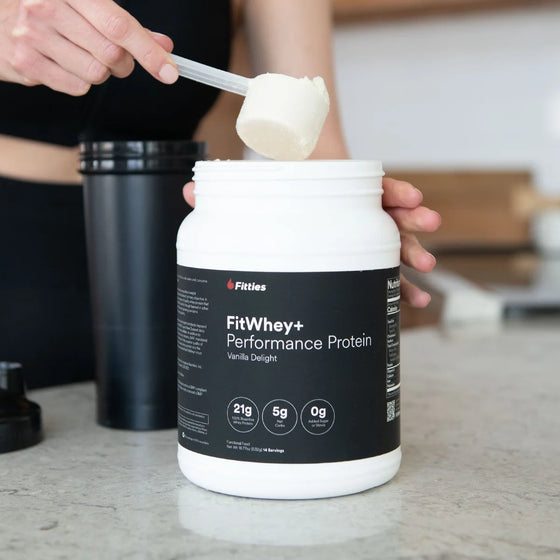
FitWhey+ is New Zealand grass-fed whey protein concentrate. 21 g of protein per serving with all nine essential amino acids printed on the panel, including 2,400 mg of leucine in the Chocolate and 2,350 mg in the Vanilla. Neither panel prints a BCAA total; adding the three branched-chain rows as printed gives 5,210 mg for the Chocolate and 5,120 mg for the Vanilla. No added sugar, no stevia, no artificial sweeteners, sweetened with monk fruit.
Shop FitWhey+