
The Fitties Journal
Magnesium L-Threonate (Magtein) Benefits: What Research Shows
Key Takeaways
Here's what matters most if you're short on time.
- Magnesium L-threonate is magnesium bound to L-threonic acid, a vitamin C metabolite, developed to raise brain magnesium.
- In a 2010 rat study, it raised magnesium in cerebrospinal fluid, while the other magnesium compounds tested did not raise it significantly.
- Three small, industry-funded trials in healthy adults found better scores than placebo on some memory and cognition tests and mixed sleep results.
- The trials used 1 to 2 g a day, which supplies roughly 75 to 145 mg of elemental magnesium.
- The adult upper limit for magnesium from supplements is 350 mg a day; magnesium from food does not count toward it.
- People with kidney problems, those pregnant or nursing, and anyone taking medication should talk to a healthcare provider first.
Magnesium L-threonate is a form of magnesium developed to raise magnesium levels in the brain, and Magtein® is the trademarked version used in its recent human trials. In rats, it did what it was built for. A 2010 study found it raised brain magnesium and improved learning and memory (Slutsky et al., 2010). In people, three recent trials in healthy adults, all small and industry funded, found better scores than placebo on some memory and cognition tests and mixed results for sleep (Zhang et al., 2022; Hausenblas et al., 2024; Lopresti and Smith, 2026).
That is a short, early evidence base under a lot of hype. Here is what the research does and does not show.
What is magnesium L-threonate?
Magnesium L-threonate is magnesium bound to L-threonic acid, which in humans is a metabolite of vitamin C (Zhang et al., 2022). Researchers at MIT and Tsinghua University reported it in 2010 as a newly developed compound that could raise magnesium in the brain through dietary supplementation (Slutsky et al., 2010).
The point was delivery. Most magnesium supplements barely raise brain magnesium even when blood levels rise, the authors of a 2026 trial note (Lopresti and Smith, 2026).
Magnesium is a cofactor in more than 300 enzymatic reactions, including those involved in energy generation and nervous system function (Lopresti and Smith, 2026). And 49% of Americans ages 1 and older took in less magnesium from food and beverages than their estimated average requirement, according to USDA survey data for 2017 to March 2020. The industry's usual answer to that gap is whichever form prints the biggest number for the least money.
FitNeuro
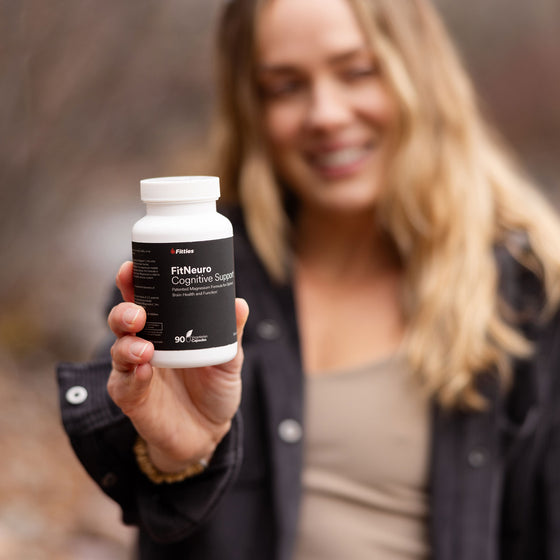
FitNeuro delivers 1 g of Magtein magnesium L-threonate per serving, plus di-magnesium malate and magnesium lysinate glycinate chelate, for 200 mg of total elemental magnesium. A disclosed dose in three vegetarian capsules, no proprietary blends.
Shop FitNeuroWhat is Magtein, and is it the same as magnesium L-threonate?
Yes, Magtein is a trademarked, patented magnesium L-threonate. FitNeuro's label, for example, lists it as a registered trademark of Magceutics®, Inc., distributed exclusively by AIDP, Inc.
It is magnesium, but a gram of Magtein is not a gram of magnesium, which is why the gram amount and the magnesium line on a label are different numbers. The 2024 sleep trial describes Magtein as containing about 75 mg of elemental magnesium per gram (Hausenblas et al., 2024), and in the 2026 trial a 2 g daily dose supplied 145 mg (Lopresti and Smith, 2026).
Every magnesium L-threonate study below also has a commercial tie to the ingredient. The 2010 rat study's senior author co-founded Magceutics, which supplied the compound (Slutsky et al., 2010), and the three human trials were funded by Wu-xi Magtein Bioscience (Zhang et al., 2022), AIDP (Hausenblas et al., 2024) and Threotech (Lopresti and Smith, 2026). That doesn't make the results wrong. It makes independent replication the thing to watch for.
What is magnesium L-threonate good for, according to the research?
The three human trials were small and short, with 80 to 109 people each, followed for 21 days to six weeks (Zhang et al., 2022; Hausenblas et al., 2024; Lopresti and Smith, 2026).
| Trial | Who took part | Daily amount and length | Result vs placebo | Funded by |
|---|---|---|---|---|
| Zhang et al., 2022 | 109 healthy adults aged 18 to 65 | 2 g formula (1.6 g Magtein plus phosphatidylserine and vitamins), 30 days | Better scores on all five parts of a memory test | Wu-xi Magtein Bioscience |
| Hausenblas et al., 2024 | 80 adults aged 35 to 55 reporting poor sleep | 1 g Magtein, 21 days | Better ring-measured deep and REM sleep scores; no difference on a sleep-difficulty questionnaire | AIDP |
| Lopresti and Smith, 2026 | 100 adults aged 18 to 45 dissatisfied with their sleep | 2 g Magtein (145 mg magnesium), 6 weeks | Larger gain on an overall cognition score; no difference on a reasoning test or ring-measured sleep | Threotech |
What did the animal research find?
In the 2010 study, rats received magnesium L-threonate in their drinking water, at 50 mg of elemental magnesium per kilogram of body weight a day, for about a month. By day 24, magnesium in their cerebrospinal fluid was 7% above baseline, while the other magnesium compounds tested did not raise it significantly (Slutsky et al., 2010). Rats given it, young and aged, did better on learning and memory tasks, and aged rats given it had a higher density of synaptic markers in the hippocampus. Rats are not people.
What do human trials show for memory and cognition?
A 2022 trial enrolled 109 healthy adults aged 18 to 65 in China, and 102 finished. For 30 days they took either a starch placebo or 2 g a day of a formula that paired 1.6 g of Magtein with phosphatidylserine and vitamins C, D3 and B6. The formula group improved more than placebo on all five parts of a standard memory test, and older participants improved more than younger ones (Zhang et al., 2022).
The catch is in the capsule. With phosphatidylserine and added vitamins in the mix, that trial cannot isolate magnesium L-threonate, a limitation the 2026 trial authors flag for most earlier Magtein studies (Lopresti and Smith, 2026).
The 2026 trial tested Magtein alone. It enrolled 100 adults aged 18 to 45 who were dissatisfied with their sleep and gave them 2 g of Magtein a day, or a placebo, for six weeks. Both groups improved on an overall score from a computerized cognition test battery, the Magtein group by 8.4 points and the placebo group by 5.6, a statistically significant difference. Reaction time also improved more with Magtein, but a reasoning test showed no difference between groups (Lopresti and Smith, 2026).
What about sleep?
The sleep results are more mixed than the marketing suggests. In a 2024 trial, 80 adults aged 35 to 55 who reported poor sleep, with a history of sleep disorders ruled out, took 1 g of Magtein two hours before bed, or a placebo, for 21 days (Hausenblas et al., 2024). On a standard sleep-difficulty questionnaire, both groups improved and the difference between them was not statistically significant. The results that did favor magnesium L-threonate were ring-measured deep and REM sleep scores and ratings of energy, mood, alertness and how people felt on waking.
The 2026 cognition trial found a similar split, a greater improvement in self-rated sleep-related impairment with Magtein, but no group differences in sleep disturbance, restorative sleep or the ring's sleep measures (Lopresti and Smith, 2026). For magnesium in general, a 2026 systematic review of 12 randomized trials found the sleep results inconsistent and rated the certainty of the evidence low to very low (Lopresti et al., 2026). If you are working through a sleep or mood condition with a doctor, bring them in before adding a supplement.
Magtein vs magnesium glycinate: what's the difference?
They are built for different jobs. Magnesium L-threonate is the form studied for brain magnesium and cognition, and the 2026 trial authors note that every study of magnesium supplementation on its own for cognitive function has used Magtein (Lopresti and Smith, 2026).
Glycinate, magnesium bound to glycine, has thin trial data of its own. In one of the few trials, 155 healthy adults who reported poor sleep took 250 mg of magnesium a day as bisglycinate for four weeks, and their sleep-difficulty scores improved slightly more than with placebo, a small effect (Schuster et al., 2025). According to the 2026 Magtein trial authors, no study has directly compared magnesium forms for sleep (Lopresti and Smith, 2026).
Per gram, that bisglycinate carried nearly twice the magnesium of Magtein, with 125 mg per 893 mg capsule (Schuster et al., 2025), against roughly 75 mg per gram (Hausenblas et al., 2024). Our full magnesium L-threonate vs glycinate comparison covers cost, timing and taking the two together, and our guide to magnesium supplement forms covers citrate, malate, oxide and the rest.
How much magnesium L-threonate should you take?
Trials have used 1 to 2 g of magnesium L-threonate a day. The 2024 sleep trial used 1 g (Hausenblas et al., 2024), and the 2026 trial used 2 g, which its authors describe as the dose most commonly used in cognitive trials of Magtein; that 2 g supplied 145 mg of elemental magnesium (Lopresti and Smith, 2026). At roughly 75 mg of magnesium per gram, the studied range works out to about 75 to 145 mg of elemental magnesium a day.
For context, the adult RDA for magnesium ranges from 310 to 420 mg a day depending on age and sex, and the tolerable upper intake level for magnesium from supplements is 350 mg a day for adults, according to the National Academies Dietary Reference Intakes report. That limit covers nonfood sources only, because magnesium naturally present in food has not been shown to cause adverse effects.
So count every supplement you take, and read the elemental magnesium in the Supplement Facts panel. Read the panel, not the hype.
When should you take magnesium L-threonate?
The trials used different schedules. The 2026 trial gave one 1 g capsule in the morning and one in the evening, two hours before bed, with or without food (Lopresti and Smith, 2026). The 2024 trial gave the full 1 g two hours before bed (Hausenblas et al., 2024), and the 2022 trial gave two capsules in the morning and two in the evening before sleep (Zhang et al., 2022). None of them compared schedules, so they cannot tell you whether one timing beats another.
How long does it take to kick in? The trials measured results after 21 days, 30 days and six weeks of daily use (Hausenblas et al., 2024; Zhang et al., 2022; Lopresti and Smith, 2026). That tells you how long the studies ran, not when, or whether, any one person will notice a change.
Does magnesium L-threonate have side effects? Who should avoid it?
In the 2026 trial, side effects were uncommon and similar to placebo. 10% of the Magtein group and 8% of the placebo group reported one possibly or probably related to the capsules, not a significant difference (Lopresti and Smith, 2026).
The known risk with any magnesium supplement is dose. The National Academies Dietary Reference Intakes report identifies diarrhea as the first sign of too much magnesium from nonfood sources, sometimes with nausea and abdominal cramping. It also notes that high blood magnesium is most commonly linked to impaired kidney function combined with excess nonfood magnesium.
Talk to your healthcare provider before starting if any of these apply.
- You have kidney disease or reduced kidney function. The kidneys regulate magnesium, and impaired function can let it build up. This is a talk-to-your-doctor situation, not a buy-it-and-see one.
- You take any medication. Ask your provider or pharmacist about interactions before adding magnesium.
- You are pregnant or nursing. The 2026 trial excluded pregnant and breastfeeding women (Lopresti and Smith, 2026), so clear any new supplement with your provider first.
FitNeuro's label caution reads, "Consult your healthcare professional prior to use. Individuals taking medication should discuss potential interactions with their healthcare professional. Do not use if tamper seal is damaged." That is not legal boilerplate to skim past. It is the actual instruction.
How does Fitties use magnesium L-threonate?
FitNeuro is built around it. One serving is three vegetarian capsules with 1 g of magnesium L-threonate as Magtein, plus di-magnesium malate and magnesium lysinate glycinate chelate, for 200 mg of magnesium in total, 48% of the Daily Value. Each container holds 30 servings, or 90 capsules. There is no proprietary blend. Every magnesium form is named on the panel, and the L-threonate amount is stated.
The label directions are three capsules once or twice daily, or as directed by your healthcare professional. One serving supplies 200 mg of supplemental magnesium, and a second daily serving takes that to 400 mg, above the 350 mg adult upper limit (National Academies), which is exactly the conversation the label tells you to have with your healthcare professional.
None of the trials above tested FitNeuro. They tested Magtein on its own or in a different formula, at their own doses, so their results describe those products, not ours.
The bottom line on magnesium L-threonate
The evidence is young and the trials are small. Worth following, and nowhere near the miracle the category likes to sell. If you take it, hold it to the standard the category usually fails, which is a real, disclosed dose of the actual L-threonate, not a token sprinkle behind a proprietary blend. Check the panel, and add up the magnesium from everything you take. For more deep dives like this one, browse all Fitties ingredient spotlights.
FitNeuro
FitNeuro delivers 1 g of Magtein magnesium L-threonate per serving, plus di-magnesium malate and magnesium lysinate glycinate chelate, for 200 mg of total elemental magnesium. A disclosed dose in three vegetarian capsules, no proprietary blends.
Shop FitNeuro