The Fitties Journal
Pre-Workout Without Beta-Alanine: Do You Need the Tingle?
Key Takeaways
Here's what matters most if you're short on time.
- Beta-alanine causes a harmless skin tingle called paresthesia, and the tingle is not a sign the product is working.
- Beta-alanine loads over about two to four weeks, so a single pre-workout dose gives no immediate effect.
- Its main researched benefit is buffering muscle acid during hard efforts lasting roughly one to four minutes, according to the International Society of Sports Nutrition's 2015 position stand.
- A pre-workout can leave out beta-alanine and still deliver energy, focus, and pump from other ingredients.
- Skipping beta-alanine makes sense if the tingle bothers you, you train in short heavy sets, or you already take it on its own.
Yes, you can take a pre-workout without beta-alanine and still train hard. Beta-alanine is a real performance ingredient, but its job is narrow. Over several weeks of daily dosing it raises muscle carnosine, which buffers the acid that builds up during hard efforts lasting roughly one to four minutes. The skin tingle it causes is harmless and has nothing to do with whether your pre-workout is working. If that tingle annoys you, if you train mostly in short heavy sets, or if you already take beta-alanine on its own, a formula that leaves it out is a reasonable call. Here is what beta-alanine does, who genuinely benefits, and what a good beta-alanine-free pre-workout uses in its place.
What does beta-alanine do in a pre-workout?
Beta-alanine is an amino acid that your body combines with histidine to make carnosine, which sits inside muscle and acts as a buffer. When you push through a hard set, hydrogen ions accumulate and muscle pH drops, which is part of what makes the muscle burn and slow down. More carnosine means more buffering capacity, which is why beta-alanine is studied as a way to support performance in the fatigue zone (Trexler et al., 2015).
The catch is timing. Carnosine builds up slowly. Research summarized in the International Society of Sports Nutrition position stand on beta-alanine points to a typical protocol of about 4 to 6 grams per day for two to four weeks before muscle carnosine is meaningfully elevated. That is the part the label rarely spells out. The dose in your scoop today does almost nothing today. It is a load-it-over-time ingredient, not an on-the-spot one.
The benefit is also specific to a window. A meta-analysis in the journal Amino Acids found beta-alanine's effect concentrated in exercise lasting roughly 60 to 240 seconds, with a median improvement in exercise capacity of about 2.85 percent. For a single all-out lift or a short sprint, buffering is not the limiting factor, so the upside shrinks.
FitBoost+
FitBoost+ is a pre-workout built without beta-alanine, so there is no tingle to push through. It uses 3 g of creatine monohydrate, 400 mg of Peak ATP, electrolytes, B vitamins, and a blend that includes a caffeine and pterostilbene co-crystal, with 95 mg of caffeine per scoop. Manufactured in a GMP compliant facility, with no artificial sweeteners or colors.
Shop FitBoost+Why does beta-alanine make you tingle?
That pins-and-needles feeling on your face, neck, and hands has a name, paresthesia. It happens because beta-alanine activates certain nerve receptors in the skin. The ISSN position stand describes paresthesia as the most commonly reported side effect and notes it can be blunted by using smaller split doses or sustained-release forms. It is uncomfortable for some people and unnoticeable for others.
Here is the part the supplement industry loves to blur. The tingle is not a performance signal. It is a sensory side effect that shows up within minutes, while the actual buffering benefit takes weeks to develop. Plenty of formulas lean on that instant tingle so a scoop feels powerful the second it hits, which is marketing, not mechanism. Feeling more does not mean the product is doing more. If a pre-workout only feels like it is working because your skin is buzzing, that tells you more about the sales pitch than the science.
Do you really need beta-alanine?
For a lot of lifters, honestly, no. Beta-alanine earns its place for training that lives in the burn zone, meaning high-rep sets, intervals, and repeated hard efforts in that one to four minute range. If your sessions are built around heavy low-rep strength work, short sprints, or long steady cardio, buffering is not your bottleneck and the benefit is small. It also does nothing for you acutely, so if you want your pre-workout to earn its keep in the next 30 minutes, beta-alanine is not the ingredient doing it.
There are also good reasons to skip it even if you do that kind of training. The tingle can be genuinely distracting. You might already take beta-alanine as a standalone so you can control the dose, in which case doubling up in your pre-workout is pointless. Use this to decide.
| Your situation | Beta-alanine: keep it or skip it? |
|---|---|
| High-rep sets and intervals in the 1 to 4 minute burn zone | Worth keeping, at a real daily dose taken consistently |
| Heavy low-rep strength work or short sprints | Little benefit either way; fine to skip |
| The tingle distracts you or you dislike it | Skip it and choose a formula without it |
| You already take beta-alanine on its own | Skip it in your pre-workout to avoid doubling up |
| You want an immediate kick from your scoop | Beta-alanine will not provide it; it works over weeks |
What does a pre-workout without beta-alanine use instead?
Dropping beta-alanine does not mean dropping performance. It means the formula leans on ingredients that do their work the day you take them, rather than one that loads over a month. A well-built beta-alanine-free pre-workout usually covers energy, focus, blood flow, and hydration through a handful of well-researched ingredients, with the key doses printed on the label.
These are the usual building blocks and what the general research says each one supports. None of this is a promise about a specific product; it is what the ingredients are studied for.
| Ingredient | What it is generally studied to support |
|---|---|
| Caffeine | Alertness, perceived energy, and training output |
| Creatine monohydrate | Power output and strength across repeated efforts |
| Peak ATP® (adenosine triphosphate) | Muscular performance and recovery with resistance training |
| Electrolytes (sodium, potassium, magnesium) | Hydration and normal muscle and nerve function |
| B vitamins | Normal energy metabolism |
Notice that none of these cause a tingle. A formula can hit energy, power, and hydration hard and still be completely calm on the skin. FitBoost+ is one example built this way. It contains no beta-alanine, and instead uses a caffeine and pterostilbene co-crystal, creatine monohydrate, and Peak ATP alongside electrolytes and B vitamins. Whether you choose that one or another, the point is that "no tingle" and "no performance" are not the same thing.
How do you choose a good beta-alanine-free pre-workout?

The absence of one ingredient does not make a pre-workout good. What matters is whether the rest of the formula is dosed like it means it. The mediocre end of this category swaps beta-alanine for a pinch of everything and counts on a big caffeine hit to make the scoop feel like it did something. You can do better by reading the label.
Look for transparent dosing on the ingredients you are actually buying it for. Check the caffeine number and match it to your tolerance and the time of day you train. Confirm the ingredients that remain are ones with real evidence behind them, like caffeine and creatine, both backed by numerous clinical trials according to the NIH Office of Dietary Supplements, rather than a long list of trace-dose filler. If you want a full walkthrough of the panel, our guides on what actually works in a pre-workout and how to read a pre-workout label break down every line.
One more practical note. If you take a stimulant-containing pre-workout, mind the total caffeine across your whole day, and if you are pregnant, nursing, take medication, or have a heart or blood pressure condition, talk to your healthcare provider before starting one. Beta-alanine or not, the smartest pre-workout is the one you can dose honestly and repeat.
FitBoost+
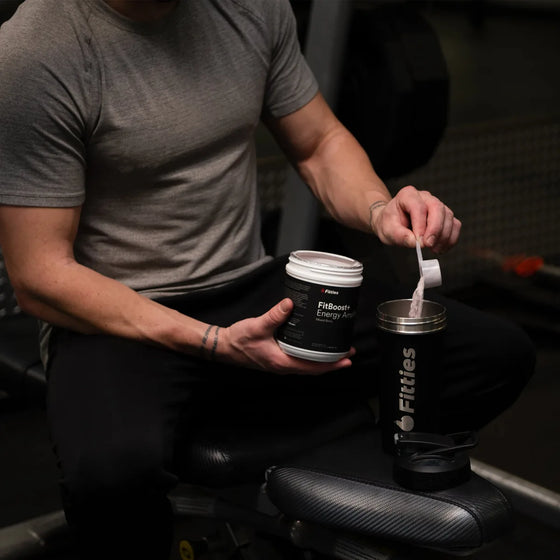
FitBoost+ is a pre-workout built without beta-alanine, so there is no tingle to push through. It uses 3 g of creatine monohydrate, 400 mg of Peak ATP, electrolytes, B vitamins, and a blend that includes a caffeine and pterostilbene co-crystal, with 95 mg of caffeine per scoop. Manufactured in a GMP compliant facility, with no artificial sweeteners or colors.
Shop FitBoost+