
The Fitties Journal
Creatine Side Effects: 5 Myths and 3 Real Ones
Key Takeaways
Here's what matters most if you're short on time.
- Creatine's three documented side effects are water weight, stomach upset from large single doses, and a raised serum creatinine reading on a blood test.
- The ISSN position stand reports no detrimental effects from up to 30 g per day for 5 years in otherwise healthy individuals.
- A 12-week randomized controlled trial published in 2025 by Lak and colleagues measured hair follicle health directly and found no difference between creatine and placebo.
- A 2003 study of collegiate football players by Greenwood and colleagues found fewer cramping and heat-illness episodes among creatine users, not more.
- Tell your doctor you supplement before a blood panel, because creatine raises the serum creatinine marker used to estimate kidney function.
- Anyone pregnant or breastfeeding, or with kidney disease, liver disease, diabetes or bipolar disorder, should speak to a provider first.
Creatine has three side effects worth knowing about, and none of them are the ones the internet argues about. You may hold extra water in the first week or two. You may get an upset stomach if you throw back a large dose at once. And a routine blood panel may come back with a raised serum creatinine reading, which looks like a kidney problem and usually is not one. That is the honest list.
Kidney damage, hair loss, dehydration, cramps, and "it is basically a steroid" are the claims that dominate the conversation. The research does not support any of them, according to a 2021 review of common creatine misconceptions (Antonio et al., 2021). Below is what the evidence actually shows, myth by myth, plus the people who genuinely should check with a doctor first.
What are the real side effects of creatine?
Creatine monohydrate is one of the most heavily studied supplements on the shelf (NIH Office of Dietary Supplements), and the side-effect profile that has emerged over three decades is unglamorous. The International Society of Sports Nutrition position stand puts it plainly. "There is no compelling scientific evidence that the short- or long-term use of creatine monohydrate (up to 30 g/day for 5 years) has any detrimental effects on otherwise healthy individuals."
That is not the same as "no effects at all." Three things do show up often enough to plan around. The NIH Office of Dietary Supplements names the two you would notice. Weight gain from water retention, the one consistent side effect in studies, and anecdotal reports of nausea, diarrhea, and related stomach upset. Here is what actually drives them.
| Real side effect | Why it happens | What to do about it |
|---|---|---|
| Water weight | Creatine is stored inside muscle cells and pulls water in with it | The scale often moves in week one. Skipping the loading phase blunts it |
| Stomach upset | Large single doses. One 10 g dose caused more diarrhea than two 5 g doses (Ostojic and Ahmetovic, 2008) | Take 3 to 5 g at a time |
| Raised serum creatinine | Creatine breaks down into creatinine, the marker used to estimate kidney function | Tell your doctor you supplement before a blood panel |
Notice what is missing from that list. Nothing about organ damage in healthy people, nothing about wrecked hormones, and nothing about hair. The supplement industry has spent twenty years either dodging these questions or answering them with a shrug and a proprietary blend, which is exactly why the myths outlived the evidence.
FitBoost+
FitBoost+ lists 3 g of creatine monohydrate on the label as its own line item, next to 400 mg of Peak ATP, 150 mg of magnesium and 95 mg of total caffeine. The creatine sits outside the formula's 465 mg proprietary blend, so that dose is printed in plain sight. Contains caffeine; consult your healthcare professional prior to use.
Shop FitBoost+Does creatine damage your kidneys?
This is the big one, and the answer in healthy people is no. The ISSN position stand states that "there is no compelling evidence that creatine supplementation negatively affects renal function in healthy or clinical populations."
The myth is durable because of a genuine lab-test quirk. Creatine is metabolized into creatinine, and serum creatinine is the exact marker clinicians use to estimate kidney function. Take creatine, and that number goes up. As a 2021 review in the Journal of the International Society of Sports Nutrition explains, blood creatinine is used as a proxy marker of kidney function, creatine supplements can raise it, and controlled research shows creatine at recommended doses does not cause kidney damage or dysfunction in healthy people. So a healthy lifter can walk out of a physical with a flagged result and a worried doctor, and nothing is wrong.
The fix is not to stop taking creatine. It is to mention it before the blood draw so the number gets read in context.
The caveat is real, though. If you already have kidney disease, diabetes, or you take medication that taxes the kidneys, this is a conversation for your doctor, not a blog post.
Does creatine cause hair loss?
Very unlikely, and we finally have direct evidence rather than inference (Lak et al., 2025).
The entire baldness scare traces back to one 2009 study of 20 college-aged rugby players. After 7 days of loading at 25 g per day, dihydrotestosterone (DHT) rose 56%, and stayed 40% above baseline through 14 days of 5 g per day maintenance. Testosterone itself did not change. That study measured a hormone. It never measured a single hair.
Sixteen years later, someone finally did. A 12-week randomized controlled trial published in 2025 gave 38 resistance-trained men aged 18 to 40 either 5 g of creatine monohydrate or a maltodextrin placebo daily, then measured DHT, testosterone, and actual hair follicle health using a Trichogram and FotoFinder imaging. The result was no significant differences between groups in DHT, testosterone ratios, or hair density and follicle counts. The authors concluded it was "the first to directly assess hair follicle health following creatine supplementation, providing strong evidence against the claim that creatine contributes to hair loss."
We will be straight about the limits, several of which the authors list themselves (Lak et al., 2025). 38 men over 12 weeks is a modest trial, it did not record family history of hair loss, and it measured androgens in blood rather than in the hair or scalp. It is not the last word. It is, however, far better evidence than the rugby study that started the panic. We went deeper on this in our full breakdown of creatine and hair loss.
Does creatine dehydrate you or cause muscle cramps?

No. If anything, the data point the other way.
The logic behind the myth sounds reasonable. Creatine pulls water into muscle cells, so there must be less water everywhere else, so you must be a cramp waiting to happen. It does not survive contact with the research (Antonio et al., 2021). The ISSN position stand concludes that creatine supplementation "does not increase the incidence of musculoskeletal injuries, dehydration, muscle cramping," and cites work in which supplemented athletes had less cramping and heat illness than non-users.
The clearest example comes from a study of collegiate football players training through a full season in the heat, where creatine users recorded fewer cramping episodes, less heat illness and dehydration, and fewer muscle strains than teammates who did not supplement.
None of which is permission to train dehydrated. Drink like an adult who sweats for a living. Just stop blaming the creatine.
Is creatine a steroid?
No, and the two are not structurally or functionally related.
Anabolic steroids are synthetic derivatives of testosterone that act on hormone receptors. Creatine is an amino acid derivative your body already produces in the liver, kidneys, and pancreas, and that you eat every time you have red meat or fish. Its job is to help regenerate ATP, the molecule that funds short, hard efforts. It does not bind androgen receptors. It does not shut down your own hormone production.
The confusion is a branding problem, not a pharmacology one. Creatine sits on the same shelf as products that genuinely are pushing the line, so it inherits their reputation.
Is creatine safe to take long term?
The long-term safety record is one of the better-documented ones in the supplement aisle. The ISSN position stand covers continuous use of up to 30 g per day for five years without detrimental effects in healthy individuals, and notes that "clinical populations have been supplemented with high levels of creatine monohydrate for years with no clinically significant or serious adverse events." The NIH Office of Dietary Supplements puts it more conservatively. Creatine is considered safe for short-term use by healthy adults, and evidence shows use for several years is safe.
There is also no established requirement to cycle off, and the ISSN dosing protocol does not include one. If you want the full dosing picture, we covered it in how much creatine to take per day.
Who should talk to a doctor before taking creatine?
This is the part most side-effect articles bury, and it matters more than any myth on the list. Health Canada tells anyone who is pregnant or breastfeeding, or who has a kidney disorder, to ask a healthcare provider before taking creatine, and a 2025 safety review notes that evidence in pregnancy and in existing kidney conditions is lacking (Longobardi et al., 2025). People with diabetes or liver disease should check with their doctor too. In a small 2007 study, both participants with bipolar disorder developed hypomania or mania while taking creatine (Roitman et al., 2007).
Add to that anyone taking prescription medication, particularly anything processed by the kidneys, and anyone with a history of abnormal heart rhythm who is considering a creatine product that also contains caffeine. A 2022 systematic review also concluded that daily caffeine during a creatine loading phase could blunt creatine's benefit, though the studies were split (Elosegui et al., 2022), which is worth knowing if your creatine arrives inside a pre-workout. We unpacked that pairing in creatine and caffeine.
None of this is medical advice, and none of it replaces a conversation with your own healthcare provider. If you are in any of those groups, have the conversation first.
How do you avoid the side effects that are real?

The three genuine side effects are all manageable, and mostly they come down to dose size and honesty with your doctor. Skip the loading phase if the scale bothers you. Loading front-loads the water retention into a single week for the sake of saturating your muscles a couple of weeks sooner. The ISSN protocol offers both routes, roughly 0.3 g per kilogram of body weight daily for 5 to 7 days, or simply 3 to 5 g per day from the start, which arrives at the same place with less drama. We compared both in the creatine loading phase breakdown.
For stomach upset, the answer is smaller doses. In a study of 59 soccer players, one 10 g dose caused diarrhea more often than two 5 g doses, and two 5 g doses caused no more stomach trouble than a placebo (Ostojic and Ahmetovic, 2008). If grit in the glass is the issue, our comparison of micronized and regular creatine monohydrate covers what a finer grind does and doesn't change. And before any blood panel, say the word "creatine" out loud to whoever is ordering it.
The other variable nobody talks about is what else is in the tub. Plenty of products bury creatine inside a proprietary blend so you never learn the dose, which makes it impossible to manage the one side effect that is dose-dependent. FitBoost+ lists 3 g of creatine monohydrate on the label as its own line item, alongside 400 mg of Peak ATP®, 150 mg of magnesium, 215 mg of potassium, 135 mg of sodium, and 95 mg of total caffeine. Whatever you take, you should be able to read the number.
FitBoost+
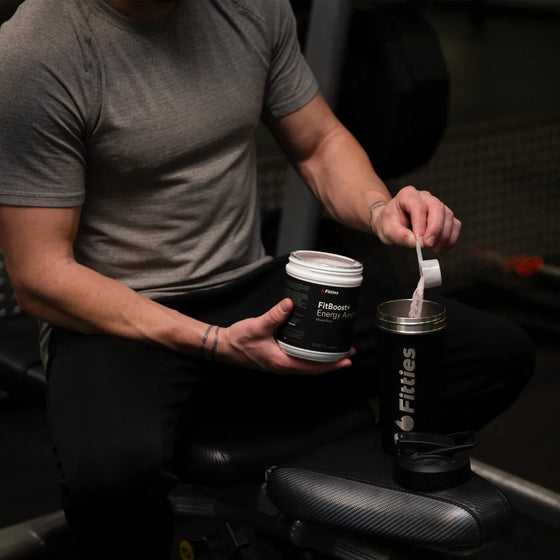
FitBoost+ lists 3 g of creatine monohydrate on the label as its own line item, next to 400 mg of Peak ATP, 150 mg of magnesium and 95 mg of total caffeine. The creatine sits outside the formula's 465 mg proprietary blend, so that dose is printed in plain sight. Contains caffeine; consult your healthcare professional prior to use.
Shop FitBoost+