The Fitties Journal
Micronized Creatine vs Monohydrate: Which Is Better?
Key Takeaways
Here's what matters most if you're short on time.
- Micronized creatine is creatine monohydrate ground into finer particles, not a different compound.
- Both forms are taken at the same 3 to 5 grams a day, and there's no evidence micronized is absorbed any better.
- Micronized mixes in more easily, but no study shows it's gentler on the stomach; large single doses are the known cause of stomach upset.
- Micronized usually costs slightly more than plain monohydrate, but far less than creatine HCl.
- For most people either form works; micronized is a texture choice.
Micronized creatine and creatine monohydrate are the same thing. Micronized creatine is monohydrate, just milled into smaller particles, which is meant to help it mix in with less grit. What it doesn't do is get more creatine into your muscles. A 2022 review found no evidence that micronized creatine is absorbed any better than standard monohydrate, which is already close to fully absorbed (Kreider et al., 2022). Both are taken at the same 3 to 5 grams a day (ISSN position stand, 2017). Micronized is a texture upgrade, not a results upgrade. Here is the honest breakdown the label marketing tends to skip.
What is micronized creatine?
Micronized creatine is creatine monohydrate that has been put through an extra manufacturing step to break the powder into much finer particles. Nothing is added and nothing is changed chemically. It is the exact same molecule, creatine monohydrate, with more surface area per gram.
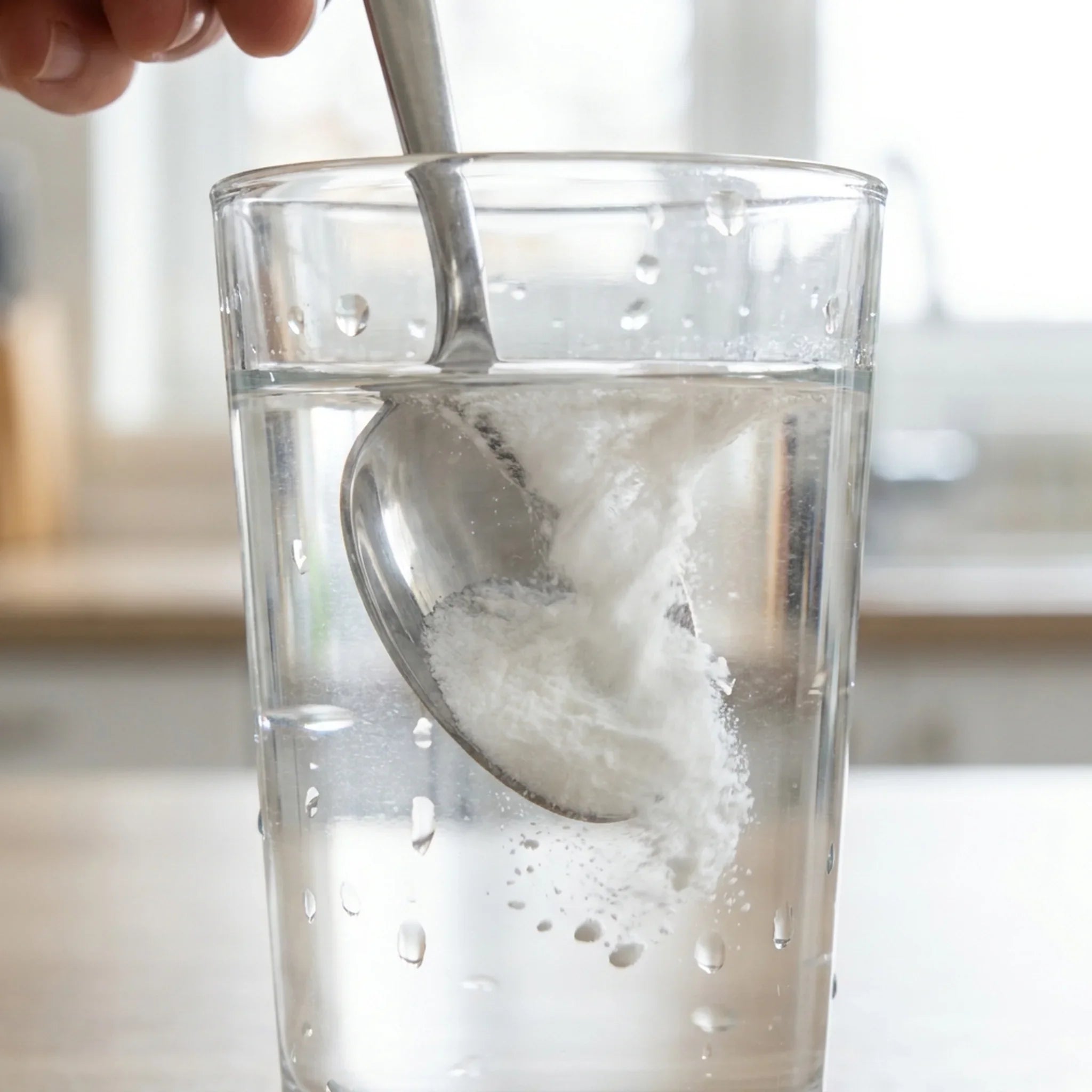
That matters because creatine monohydrate isn't very soluble. About 14 grams dissolve in a liter of room-temperature water, and only about 6 grams in cold water (Kreider et al., 2022). A finer grind dissolves faster up to that limit and stays suspended longer, so less sinks to the bottom. Think of granulated sugar versus powdered sugar stirred into iced tea. Same sugar, but one disappears cleaner. The creatine your body actually uses is identical either way.
This is worth being clear about because "micronized" gets marketed as if it were a separate, more advanced kind of creatine. It is not. It sits under the same umbrella as regular creatine monohydrate, which the International Society of Sports Nutrition calls the most extensively studied and clinically effective form, and which the 2022 bioavailability and efficacy review treats as the gold standard other forms are measured against.
FitBoost+
FitBoost+ is built on 3 g of creatine monohydrate, the researched form, plus 400 mg of Peak ATP and electrolytes. It is a pre-workout with 95 mg of caffeine per scoop, so count it toward your daily intake.
Shop FitBoost+Is micronized creatine better than monohydrate?

For building muscle and strength, no. This is where the marketing and the evidence separate. The pitch for micronized creatine is that finer particles mean better dissolving, better absorption, and therefore better results. Finer particles do dissolve faster. The rest doesn't follow.
Regular creatine monohydrate already absorbs almost completely. Less than 1% breaks down during digestion, and close to all of it is taken up by the body or excreted, which is one reason it has stayed the gold standard for decades (Kreider et al., 2022). The same review found no evidence that micronized creatine is absorbed any better. Better mixability in the shaker is not the same as more creatine in the muscle.
Both forms work by the same mechanism once absorbed. They top up the creatine your muscles store as phosphocreatine, which helps regenerate ATP, the fuel you burn during short, hard efforts like a heavy set or a sprint (ISSN position stand, 2017). Fill the same tank with the same fuel and you get the same drive. The particle size changed on the way in; the biology did not.
| Factor | Regular Monohydrate | Micronized Monohydrate |
|---|---|---|
| The molecule | Creatine monohydrate | Creatine monohydrate (finer particles) |
| Muscle and strength gains | The most studied form | No evidence of a difference |
| Daily dose | 3 to 5 g | 3 to 5 g |
| Mixability | Good, can leave slight grit | Finer, so it stirs in more easily |
| Stomach comfort | No study compares them | No study compares them |
| Cost per gram | Lowest | Slightly higher |
Does micronized creatine mix better?
Yes, and that's where micronized genuinely earns its name. Finer particles dissolve faster and stay suspended longer, so you get a smoother drink and less chalky grit sinking to the bottom of the shaker. Just don't expect a perfectly clear glass. At room temperature a liter of water dissolves only about 14 grams of creatine, so a 5-gram scoop in an 8-ounce glass can't fully dissolve, whatever the grind. Warm water, juice, or stirring it into a protein shake all help it go in (Kreider et al., 2022).
Is it easier on your stomach? No published study shows that. The best evidence points at dose size, not particle size. In a study of 59 soccer players, a single 10-gram dose caused diarrhea more often than two 5-gram doses, and two 5-gram doses caused no more stomach trouble than a placebo (Ostojic and Ahmetovic, 2008). Broader reviews find no convincing evidence that creatine causes bloating or stomach upset (Kreider et al., 2022). If creatine has bothered your stomach, split larger amounts into doses of 5 grams or less. Our rundown of creatine side effects covers the rest.
The honest summary is that micronized is a quality-of-life improvement. Smoother mix, same creatine, same results.
Does creatine cause water retention or bloating?
A little water, early on. A 2021 review by a team of creatine researchers found water retention is the most common side effect in the first several days, mostly as extra water inside muscle cells, while several training studies of 5 to 10 weeks found no change in total body water (Antonio et al., 2021). Micronizing doesn't change any of this, since it's the same creatine. For the scale side of it, see does creatine make you gain weight.
Is micronized creatine worth the extra cost?
It depends on whether grit bothers you, because that is the only thing you are paying for. Micronized creatine usually costs a little more than plain monohydrate thanks to the extra processing. It is a small premium, not a big one.
Keep that premium in perspective. Both forms of monohydrate are still the cheapest creatine per gram you can buy. The genuinely expensive options are the newer "premium" forms like creatine HCl, which are sold at a real markup on the promise of better absorption, a claim the 2022 bioavailability and efficacy review found no evidence for in humans. If you want the full breakdown there, our comparison of creatine monohydrate vs HCl covers why the upgrade rarely pays off. Micronized sits in a much friendlier spot. It is a minor step up in price for a nicer drinking experience, on the same proven molecule.
Which type of creatine is best?

Creatine monohydrate, plain or micronized. The ISSN calls it the most extensively studied and clinically effective form (ISSN position stand, 2017), and no published study has shown that another form, including HCl, ethyl ester, nitrate or buffered creatine, stores more creatine in muscle (Antonio et al., 2021). Several of the alternatives also carry less creatine per gram (Kreider et al., 2022).
| Form | Creatine by weight | What the research shows |
|---|---|---|
| Creatine monohydrate (plain or micronized) | 87.9% | The most studied form, close to fully absorbed |
| Creatine ethyl ester | 82.4% | Partly breaks down to creatinine during digestion, so less is absorbed |
| Creatine HCl | 78.2% | Not shown to store more creatine in muscle than monohydrate |
| Creatine nitrate | 67.5% | Not shown to store more creatine in muscle than monohydrate |
If you're weighing gummies against powder, our creatine gummies vs powder comparison covers that choice.
For most people, plain or micronized creatine monohydrate is the answer, and the choice between them comes down to one question. Does texture bother you? If you do not care about a little grit, regular monohydrate is the cheapest effective creatine on the shelf and there is no reason to pay more. If you want a cleaner mix, micronized is worth the small premium. Either way you are getting the same researched molecule at the same dose.
What you do not need is a form marketed as a breakthrough for double the price. The supplement industry loves taking a solved problem, creatine monohydrate, and reselling it as an upgrade. Micronizing is a legitimate refinement of that molecule; most of the pricier "advanced" creatines are not.
Creatine also shows up inside well-built pre-workouts, where the researched form is what matters. FitBoost+ is built on creatine monohydrate (3 grams per serving) alongside Peak ATP® and a caffeine pterostilbene co-crystal, rather than chasing a trendier, less-proven form. It does contain caffeine, so count it toward your daily total. Whether you scoop plain monohydrate, micronized, or take it inside a formula, the creatine doing the work is the same.
How do you take creatine monohydrate?
The protocol is the same for micronized and regular monohydrate, and it has not changed in years. Per the ISSN position stand, you have two ways to start.
- With a loading phase: take about 20 grams a day, split into four 5 gram doses, for 5 to 7 days to saturate your muscles quickly, then drop to 3 to 5 grams a day to maintain. Our guide to the creatine loading phase covers whether it's worth it.
- Without loading: take 3 to 5 grams a day from the start. You reach the same muscle creatine levels in about 3 to 4 weeks, just more gradually.
Timing barely matters. Total daily intake and consistency are what fill your creatine stores, so take it whenever you will actually remember. If you want the detail on that, see our guide on when to take creatine, and our complete creatine buyer's guide covers what to look for before you buy. For dosing by body weight, see how much creatine per day.
Before you start. Creatine is well tolerated in healthy adults, but it is not right for everyone. If you take medication, are pregnant or nursing, or manage a kidney or other health condition, talk to your healthcare provider before starting creatine.

FitBoost+
FitBoost+ is built on 3 g of creatine monohydrate, the researched form, plus 400 mg of Peak ATP and electrolytes. It is a pre-workout with 95 mg of caffeine per scoop, so count it toward your daily intake.
Shop FitBoost+