The Fitties Journal
Creatine Gummies vs Powder: Dose, Cost, and What to Check
Key Takeaways
Here's what matters most if you're short on time.
- Creatine monohydrate powder delivers a full 3 to 5 g dose in one scoop, the daily amount the International Society of Sports Nutrition describes for maintaining muscle creatine stores.
- Creatine per gummy varies widely by brand, so check how many pieces it takes to reach 3 to 5 g.
- Creatine degrades into creatinine, an inactive byproduct, in the moist acidic base of a gummy.
- Chews and capsules avoid the gummy stability problem but still cost more per gram than powder.
- Divide 5,000 mg by the creatine per piece to find your real daily serving before you buy.
Powder. If the only thing you care about is getting a verified 3 to 5 g of creatine into you every day, powder wins on dose accuracy, cost, and verifiability, and it is not close. That said, the format itself is not the problem. A gummy that genuinely contains what its label says works exactly like a scoop does, because it is the same molecule saturating the same muscle. The catch is knowing that it does. So the honest answer is not "powder is better." It is that powder is very hard to get wrong, and a gummy is only as good as the testing behind it.
Do creatine gummies work as well as creatine powder?
Chemically, yes. Creatine monohydrate does not care what shape it was in on the way down. It saturates muscle creatine stores the same way whether it arrived dissolved in water or chewed off a candy. What changes between formats is not the mechanism, it is the three boring things that decide whether you actually get the dose. They are how much is in each piece, whether that number is real, and what you paid for it.
Those three things are where the two formats differ most. Here is how the formats line up.
| Factor | Powder | Gummies | Chews and capsules |
|---|---|---|---|
| Creatine per piece or scoop | 3 to 5 g in one scoop | Varies by brand, read the panel | Varies widely, read the panel |
| Pieces to reach 5 g | One scoop | Several, depending on the brand | Usually several |
| Dose accuracy when tested | Stable and straightforward to assay | Harder to keep stable; look for testing on the finished product | Dry formats, fewer stability problems than gummies |
| Cost per gram of creatine | Lowest in the category | Highest, you are paying for the candy | Between the two |
| Convenience | Needs water and a scoop | Best, no mixing and no water | Good, pocketable |
| Added sugar | None | Often sugar or sugar alcohols | Usually little to none |
| Best for | Anyone who wants an exact, cheap, checkable dose | People who will not touch powder, from a tested brand | Travel and gym bags, if the math works out |
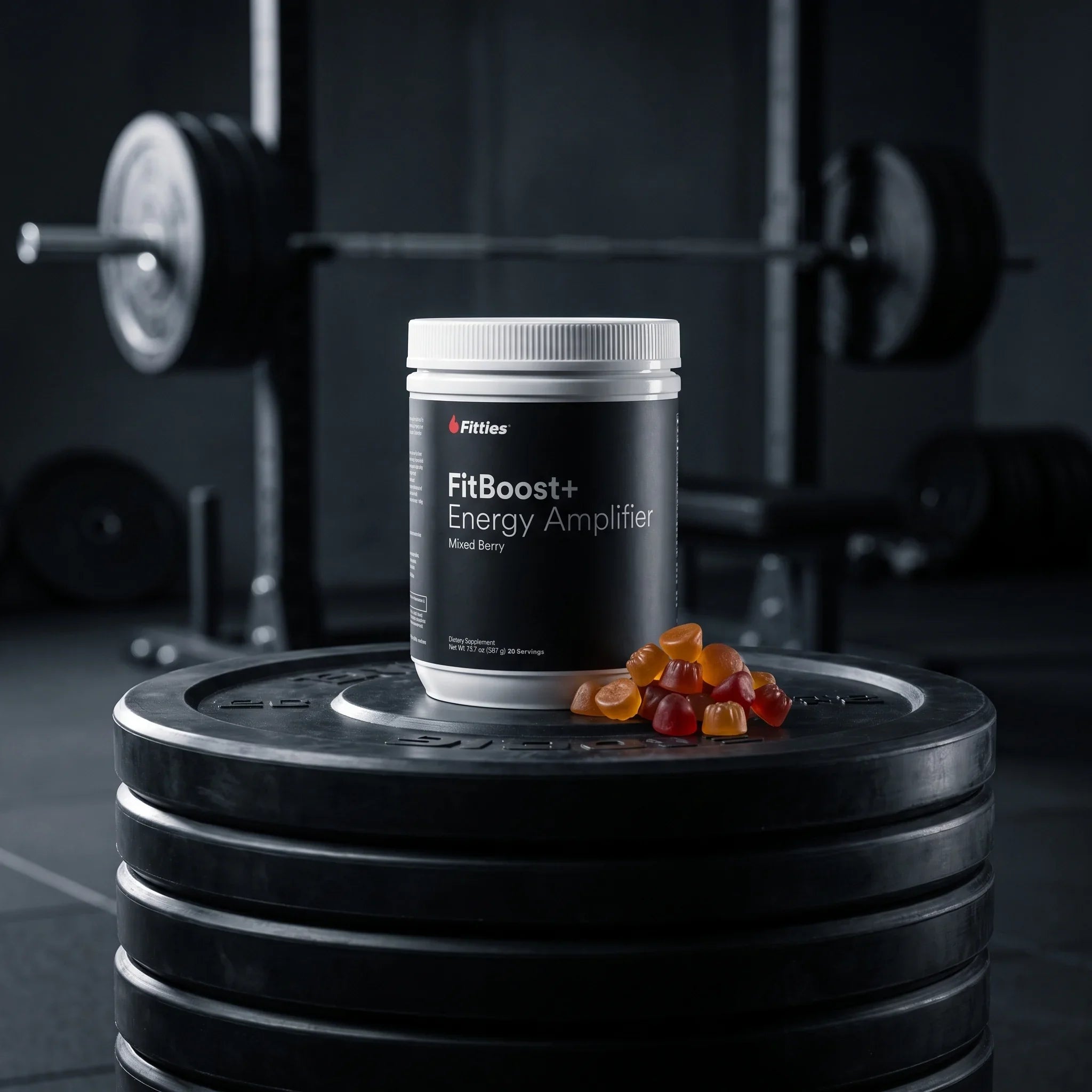
FitBoost+
FitBoost+ is a powder you can read. It has a disclosed 3 g of creatine monohydrate per scoop, plus 95 mg of caffeine from a blend that includes a caffeine and pterostilbene co-crystal, 400 mg of Peak ATP, and electrolytes, with zero sugar. Manufactured in a GMP compliant facility.
Shop FitBoost+Why is creatine harder to keep stable in a gummy?
When creatine breaks down, it turns into creatinine. Creatinine is the spent version. It is not the thing the research is about, and it does nothing for your muscle creatine stores. It is a metabolic byproduct your body excretes in urine (Kreider et al., 2017).
There is a real manufacturing reason gummies are harder. Creatine monohydrate is essentially inert sitting in a sealed tub of dry powder, which is why a tub you bought last year is still a tub of creatine. Put that same molecule into a warm, wet, acidic gummy base and hold it there for a shelf life measured in months, and it starts converting. Making a gummy that still carries a full, stable dose on the day someone eats it is genuinely hard.
The fix is not complicated. Buy from a brand that publishes current testing on the actual finished product, or skip the format risk and use powder, where the dose is cheap to verify and hard to fake.
How many gummies equal one scoop of creatine powder?

It depends entirely on the label, which is the whole problem with the question. Divide 5,000 mg by the creatine in one gummy. A gummy carrying 1,000 mg means five gummies to reach 5 g, and one carrying 500 mg means ten.
The target itself is not in dispute, which is what makes underdosing so avoidable. The International Society of Sports Nutrition position stand on creatine describes maintaining muscle creatine stores with 3 to 5 g per day, notes that larger athletes may need 5 to 10 g per day, and describes an optional faster loading protocol of 5 g four times daily for 5 to 7 days. The same position stand calls creatine monohydrate "the most effective ergogenic nutritional supplement currently available to athletes" and the most commonly studied form in the literature. Everything else in the category is measured against it.
So run the arithmetic before you buy, not after. Take the creatine per gummy off the Supplement Facts panel, divide 5,000 mg by it, and that is your real daily serving. If the answer is a handful of candy per day, the format is not saving you anything. Our guide to how much creatine to take per day walks through dosing by body weight and goal if you want to set your target first.
What about creatine chews, capsules, and pills?
They sit between the two, and they dodge the specific failure mode that catches gummies. A chew is usually pressed powder in tablet form and a capsule is powder in a shell, so neither one parks creatine in a wet, acidic base for months. Dry is dry. The stability question that makes gummies hard to manufacture largely goes away.
What does not go away is the dose math. Capsules and chews still carry a fraction of a scoop each, so you are still counting pieces to reach 3 to 5 g, and you are still paying more per gram than you would for plain powder. They are a reasonable travel format and a poor everyday one. If you want the format comparison one level deeper, our breakdowns of creatine monohydrate vs HCl and micronized creatine vs monohydrate cover which form to buy once you have settled on powder.
Do creatine gummies cost more than creatine powder?

Yes, and the gap is wider than the shelf price suggests, because you are not comparing tubs to jars. You are comparing grams of creatine to grams of creatine, and a gummy bottle is mostly not creatine. Sugar, gelatin, flavoring, coating, and a more complex manufacturing process all take up space and cost money, and none of it is the active ingredient you came for.
Do not take anyone's multiplier on faith, including ours. Run the number yourself in about fifteen seconds. Take the total creatine in the container, which is creatine per piece multiplied by pieces per container, convert it to grams, then divide the price by that figure. Now you have cost per gram of creatine, which is the only price that means anything. Do it for a gummy bottle and a tub of monohydrate side by side and the comparison stops being a matter of opinion.
Creatine is one of the cheapest genuinely well-supported supplements in the entire market. Paying a premium for it is a choice you should make on purpose, for convenience you will actually use, not because a bottle looked friendlier on the shelf.
Do creatine gummies have different side effects than powder?
Not from the creatine itself, assuming the dose is the same. Creatine monohydrate is one of the most studied sports supplements there is, with more than 500 peer-reviewed publications (Antonio et al., 2021), and the ISSN position stand describes short and long-term supplementation of up to 30 g per day for five years as safe and well tolerated in healthy individuals across a range of populations. The molecule is the same in either format.
What differs is everything wrapped around it. Gummies bring sugar or sugar alcohols, and sugar alcohols in quantity are a well known cause of digestive upset, which matters more when your serving is six gummies rather than one. Powder brings the opposite complaint. Taking a big dose on an empty stomach with too little water can leave people feeling off, which is usually solved by splitting the dose or mixing it into more liquid. And the water-weight question that comes up with every creatine format is covered properly in our post on whether creatine makes you gain weight, along with the fuller picture in our roundup of creatine side effects, the myths and the real ones.
If you are pregnant or nursing, taking medication, or managing a health condition, talk to your healthcare provider before starting any creatine product, in any format.
How do you spot a creatine gummy worth buying?
If you have decided you want gummies, buy like a skeptic. Four checks, in order, and a product that fails any of them is not worth your money.
- Creatine per gummy is printed on the panel in milligrams. Not "creatine blend," not a serving-level number with no per-piece figure. If they will not tell you what is in one gummy, assume the answer is disappointing.
- The math to 3 to 5 g is reasonable. Divide 5,000 mg by the per-gummy amount. If the answer is more than about five gummies a day, the format has stopped making sense.
- The brand publishes current testing on the finished product, not on the raw creatine it bought. Batch-level results, dated, for the gummy in your hand.
- The sugar and sugar alcohol load at your real serving size is something you are happy to eat every day for months, because that is the actual commitment.
Those four checks are not a high bar.
Creatine gummies or powder: which should you choose?
Choose powder if you want the most creatine per dollar, an exact dose, and the ability to know precisely what you are taking. That is most people, most of the time. It is the most extensively studied form of creatine (Antonio et al., 2021) and the one that is close to impossible to get wrong.
Choose gummies only if you have honestly tried powder and will not stay consistent with it, and even then only from a brand that clears all four checks above. Consistency beats optimization, and a gummy you take daily beats a tub you abandon in February. But convenience is worth paying for only when you are actually getting the thing you paid for.
If you would rather have your creatine inside a full formula than as a standalone scoop, that is where a disclosed-dose powder earns its place. FitBoost+ prints 3 g of creatine monohydrate on the Supplement Facts panel, alongside 95 mg of caffeine from a blend that includes a caffeine and pterostilbene co-crystal, 400 mg of Peak ATP®, electrolytes, and zero sugar. The creatine dose is its own line on the panel, which is the opposite of the gummy problem. For everything else worth knowing before you spend a dollar on creatine, start with the full creatine buyer's guide.
One practical note on FitBoost+ is that it contains 95 mg of caffeine per scoop. If you are sensitive to caffeine, take medication, or have a history of abnormal heart rhythm, talk to your healthcare provider before using it, and do not combine it with other stimulants.

FitBoost+
FitBoost+ is a powder you can read. It has a disclosed 3 g of creatine monohydrate per scoop, plus 95 mg of caffeine from a blend that includes a caffeine and pterostilbene co-crystal, 400 mg of Peak ATP, and electrolytes, with zero sugar. Manufactured in a GMP compliant facility.
Shop FitBoost+