
The Fitties Journal
Theacrine (TeaCrine) vs Caffeine: 3 Differences and What Trials Found
Key Takeaways
Here's what matters most if you're short on time.
- Theacrine is a purine alkaloid that the kucha tea plant makes from caffeine.
- In eight adults, theacrine's half-life was 16.5 to 26.1 hours, versus 6.2 hours for caffeine.
- In an 8-week trial, safety markers stayed within normal limits at 200 or 300 mg a day.
- In three equal-dose trials, theacrine alone produced no significant gains over placebo; caffeine did.
- Taking caffeine with theacrine raised theacrine's peak blood level in a small study.
Theacrine is a purine alkaloid found in kucha tea leaves, certain coffee species and the cupuaçu fruit (Taylor et al., 2016). TeaCrine® is a branded, nature-identical version of the same molecule. Researchers describe it as similar in structure to caffeine, with a longer half-life and less habituation, and propose it as a caffeine alternative (Lints et al., 2025). The data behind that pitch are real, but thinner than supplement labels suggest.
The short version is that theacrine clears far more slowly than caffeine. In a study of eight healthy adults, its average half-life was 16.5 hours after 25 mg and 26.1 hours after 125 mg, against 6.2 hours for 150 mg of caffeine (He et al., 2017). An 8-week trial of 200 or 300 mg a day found safety markers within normal limits and no sign of habituation in ratings taken before each dose (Taylor et al., 2016). On energy, focus and training the results are mixed, and in three equal-dose trials every significant win over placebo came from caffeine or caffeine combinations (Cesareo et al., 2019; Bello et al., 2019; Jovanov et al., 2025).
What is theacrine, and what is TeaCrine?
Chemically, theacrine is 1,3,7,9-tetramethyluric acid (Taylor et al., 2016). Its signature source, kucha, is a wild tea plant once classed as Camellia assamica var. kucha; the Camellia sinensis leaves used for green and black tea contain little or none (Sheng et al., 2020).
In kucha leaves, theacrine and caffeine were the major purine alkaloids, and labeled caffeine fed to the leaves was converted into theacrine (Zheng et al., 2002). The conversion oxidizes the caffeine molecule at one carbon, C8, and adds a methyl group at one nitrogen, N9 (Zhang et al., 2020). That is the whole structural difference between the two.
TeaCrine, the branded form tested in several of the trials below, is described as nature-identical and chemically equivalent to the plant compound (Taylor et al., 2016) or as its synthetic version (Cesareo et al., 2019), the molecule itself, not ground kucha leaves.
FitNutrients+
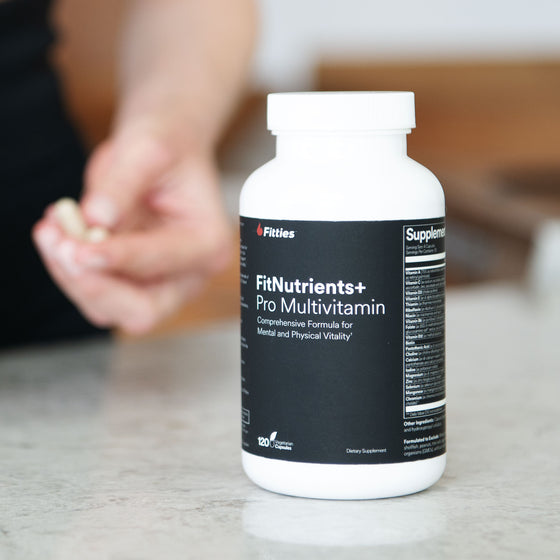
FitNutrients+ is a daily multivitamin and mineral formula with 100 mg of theacrine, as TeaCrine, in every four-capsule serving. Every ingredient on its Supplement Facts panel is listed with its exact amount, with no proprietary blend. Take four vegetarian capsules daily, or as directed by your healthcare professional.
Shop FitNutrients+How is theacrine different from caffeine?

On paper they are near twins. Caffeine is 1,3,7-trimethylxanthine, and theacrine is 1,3,7,9-tetramethyluric acid (Cesareo et al., 2019). Three differences show up in the data, and one question is still open.
It lingers. In the eight-person study, which TeaCrine's distributor funded, theacrine's half-life was 16.5 to 26.1 hours depending on dose, against 6.2 hours for caffeine (He et al., 2017). An independent study of 12 volunteers found the same pattern in saliva after single doses, with about 21 hours for 50 mg of theacrine and about 5 hours for 25 mg of caffeine (Wildgrube et al., 2025). A half-life measures how fast a compound is cleared, not how long any effect lasts.
It peaks later. Theacrine reached its peak blood level at a median of 1.8 hours after either dose, compared with 0.8 hours for caffeine (He et al., 2017).
It may not build tolerance, at least by one measure. In the 8-week trial, also distributor-funded, pre-dose ratings of energy, focus, concentration, anxiety and mood stayed stable at 200 or 300 mg a day, which the authors read as no sign of the rapid tolerance they describe as typical of caffeine and other stimulants (Taylor et al., 2016). Repeated dosing in rats also produced neither tolerance nor sensitization in their movement response (Feduccia et al., 2012). Note what was measured, though. The baseline before each dose, not the lift after it.
The open question is how it works. Caffeine keeps you awake by blocking adenosine binding (Gardiner et al., 2024). In rats, theacrine blunted the slowdown caused by drugs that activate adenosine receptors, which suggests it blocks them too, and its effect on movement depended partly on dopamine receptors (Feduccia et al., 2012). In people, the 2024 trial team calls the mechanism unclear.
| Measure | Theacrine | Caffeine |
|---|---|---|
| Chemical name | 1,3,7,9-tetramethyluric acid | 1,3,7-trimethylxanthine |
| Average half-life (8 adults) | 16.5 hours at 25 mg; 26.1 hours at 125 mg | 6.2 hours at 150 mg |
| Median time to peak blood level | 1.8 hours | 0.8 hours |
| When taken together | Caffeine raised its peak level and total exposure | Unchanged by theacrine |
Theacrine benefits: what do the human trials show?
Less than the marketing implies. The trials are small, several were funded by TeaCrine's distributor, and they often disagree.
Energy and focus
In a double-blind crossover trial, 15 healthy adults reported more energy, less fatigue and better concentration in the 3 hours after a single 200 mg dose than after placebo (Ziegenfuss et al., 2017).
Later trials did not reproduce that lift. At 300 mg, 12 resistance-trained men reported no significant rise in energy, focus or motivation, while 300 mg of caffeine raised all three (Cesareo et al., 2019). At 3, 6 or 9 mg per kilogram of body weight, 19 habitual caffeine users showed no significant change in energy ratings, heart rate, blood pressure or cognition, though salivary cortisol, a stress marker, was higher than with placebo (Stoke et al., 2026). In a 2024 trial, ratings of alertness, fatigue and anxiousness were largely unaffected at 100 or 400 mg (Gardiner et al., 2024).
Tally it up. One small positive trial and three that found little. Theacrine's reputation for energy runs ahead of its data.
Training and performance
Three trials put theacrine and caffeine head to head at equal doses. In 12 resistance-trained men, neither 300 mg of theacrine nor 300 mg of caffeine improved strength, power or endurance (Cesareo et al., 2019). In 24 high-level soccer players, 275 mg of caffeine sped up choice reaction time, while 275 mg of theacrine gave no cognitive benefit and only a non-significant trend toward longer time to exhaustion (Bello et al., 2019). In 20 highly trained canoe sprinters, 200 mg of caffeine improved 500-meter time trial performance, while 200 mg of theacrine alone did not reach significance (Jovanov et al., 2025). Every significant win over placebo in those trials came from caffeine or a caffeine combination. TeaCrine's distributor funded the resistance and soccer trials; a government ministry funded the canoe trial.
Trials without a caffeine arm agree. A single 200 mg dose taken 60 minutes before testing made no difference to jump, agility, sprint or running tests in 22 amateur flag-football players split between theacrine and placebo (Cerqueira et al., 2022). In 19 cyclists, 3 or 6 mg per kilogram did not improve 4 km time trial performance (Vieira-Cavalcante et al., 2025). On its own, theacrine has not yet earned a place as a training aid.
Sleep
In a randomized, double-blind crossover trial with no external funding, 22 healthy young men took 100 mg, 400 mg or placebo 12, 8 or 4 hours before bed (Gardiner et al., 2024). Neither dose significantly changed objectively measured sleep compared with placebo, though 400 mg showed small, non-significant effects on sleep efficiency and time awake after falling asleep that the authors say need further study. Taken within 8 hours of bedtime, 400 mg also reduced lapses on a vigilance test the next morning, with no significant change in reaction time.
Can you take theacrine with caffeine?
Theacrine is frequently taken with caffeine, and the pairing changes the chemistry. In the pharmacokinetic study, adding 150 mg of caffeine to 125 mg of theacrine raised theacrine's peak blood level and total exposure without changing its half-life, while heart rate and blood pressure did not differ between conditions (He et al., 2017).
The more encouraging performance data come from combinations. In 20 ROTC cadets and military or law enforcement officers, both 150 mg of caffeine plus 150 mg of theacrine and 300 mg of caffeine improved several cognitive tests versus placebo, even after hard interval exercise, and the combination beat caffeine alone on speed and consistency in one working-memory task (Lints et al., 2025). That trial was co-funded by the U.S. Department of Defense and a supplement company, with study products from TeaCrine's distributor.
The catch is that caffeine adds up. For most adults, the U.S. Food and Drug Administration cites 400 mg of caffeine a day as an amount not generally associated with negative effects, and it notes that sensitivity varies widely. If you stack theacrine with coffee or a pre-workout, count every caffeine source, and talk to your healthcare provider first if you take medication, are pregnant or nursing, or know you are sensitive to stimulants. For the caffeine side of the stack, see how caffeine pairs with creatine, how much caffeine is in pre-workout and coffee before a workout.
Is theacrine safe, and who should avoid it?
In healthy young adults over the short term, the safety data look clean. Over 8 weeks at 200 or 300 mg a day, heart rate, blood pressure and blood markers, including liver and kidney function, stayed within normal limits (Taylor et al., 2016). A single 200 mg dose did not change resting heart rate or hemodynamic measures in one trial (Ziegenfuss et al., 2017), or heart rate and blood pressure in canoe sprinters (Jovanov et al., 2025). One caveat is that in the small open-label arm of the 2017 study, anxiety ratings rose over a week at 200 mg a day, though not at 400 mg.
Not every trial was so quiet. Cyclists taking 3 or 6 mg per kilogram, roughly 215 or 430 mg for the average participant, reported side effects including gastrointestinal discomfort, a sense of a racing heart, dizziness, headache and hand tremor, and the higher dose raised resting blood pressure (Vieira-Cavalcante et al., 2025). In a distributor-funded 90-day rat study, 180 mg per kilogram a day showed no relevant toxicity, while higher doses were linked to liver damage, three deaths and reduced sperm production (Clewell et al., 2016).
The longest human trial here ran 8 weeks, most participants were healthy young adults, and the 8-week trial excluded anyone pregnant or nursing (Taylor et al., 2016). Talk to your healthcare provider before using theacrine if you are pregnant or nursing, take any medication, have a medical condition, or are sensitive to stimulants. Tested athletes should also check with their anti-doping authority. A 2025 review co-written by Polish Anti-Doping Agency scientists listed theacrine's anti-doping status as unclear (Pokrywka et al., 2025).
The FitNutrients+ label carries this caution. "Consult your healthcare professional before use. Individuals taking medication should discuss potential interactions with their healthcare professional. Do not use if tamper seal is damaged."
How much theacrine do studies use, and when?
Human studies have used single doses from 25 mg to 400 mg, plus body-weight doses of 3 to 9 mg per kilogram (He et al., 2017; Gardiner et al., 2024; Stoke et al., 2026). The longest trial gave 200 or 300 mg once a day, between breakfast and lunch, for 8 weeks (Taylor et al., 2016). Performance trials typically dosed 30 to 90 minutes before testing (Bello et al., 2019; Cesareo et al., 2019), and in the sleep trial even a dose 4 hours before bed did not significantly change measured sleep. These are research doses, not recommendations; ask your healthcare provider what fits you.
How does Fitties use theacrine?

FitNutrients+ is a daily multivitamin and mineral formula, and theacrine is one ingredient in it. Each serving of four vegetarian capsules contains 100 mg of theacrine as TeaCrine, alongside the vitamins, minerals and other ingredients listed on the Supplement Facts panel. The label directions are four capsules daily, or as directed by your healthcare professional, and each bottle holds 120 capsules, or 30 servings.
Now the context no label can give you. That 100 mg is lower than the doses used in most of the trials above, so none of those results describe what this formula does, and we do not claim they do. What we do offer is transparency. The exact amount is printed on the label, not buried in a proprietary blend where nobody can check it. The full Supplement Facts panel and directions are on the FitNutrients+ product page.
Theacrine has a small, mixed research record, which is exactly why the dose belongs on the label. For more ingredient deep dives, browse all Fitties ingredient spotlights.
FitNutrients+
FitNutrients+ is a daily multivitamin and mineral formula with 100 mg of theacrine, as TeaCrine, in every four-capsule serving. Every ingredient on its Supplement Facts panel is listed with its exact amount, with no proprietary blend. Take four vegetarian capsules daily, or as directed by your healthcare professional.
Shop FitNutrients+