The Fitties Journal
Coffee Before a Workout: Is It a Good Pre-Workout?
Key Takeaways
Here's what matters most if you're short on time.
- Caffeine has been shown to improve exercise performance in many, but not all, studies, according to the International Society of Sports Nutrition, and coffee is a legitimate source of it.
- The research-backed dose is 3 to 6 mg of caffeine per kilogram of body weight, according to the International Society of Sports Nutrition.
- A 12-ounce coffee ranges from about 113 to 247 mg of caffeine, so the dose is hard to dial in.
- Caffeine peaks 30 to 120 minutes after you drink it, and 60 minutes before training is the timing most commonly used in studies, according to the International Society of Sports Nutrition.
- Keep total caffeine under 400 mg a day; pregnant people should stay under 200 mg.
Yes, coffee before a workout works, and it is not a bro-science myth. The reason is caffeine, which has been shown to improve several aspects of exercise performance in many, though not all, studies. The research-backed dose is 3 to 6 milligrams of caffeine per kilogram of body weight, and the most commonly used timing is 60 minutes before you train, according to the International Society of Sports Nutrition's position stand on caffeine. A cup of coffee delivers that caffeine, which is why it earns its spot in your pre-gym routine.
Here is the catch the coffee blogs skip. A plain coffee is caffeine and nothing else, and the dose swings wildly from one cup to the next. That is fine for a wake-up. Whether it is enough for your training is a different question, and the honest answer is that it depends on what you want out of the next hour.
Is coffee a good pre-workout?
For caffeine, yes. Coffee is a legitimate, cheap, effective source of the one ingredient that carries most commercial pre-workouts anyway. The position stand found caffeine improves muscular endurance, strength, power, sprinting, and jumping, with the most consistent moderate-to-large benefits showing up in aerobic endurance. It also lowers how hard a session feels, so you can push a little longer before your brain taps out.
What coffee is not is a complete training drink. It has no electrolytes to replace what you sweat out, no creatine, and none of the other actives that a formula is built around. It is the caffeine, full stop. So coffee is a good pre-workout the way a plain barbell is good equipment. It does the main job well and leaves the rest to you. If caffeine is all you were after, a cup of coffee is a perfectly smart choice.
FitBoost+
A cup of coffee gives you caffeine and a rough guess at the dose. FitBoost+ lists 95 mg of caffeine per scoop, plus 3 g of creatine monohydrate, 400 mg of Peak ATP, and the electrolytes sodium, potassium, and magnesium, with zero sugar. It is built for the 30 minutes before you train.
Shop FitBoost+How much coffee should you drink before a workout?
Aim for 3 to 6 milligrams of caffeine per kilogram of body weight, per the ISSN position stand. The minimum effective dose can be as low as 2 mg/kg, and very high doses around 9 mg/kg mostly buy you jitters and a racing heart, not extra performance. Start at the low end, especially if you are not a daily caffeine drinker, and see how you respond.
Here is what that range looks like by body weight. Numbers are rounded.
| Body weight | Low end (3 mg/kg) | High end (6 mg/kg) |
|---|---|---|
| 130 lb (59 kg) | about 175 mg | about 355 mg |
| 155 lb (70 kg) | about 210 mg | about 420 mg |
| 185 lb (84 kg) | about 250 mg | about 505 mg |
| 210 lb (95 kg) | about 285 mg | about 570 mg |
In cups, that target is wide. The FDA puts a 12 oz cup of regular brewed coffee at 113 to 247 mg, so the low end for a 155 lb adult, about 210 mg, could take anything from just under one cup to nearly two.
Two guardrails. First, the FDA puts 400 mg a day as the ceiling not generally tied to negative effects for healthy adults, so the high end of that table can eat most of your daily budget in one serving. Second, that budget includes every other coffee, tea, and soda you drink. The pre-workout dose is not a free number, it comes out of the same 400.
When should you drink coffee before a workout?

Drink it 45 to 60 minutes before you train. Caffeine hits peak levels in your blood anywhere from 30 to 120 minutes after you drink it, according to the ISSN position stand, so that window lines the peak up with your working sets rather than your warm-up or your drive home. If you are doing a short session, 30 to 45 minutes is fine. If you like to sip it slowly, start earlier.
Timing matters on the back end too. Caffeine has a half-life of roughly 4 to 6 hours, which means half of it is still in your system that long after the last sip, and for some people it runs longer. Train in the evening and a pre-workout coffee can quietly wreck the sleep that your training actually depends on. If your session is after about 4 or 5 p.m., that is the moment to think hard about decaf, a smaller dose, or a caffeine-free option. For a deeper look at how long a stimulant dose really lingers, see our guide on how long pre-workout and caffeine last.
Coffee vs pre-workout: which is better?
Neither is universally better, they solve different problems. Coffee is the minimalist option. Caffeine, cheap, no frills. A formulated pre-workout or energy mix is the complete-package option, with a known caffeine dose plus the other ingredients a hard session runs on, like electrolytes and, in some formulas, creatine. The right pick depends on whether you want just the stimulant or the whole toolkit. Here is the honest side-by-side.
| What matters | Black coffee | Formulated pre-workout mix |
|---|---|---|
| Caffeine dose | Variable, about 113 to 247 mg per 12 oz | Fixed and printed on the label |
| Electrolytes | None | Often included |
| Creatine or Peak ATP® | None | In some formulas |
| Sugar | Zero if you drink it black | Zero to a lot, read the label |
| Cost per serving | Lowest | Higher |
| Convenience | Needs brewing or a cafe stop | Scoop into water, done |
The single biggest weakness of coffee is dose control. The FDA puts regular brewed non-specialty coffee at 113 to 247 milligrams of caffeine per 12 fluid ounces, a more than twofold spread. Beans, roast and brew method all move the number. You cannot reliably hit 3 to 6 mg/kg when your source ranges that much. A formula prints the number on the tub, so you at least know the dose you are aiming for. And where a plain coffee stops at caffeine, a formula can carry the electrolytes you sweat out and, in some cases, the actives that a stimulant alone does not provide.
The average formula also carries more caffeine than a typical cup. The 100 top-selling pre-workouts averaged 254 mg per serving on the label (Jagim et al., 2019), above the top of the FDA's range for a 12 oz coffee. For the full numbers, see how much caffeine is in pre-workout and when it is too much.
FitBoost+ is our version of the complete-package route. One scoop lists 95 mg of caffeine from a blend that includes a caffeine and pterostilbene co-crystal, plus 3 g of creatine monohydrate, 400 mg of Peak ATP, and real electrolytes including sodium, potassium, and magnesium, with 5 g of carbs and zero sugar. It is built to be mixed with water and taken about 30 minutes before you train. Coffee gives you caffeine and a rough guess. This gives you the number and the rest of the kit. If a simpler caffeine source is more your speed, that is a fair call too, just skip the sugar bombs (see below).
Does coffee before a workout have downsides?

A few, and they are all manageable. On an empty stomach, coffee gives some people stomach cramps or the need for an urgent bathroom trip mid-session. A small snack, a splash of milk, or protein powder in your coffee usually settles it, and our breakdown of what to eat before a workout covers how far out to time that snack. Too much caffeine brings jitters, a pounding heart, and anxiety that can sabotage a lift instead of sharpening it, which is why the low end of the dose range is the smart place to start.
The biggest own-goal is the drink itself. A large caramel-syrup coffee-shop creation is not a pre-workout, it is a dessert with a caffeine chaser, and the sugar crash can hit right in the middle of your session. Keep it black, or close to it. And mind the clock, because the sleep hit from late caffeine is real and it works directly against recovery.
A couple of people should be more careful. If you are pregnant, ACOG reports that research suggests caffeine under 200 mg a day does not cause miscarriage or preterm birth, which changes the math above. If you take medication, have a heart rhythm issue, or are simply caffeine-sensitive, talk to your healthcare provider before making a stimulant part of your routine. Caffeine is a tool, not a free lunch, and it rewards people who respect the dose.
FitBoost+
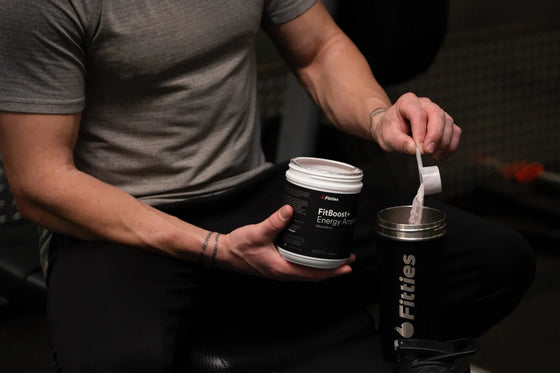
A cup of coffee gives you caffeine and a rough guess at the dose. FitBoost+ lists 95 mg of caffeine per scoop, plus 3 g of creatine monohydrate, 400 mg of Peak ATP, and the electrolytes sodium, potassium, and magnesium, with zero sugar. It is built for the 30 minutes before you train.
Shop FitBoost+