The Fitties Journal
Protein Powder in Coffee: Does Heat Ruin It, and 5 Steps to Zero Clumps
Key Takeaways
Here's what matters most if you're short on time.
- Hot coffee denatures whey protein, which changes its texture and solubility, not the amino acids it is made of.
- Curdling is a pH problem. Brewed coffee sits inside the pH range where whey proteins aggregate and drop out of solution.
- Stirring the powder into a small amount of cold liquid first, then adding the coffee, stops most clumping.
- On measured pH, cold brew is not meaningfully less acidic than hot brew. It is just cooler.
- Collagen peptides dissolve most easily in coffee but have a different amino acid profile than whey or a pea and rice blend.
No, hot coffee does not destroy the protein in your protein powder. Heat unfolds protein, a process called denaturation, and denaturation is not destruction. The amino acids stay intact, and unfolding is something your digestion does on its own anyway. What hot coffee actively causes is curdling, and that turns out to be a pH problem more than a heat problem. Brewed coffee sits at a pH of roughly 4.85 to 5.10, which lands inside the narrow band where whey proteins clump together and fall out of solution. Change the order you combine them in and the clumping mostly stops.
Does hot coffee destroy the protein in your powder?
No. Denaturing a protein means unfolding its three-dimensional shape. The peptide bonds and the amino acids that make up the protein are still there. Cooking an egg denatures its protein and nobody argues a fried egg has stopped being protein.
Whey has a measurable point where this starts. Beta-lactoglobulin, the dominant protein in whey, undergoes its main structural change near 80 C, about 176 F, according to calorimetry work published in the Journal of Dairy Science. Coffee brewed with water off the boil clears that easily. So yes, your whey is denatured. That is a texture and solubility event, not a nutrition event.
Here is the part the "raw, cold-processed, undenatured" marketing crowd would rather you skipped. Your stomach denatures dietary protein regardless. Hydrochloric acid in gastric juice denatures dietary proteins, partially unfolding them so digestive enzymes can reach their peptide bonds, according to a review in Advances in Physiology Education, and pepsin, the enzyme that starts breaking those chains apart, works best at a pH of approximately 1.5 to 2. Unfolding the protein is step one of digestion. Your coffee just got there first.
FitWhey+
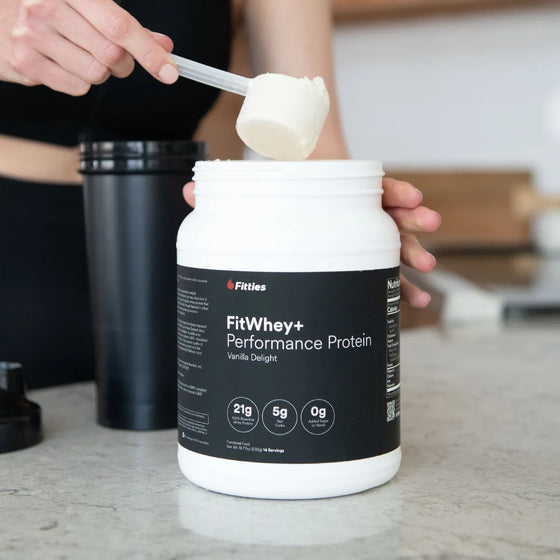
FitWhey+ is New Zealand grass-fed whey protein concentrate, 21 g per serving, sweetened with monk fruit extract. No added sugar, no stevia, no artificial sweeteners or colors, and it contains milk. The label directs mixing it in cold water, which is exactly the slurry step above.
Shop FitWhey+Why does protein powder curdle in coffee?

This is the real question, and almost nobody answers it correctly. The answer is the isoelectric point.
Every protein has a pH at which its net electrical charge is zero. At that point the molecules stop repelling each other and start sticking together. For whey, the US Dairy Export Council report puts that aggregation zone at a pH of 4.8 to 5.3, and notes that in that range "the potential for protein-protein interaction is at its highest point" and the protein "will precipitate out of solution readily."
Now look at coffee. A study published in Scientific Reports measured hot brew coffee at a pH of 4.85 to 5.10 and cold brew at 4.96 to 5.13. Your morning cup is sitting almost exactly in the middle of whey's clumping window.
Add heat on top of that and you compound it. Unfolded protein exposes sticky interior regions that were previously tucked away, those regions find each other, and you get grit at the bottom and a skin on top. The heat is not the cause. The heat is the accelerant.
| Measured pH | Range |
|---|---|
| Whey aggregation window | 4.8 to 5.3 |
| Hot brew coffee | 4.85 to 5.10 |
| Cold brew coffee | 4.96 to 5.13 |
Notice what that table quietly kills. Cold brew is widely sold as the low-acid option, but on those measurements its pH is not meaningfully lower than hot brew. It is cooler, which helps. It is not less acidic in a way that saves your protein from clumping.
How do you mix protein powder into coffee without clumps?
The fix is not a better powder. It is a better order of operations. Five steps, and step two does most of the work.
- Let the coffee cool for a few minutes. Not to lukewarm. Just off the peak. You are trying to get below the temperature that flash-denatures whey the instant it lands.
- Make a slurry first. Put the powder in the empty cup with two or three tablespoons of cold water or milk and stir it into a smooth paste before any coffee goes near it. Hydrating the powder in cold liquid is the single highest-leverage move here.
- Pour the coffee into the slurry. Not powder into coffee. Adding hot liquid gradually to an already-dispersed paste beats dumping dry powder onto a hot surface every time.
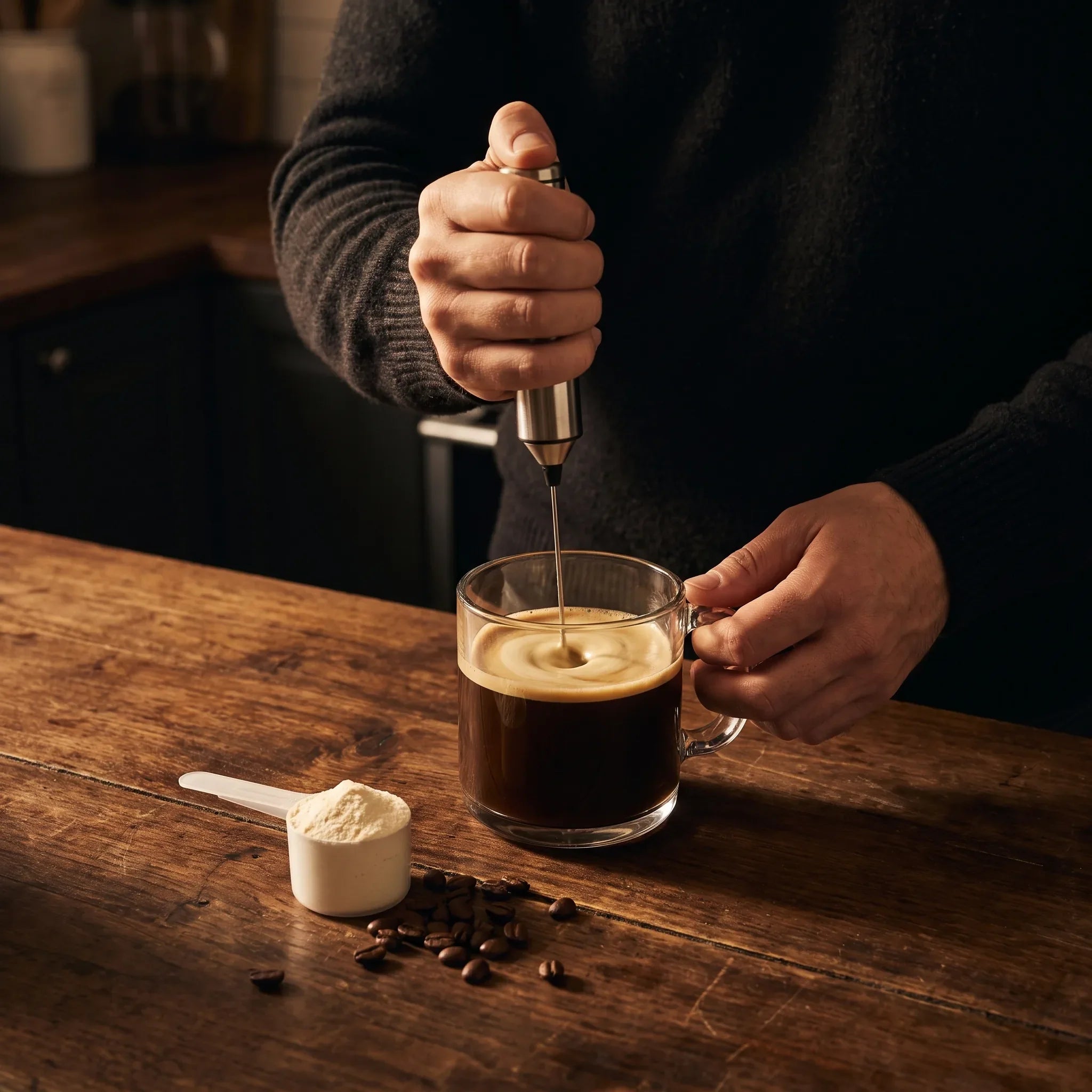
- Use motion, not a spoon. A handheld frother, a shaker with a wire ball, or five seconds in a blender. A spoon in a mug does not generate enough shear to break up what has already seized.
- Finish with milk or cream if you take it. A cold splash drops the cup temperature on contact, which is exactly what you want.
Do those five and hot coffee stops being the enemy. Skip step two and no powder on the market will save you.
Which protein powder mixes best in coffee?
Collagen peptides, if mixability is the only thing you are grading on. They do not all behave the same in a hot cup, and the differences are structural rather than a matter of quality.
| Protein type | Behavior in hot coffee | Best move |
|---|---|---|
| Whey concentrate | Most likely to clump or form a skin | Slurry it, cool the cup first |
| Whey isolate | Thinner mix, still seizes if dumped in hot | Slurry it, frother finish |
| Plant (pea and rice) | Grittier by nature, less prone to curdling | Blender or frother, no exceptions |
| Collagen peptides | Already hydrolyzed, dissolves clear | Stir in directly |
Collagen is the easiest thing in the world to stir into coffee, which is why it dominates the "add protein to your latte" conversation. It also has a different amino acid profile from whey or a pea and rice blend, so treat it as a different tool rather than a straight swap. If you are choosing between the other two, our breakdown of whey versus plant protein covers what actually separates them.
How much caffeine and protein are you actually getting?

Worth doing the arithmetic before this becomes a three-cups-a-day habit stacked on top of a pre-workout.
The FDA puts regular brewed coffee at 113 to 247 milligrams of caffeine per 12 fluid ounce serving, and cites 400 milligrams a day, roughly two to three 12 ounce cups, as an amount not generally associated with negative effects in healthy adults. If your protein coffee is also your second coffee, and there is caffeine in your pre-workout, that number arrives faster than people expect. Our guide to coffee before a workout goes further into the timing side of that.
On the protein side, read your own label instead of guessing. A two-scoop, 38 gram serving of FitWhey+ Vanilla provides 21 grams of protein and 130 calories, with 11 grams of total carbohydrate including 6 grams of fiber, 0 grams of added sugar, and monk fruit extract doing the sweetening. It contains milk. Its directions call for mixing two scoops in cold water, which is the same slurry logic as step two above, printed on the tub.
Two label notes are worth respecting rather than writing around. Very low calorie protein diets below 400 calories per day may cause serious illness or death and should not be used for weight reduction without medical supervision, and this product is not intended for infants, children, or pregnant or nursing women.
Is protein coffee worth it?
Honestly, it depends on what it is replacing. If you were going to drink the coffee and have the protein anyway, combining them saves you a cup to wash and gets both into you before you leave the house. That is a real convenience win and no small thing on a busy morning. Our take on the protein shake for breakfast question covers where this fits in a morning that is otherwise skipped.
If you are using it to replace a proper meal every day, that is a different conversation and one worth having with a professional who knows your situation.
And if you are shopping the ready-to-drink protein coffee aisle instead of mixing your own, turn the can around and read the panel for grams of protein per serving, grams of added sugar, and what is doing the sweetening. That single habit sorts a crowded category faster than any review will. The industry has spent years betting that nobody reads the back.
If you take medication, are pregnant or nursing, or manage a health condition, talk to your healthcare provider before adding caffeine or a new supplement to your routine.
FitWhey+
FitWhey+ is New Zealand grass-fed whey protein concentrate, 21 g per serving, sweetened with monk fruit extract. No added sugar, no stevia, no artificial sweeteners or colors, and it contains milk. The label directs mixing it in cold water, which is exactly the slurry step above.
Shop FitWhey+