The Fitties Journal
Protein Shake for Breakfast: 5 Rules to Make It a Real Meal
Key Takeaways
Here's what matters most if you're short on time.
- A scoop of protein powder in water is a protein dose, not a breakfast.
- The International Society of Sports Nutrition puts an effective protein dose at 20 to 40 grams, or about 0.25 grams per kilogram of body weight.
- Fiber and fat are what turn a shake into a meal, and most protein powders supply almost none of either.
- The FDA sets the fiber Daily Value at 28 grams and calls a serving high in fiber at 20 percent of that, which is 5.6 grams.
- No published study has tested the viral 30-30-30 rule, though its 30 gram target sits inside the 20 to 40 gram dose range the ISSN describes.
- Read the Added Sugars line on the panel before you read the protein number.
Yes, a protein shake is a legitimate breakfast. One scoop shaken into water is not. That is a protein supplement wearing a meal's job title, and mistaking the two is the reason the habit tends to get abandoned by week two.
A breakfast shake has to clear three bars. It needs 20 to 40 grams of protein, which is the per-serving dose range the International Society of Sports Nutrition sets out in its 2017 position stand on protein and exercise. It needs real fiber. And it needs a fat source, so the whole thing digests like food instead of flavored water. Miss those and you have a snack with excellent marketing.
Is a protein shake a good breakfast?
It is, as long as you judge it on what is in the glass rather than the fact that it is a glass, and the same test applies to a mug if protein powder in coffee is how your morning actually runs. Your body does not award bonus points for chewing. It responds to protein, fiber, fat, and total calories, and a blender can deliver all four.
The problem is that the default shake delivers one of them. A two-scoop serving of whey in water is built to be a protein dose and nothing else. FitWhey+ Vanilla, for example, lists 130 calories, 21 g of protein and 6 g of fiber per serving on its Nutrition Facts panel (Chocolate has 170 calories and 3 g of fiber). As a post-training top-up, that is exactly right. As the first meal of a nine-hour workday, it is a rounding error.
The supplement industry has been happy to blur that line for years, because "meal replacement" sells better than "protein supplement" and costs the same to make. The tell is always the panel rather than the front of the pack. Turn the tub around and compare the protein number against the Added Sugars line before you accept that anything is a meal.
Built properly, though, a shake is a genuinely good breakfast, and for a specific kind of person it is the best one available. People who are not hungry early, people who are out the door in ten minutes, and people who otherwise skip breakfast entirely and arrive at lunch ready to eat anything not nailed down.
FitWhey+
Two scoops give you 21 g of 100% New Zealand grass-fed whey protein and 3 to 6 g of fiber depending on flavor, mostly chicory inulin, which is not standard on a protein panel. Sweetened with monk fruit. No added sugar, no stevia, no artificial sweeteners. Contains milk.
Shop FitWhey+How much protein should a breakfast shake have?

Start at 20 to 40 grams. The ISSN position stand puts an effective protein dose at 20 to 40 grams, or about 0.25 grams per kilogram of body weight per serving, containing 700 to 3,000 mg of leucine, with doses spread every 3 to 4 hours across the day. For a 170-pound person, 0.25 g/kg works out to roughly 19 grams, so the absolute range is the more useful target.
That last part, the spreading, is the reason breakfast matters more than most people think. Plenty of otherwise well-fed days are protein-backloaded, with a token breakfast, a modest lunch, and most of the day's protein at dinner. Putting 25 to 30 grams into the morning costs nothing and moves the day closer to the even distribution the position stand describes.
Note what the daily numbers actually are, because they get quoted badly. The RDA is 0.8 grams per kilogram of body weight, which works out to 56 grams a day for adult men and 46 for adult women. That is the floor for avoiding deficiency, not the target for building anything. The ISSN puts the range for people who train at 1.4 to 2.0 grams per kilogram per day. If you want the full breakdown, our guide to how much protein you actually need runs the math by body weight and goal.
What about the 30-30-30 rule?
You have probably seen it. 30 grams of protein within 30 minutes of waking, then 30 minutes of low-intensity exercise. It is a tidy heuristic and a terrible law. We could not find a published study that tests the plan itself. A PubMed search for it turns up nothing relevant. The protein piece does have some support, though. A meta-analysis found that higher-protein preloads raised fullness ratings more than lower-protein ones, under tightly controlled conditions (Dhillon et al., 2016).
Which is the honest read. The 30 gram number is inside the ISSN range, so it is a fine place to aim. The stopwatch is theater.
The 5 rules for a breakfast shake that eats like a meal
These are in priority order. Get the first two right and you have already beaten most of what is sold as a breakfast shake.
Rule 1: Aim at the top half of that range
The ISSN range is 20 to 40 grams, and for a meal you want to hold, start at 25 rather than at the floor. Most single scoops land between 20 and 25 grams, which is why the serving size on the back of the tub is often two. Read the panel, do not trust the front. If your powder gives you 21 grams per serving, the milk, oats and nut butter you are about to add will carry you into the high twenties without trying.
Rule 2: Get 5 to 10 grams of fiber in there
This is the rule almost nobody follows, and it is the one that separates a meal from a snack. The FDA sets the Daily Value for fiber at 28 grams and classifies a serving as high in fiber at 20% of the Daily Value or more, which is 5.6 grams. Most protein powders contribute zero. Rolled oats, chia, ground flax, frozen berries and a scoop of powder that actually contains fiber all close the gap.
Rule 3: Add a real fat source
A tablespoon of nut butter, a quarter of an avocado, or a spoonful of ground flax. This is the unglamorous mechanism behind "this one actually held me." A review in Proceedings of the Nutrition Society notes that a single high-fat meal has a longer gastric emptying time than a low-fat one. It costs about 95 calories, which is a fair price for the shake behaving like breakfast rather than a beverage.
Rule 4: Check what is sweetening it before you check the protein
Flip the tub over and read the Added Sugars line before you read the protein number. Ready-to-drink breakfast shakes in particular are where sugar hides behind a wellness font, and the ingredient list settles the argument the front of the pack is trying to win. Monk fruit, allulose and plain unsweetened sit at the clean end of the shelf; cane sugar, "organic cane juice" and maltodextrin high in the list are the tell. Our 6-point label check walks the whole panel.
Rule 5: Do not make it every breakfast
A shake is a tool, not a religion. Whole food gives you a wider micronutrient range, more chewing, and more volume per calorie than anything you can blend. Running shakes four or five mornings a week and eating real food the rest is a sane pattern. Running them seven days a week for a year is a narrowing diet, and you will feel it before a blood panel does.
What a real breakfast shake looks like
Here is a build that clears every rule above. The protein row uses FitWhey+ Vanilla, which lists 21 g of protein and 6 g of fiber per two-scoop serving on its Nutrition Facts panel, so the fiber math starts ahead rather than at zero. Whole-food values are rounded from USDA FoodData Central.
| Component | Example | Protein | Fiber | Calories |
|---|---|---|---|---|
| Liquid base | 1 cup unsweetened almond milk | 1 g | 1 g | 40 |
| Protein | 2 scoops FitWhey+ (38 g) | 21 g | 6 g | 130 |
| Fiber | 1/3 cup rolled oats | 3 g | 3 g | 100 |
| Fat | 1 tbsp natural peanut butter | 4 g | 1 g | 95 |
| Fruit | 1/2 cup frozen blueberries | 0 g | 2 g | 40 |
| Total | One breakfast | 29 g | 13 g | 405 |
Twenty-nine grams of protein and 13 grams of fiber, which is 46% of the FDA's 28 gram Daily Value for fiber before you have eaten anything else. Those totals use Vanilla FitWhey+; Chocolate lists 3 g of fiber per serving, so the same build comes to 10 grams. Compare that to a scoop in water and it is a different meal entirely, for about 275 extra calories and 90 extra seconds.
Protein shake or a breakfast you chew?

Neither one wins outright, which is why the internet argues about it forever. They are good at different things, and the right answer is usually "both, on different mornings."
The shake wins on speed, portability, and appetite. If you are not hungry at 6:30 a.m., drinking 400 calories is easy and eating them is not. It also wins on precision. You know exactly what went in, because you put it there.
The plate wins on micronutrient breadth. Whole eggs carry choline, selenium and vitamin D, per USDA FoodData Central, none of which a protein powder is obliged to include. Chewing also takes longer, and a stomach full of actual food registers differently than the same calories drunk in ninety seconds.
Here is the honest comparison, using the shake above against a standard eggs-and-oatmeal plate. Whole-food values are rounded from USDA FoodData Central.
| Built breakfast shake | 3 eggs + 1/2 cup oats | |
|---|---|---|
| Protein | 29 g | 24 g |
| Fiber | 13 g | 4 g |
| Calories | 405 | 365 |
| Time to make | About 3 minutes | 10 to 15 minutes |
| Portable | Yes | No |
| Micronutrient range | Narrow, from what you add | Wider |
Who should skip the breakfast shake
Not everyone should default to this, and a few people should not do it at all without talking to someone qualified first.
- Anyone using shakes to run a very low calorie diet. The FitWhey+ label carries an explicit warning that very low calorie protein diets (below 400 calories per day) may cause serious illness or death, and that it should not be used for weight reduction in such diets without medical supervision.
- Infants, children, and anyone pregnant or nursing. The same label states the product is not intended for them. This is a keep-out, not a caution.
- Anyone with a milk allergy. Whey is a dairy protein. FitWhey+ declares milk as an allergen on its label, and a plant blend such as pea and rice protein is the swap.
- Anyone on medication or managing a health condition. Talk to your healthcare provider before you change what your first meal of the day looks like, particularly if your morning routine is timed around medication.
Beyond that, the ordinary caveat applies. If your day already contains plenty of protein and you eat a decent breakfast, a shake is a convenience, not an upgrade.
How to build one in three minutes
- Liquid first. 8 to 12 oz of water, dairy milk, or unsweetened plant milk into the blender or shaker. Liquid before powder is what stops the clumping.
- Protein next. A full serving, not half. Check the panel for what a serving actually is.
- Fiber. A third of a cup of rolled oats, or a tablespoon of chia or ground flax.
- Fat. A tablespoon of nut butter, or a quarter avocado if you want it thicker and less sweet.
- Fruit and ice. Half a cup of frozen berries or half a banana. Frozen fruit doubles as the ice.
- Blend 30 seconds. A shaker works for steps 1 and 2 only; oats and nut butter need a blender.
Make it the night before if your mornings are genuinely tight. It will thicken in the fridge, so hold back a splash of liquid to loosen it. And if you are wondering whether the same shake is better before or after training rather than at breakfast, that is a separate question with a clearer answer.
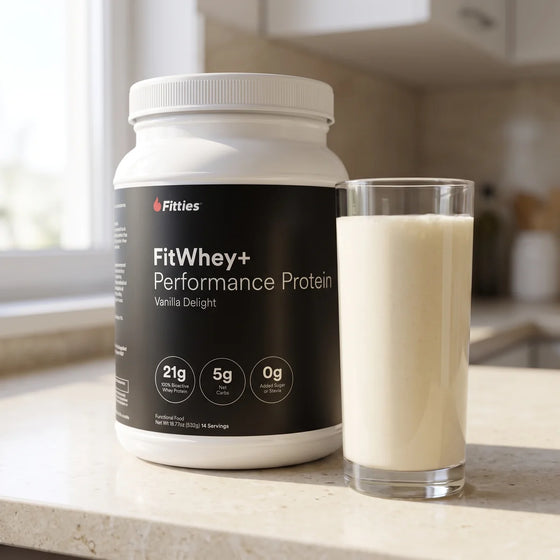
FitWhey+
Two scoops give you 21 g of 100% New Zealand grass-fed whey protein and 3 to 6 g of fiber depending on flavor, mostly chicory inulin, which is not standard on a protein panel. Sweetened with monk fruit. No added sugar, no stevia, no artificial sweeteners. Contains milk.
Shop FitWhey+