The Fitties Journal
Protein Powder Without Artificial Sweeteners: The 6-Point Label Check
Key Takeaways
Here's what matters most if you're short on time.
- The FDA has approved six high-intensity sweeteners as food additives. They are aspartame, acesulfame potassium, sucralose, neotame, advantame, and saccharin.
- No artificial sweeteners is a marketing phrase, not a regulated one, and it does not tell you what replaced them.
- Steviol glycosides and monk fruit extract are GRAS rather than approved food additives, so a powder can carry the claim and still taste strongly of stevia.
- Sugar alcohols such as erythritol are a separate category and are not artificial sweeteners.
- FDA has not engaged in rulemaking to establish a formal definition for the term natural in food labeling, only a longstanding policy.
- Sweeteners are declared by name in the ingredient list, so natural flavors is not where one hides.
A protein powder without artificial sweeteners is one whose ingredient list contains none of the six high-intensity sweeteners the FDA has approved as food additives. They are aspartame, acesulfame potassium, sucralose, neotame, advantame, and saccharin. Everything else on the shelf is sweetened another way, usually with steviol glycosides from stevia, monk fruit extract, a sugar alcohol such as erythritol, or plain sugar.
Here is the part that never makes it onto the front of the tub. "No artificial sweeteners" is a marketing phrase, not a regulated one. It tells you what a formula left out. It tells you nothing about what went in. Two tubs can carry the identical claim and taste nothing alike, because one leans on stevia and the other on monk fruit.
So stop reading the front. The answer is on the back, and it takes about 60 seconds to find. Six checks, in order, on any tub you pick up.
What counts as an artificial sweetener?
There is an actual list, which is more than the supplement aisle usually admits. The FDA has approved six high-intensity sweeteners for use as food additives, and separately has not questioned the Generally Recognized As Safe (GRAS) conclusions for three plant-derived and protein-derived sweeteners. Those two groups are what the industry loosely calls "artificial" and "natural," and the line between them is regulatory, not chemical.
| Sweetener | FDA status | Usually labeled as |
|---|---|---|
| Sucralose | Approved food additive | Sucralose |
| Acesulfame potassium | Approved food additive | Ace-K, acesulfame K |
| Aspartame | Approved food additive | Aspartame |
| Saccharin | Approved food additive | Saccharin |
| Neotame | Approved food additive | Neotame |
| Advantame | Approved food additive | Advantame |
| Steviol glycosides | GRAS (high-purity only) | Stevia leaf extract, Reb A, Reb M |
| Monk fruit | GRAS | Monk fruit extract, luo han guo |
| Thaumatin | GRAS | Thaumatin |
One detail is worth knowing, because it separates a real stevia ingredient from a sloppy one. Only high-purity steviol glycosides carry that GRAS status. Whole-leaf stevia and crude stevia extracts are subject to an FDA Import Alert and are not permitted for use as sweeteners. If a label says "stevia leaf" and nothing more specific, that is a question worth asking the brand.
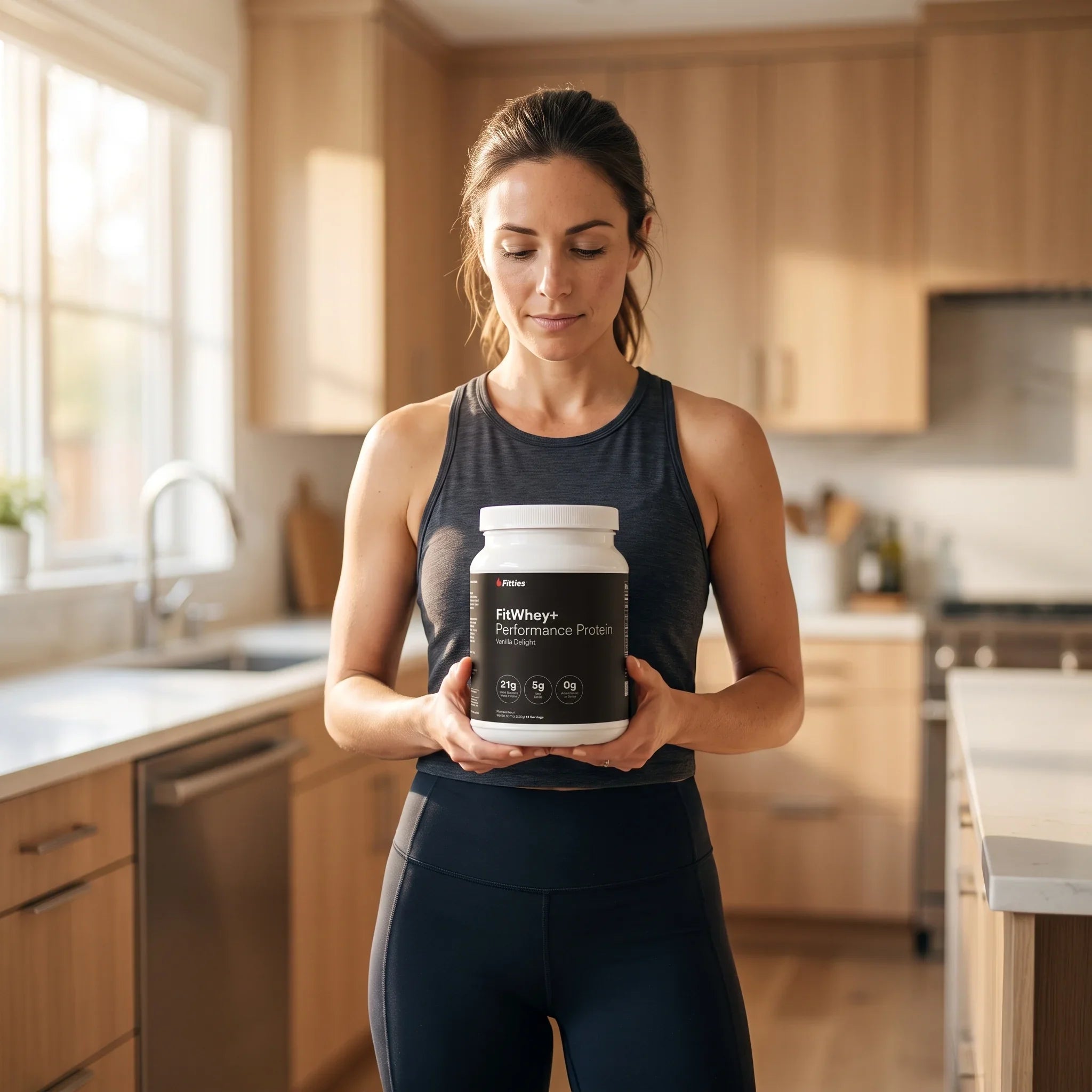
FitWhey+
Sweetened with monk fruit extract. No added sugar, no stevia, no artificial sweeteners, straight off the panel rather than off the marketing. 21 g of 100% New Zealand whey protein per serving, with 5 g net carbs in Vanilla and 10 g in Chocolate, and an ingredient list short enough to read in the aisle. Contains milk.
Shop FitWhey+Why does "no artificial sweeteners" almost always mean stevia?

Because the claim is a swap, not a subtraction. Pulling sucralose out of a formula does not make the powder less sweet, it just hands the job to a different ingredient. For most of the category the replacement is steviol glycosides, because stevia is cheap, stable, and, like everything in this class, many times sweeter than table sugar, so a very small amount flavors a whole tub.
The catch is that stevia has a distinct bitter, licorice-adjacent aftertaste that a meaningful share of people cannot stand. That is why "protein powder without artificial sweeteners or stevia" is one of the most common follow-up searches on this topic. People do the first filter, buy the tub, taste it, and realize the thing they were actually trying to avoid was never on the artificial list to begin with.
Monk fruit is the other common route. Its sweetness comes from mogrosides rather than steviol glycosides, and it carries a different flavor profile, which is the entire reason some formulators pay more for it. Both FitWhey+ and FitPlant+ are sweetened with monk fruit extract, and both labels state no sugar, no stevia, and no artificial sweeteners. That is a formulation choice, not a health claim, and it is the kind of thing you should be able to verify on any tub you buy in about ten seconds.
Are sugar alcohols artificial sweeteners?
No, and this is the gap most "clean label" roundups walk straight past. Sugar alcohols, or polyols, are their own category. A powder can be entirely free of the six approved high-intensity sweeteners, market itself hard on that fact, and still be carrying a few grams of erythritol per scoop.
Here are the ones you will actually see on a supplement panel.
- Erythritol, the most common in protein and greens powders
- Xylitol, more common in gums and chews
- Maltitol, common in protein bars rather than powders
- Sorbitol and mannitol, which carry their own labeling rules
Those last two are the clearest signal that regulators treat this category as distinct. Foods where reasonably foreseeable consumption may result in a daily intake of 50 grams of sorbitol must carry the statement "Excess consumption may have a laxative effect", and the same statement is required for mannitol at a daily intake of 20 grams or more. Those thresholds are far above what a scoop of protein delivers, but they tell you why some people find certain powders sit badly and others do not. If a formula disagrees with your gut, the sugar alcohol line is the first place to look, not the sweetener you were originally worried about.
Does "natural flavors" hide a sweetener?
This is the question that generates the most suspicion and has the most boring answer. No. Sweeteners have to be declared by name in the ingredient list. "Natural flavors" is a flavor ingredient, not a sweetener declaration, and it is not a place a manufacturer can quietly park sucralose.
What "natural" does not give you is any regulatory guarantee. The FDA states plainly that although it "has not engaged in rulemaking to establish a formal definition for the term 'natural'", it maintains a longstanding policy that the term means nothing artificial or synthetic has been included that would not normally be expected in that food. A policy is not a standard, and it says nothing about processing, sourcing, or dose. So treat "all natural" on the front of a tub as a mood, and the ingredient list as the fact.
The practical version is that if you cannot find a sweetener name in the ingredient list, you have not read far enough. It is in there, spelled out, usually near the end where the small-inclusion ingredients live.
What does the added sugars line tell you?

More than most people use it for. The Nutrition Facts or Supplement Facts panel separates Total Sugars from Added Sugars, and the relationship between those two numbers and how the powder actually tastes tells you what is doing the sweetening.
If a powder tastes sweet and shows 0 g of added sugars, a non-nutritive sweetener is carrying the flavor, and it is named in the ingredient list. If it shows several grams of added sugars, some of the sweetness is coming from sugar itself, which is a legitimate formulation choice but a very different product from what most people mean when they search for this.
A worked example, using the label rather than the marketing. The FitWhey+ Vanilla panel lists 21 g of protein, 130 calories, 11 g total carbohydrate, 6 g dietary fiber, 2 g total sugars and 0 g added sugars per two-scoop (38 g) serving, with monk fruit extract in the ingredient list and no stevia or artificial sweeteners on it. It contains milk. FitPlant+ runs the same play on a pea and rice base at 15 g of protein per serving and is formulated to exclude animal and dairy products. Two panels, two minutes, no guessing.
Worth noting from the FitWhey+ label itself is that very low calorie protein diets (below 400 calories per day) may cause serious illness or death, and it should not be used for weight reduction in such diets without medical supervision. It is not for use by infants, children, or pregnant or nursing women.
Is there a health reason to avoid artificial sweeteners?
Here is the straight answer, which is less dramatic than either side of the internet wants it to be.
The six approved high-intensity sweeteners went through FDA review and are approved for use in food. That is a real bar, and pretending otherwise is the kind of fearmongering the supplement industry runs on. At the same time, the World Health Organization released a guideline in 2023 that "recommends against the use of NSS to control body weight or reduce the risk of noncommunicable diseases". WHO classed that recommendation as conditional rather than absolute, noted the evidence may be confounded, and excluded people with pre-existing diabetes from its scope. The sweeteners named in it are acesulfame K, aspartame, advantame, cyclamates, neotame, saccharin, sucralose, stevia and stevia derivatives.
Two honest observations about that list. First, it includes stevia, which means the popular "natural sweetener" shortcut does not get you out of the conversation. Second, monk fruit is not among the common examples WHO names, but the recommendation covers all synthetic and naturally occurring non-sugar sweeteners, so leaving it off the list is neither an exemption nor an endorsement.
For most people, the real reason to skip artificial sweeteners is simpler and does not need a study behind it. Taste, gut comfort, or plain preference for a shorter ingredient list. Those are legitimate reasons on their own. You do not need to believe a sweetener is dangerous to decide you would rather not drink it twice a day. If you take medication, are pregnant or nursing, or manage an ongoing condition, talk to your healthcare provider before changing what you take.
How do you run the 6-point check in 60 seconds?
Pick up any tub and go in this order. It works on whey, plant, casein, and anything else in the aisle.
- Ignore the front panel entirely. Claims live there. Facts do not.
- Scan the ingredient list for the six. Sucralose, acesulfame potassium, aspartame, saccharin, neotame, advantame. Present or absent, no interpretation needed.
- Find the actual sweetener. Something is doing the job. Usually steviol glycosides or monk fruit extract, named near the end of the list.
- Check the sugar alcohol line. Erythritol and friends are a separate category and a separate question for your gut.
- Read the added sugars number. Sweet plus 0 g added sugars means a non-nutritive sweetener is in there somewhere. Go find it.
- Confirm the allergen and free-from statements. These are per-product, and they are the one part of the label that is a safety matter rather than a preference.
That is the whole method. It is not sophisticated, and that is the point. The supplement industry has spent two decades betting that you will read the front of the tub and stop. Six checks, one minute, and the marketing stops working on you. If you want the longer version of this skill, our guide to how to read supplement labels covers the rest of the panel, and the piece on monk fruit as a zero-calorie sweetener goes deeper on the one most people know least about.

FitWhey+
Sweetened with monk fruit extract. No added sugar, no stevia, no artificial sweeteners, straight off the panel rather than off the marketing. 21 g of 100% New Zealand whey protein per serving, with 5 g net carbs in Vanilla and 10 g in Chocolate, and an ingredient list short enough to read in the aisle. Contains milk.
Shop FitWhey+