
The Fitties Journal
What Is 5-HTP? The Dose, the Evidence, and Who Should Skip It
Key Takeaways
Here's what matters most if you're short on time:
- 5-HTP is the direct precursor to serotonin, one enzymatic step away, and supplement versions are extracted from Griffonia simplicifolia seeds.
- The largest randomized trial in this table, 166 patients over 8 weeks, raised blood serotonin significantly but did not beat placebo on its primary outcome.
- There is no established recommended intake for 5-HTP. Published trial doses run from 50 mg to 900 mg per day in specific populations.
- Nausea and vomiting are the most commonly reported side effects, and dropout in one rising-dose study climbed from 6.6 percent at 100 mg to 45.5 percent at 300 mg.
- 5-HTP acts on the serotonin system, so it needs a conversation with your healthcare provider if you take antidepressants, migraine medication, or carbidopa.
- The 1989 eosinophilia-myalgia outbreak was traced to L-tryptophan, not 5-HTP, but the contaminant question for 5-HTP remains unresolved.
5-HTP (5-hydroxytryptophan) is a compound your body makes from the amino acid tryptophan, and it sits one enzymatic step before serotonin. Supplement versions are extracted from the seeds of a West African shrub, Griffonia simplicifolia. It is sold mostly for mood, sleep, and appetite.
That is the easy part. The harder part, and the reason this page is longer than most: 5-HTP is one of the few supplements on the shelf with a real drug-interaction problem, a contested safety history, and a research base that is much thinner than the category's confidence would suggest. The industry sells it like a herbal tea. It behaves more like a serotonergic compound, because that is what it is.
What does 5-HTP do in your body?
Serotonin is built in two steps. Tryptophan is converted to 5-HTP by an enzyme called tryptophan hydroxylase, and 5-HTP is then converted to serotonin by aromatic L-amino acid decarboxylase. That first step is the rate-limiting one, meaning it is the bottleneck that controls the whole pathway, according to the National Library of Medicine's StatPearls review of serotonin physiology.
Taking 5-HTP skips that bottleneck. Memorial Sloan Kettering describes this as the advantage of 5-HTP over tryptophan: it bypasses the rate-limiting step, and it crosses the blood-brain barrier.
You will see a claim repeated across supplement sites that 5-HTP crosses into the brain "without needing a transporter." That is a misreading of a 1998 review, which said intestinal absorption does not require a transport molecule. Brain entry is a separate question, and imaging research has measured 5-HTP transport across the blood-brain barrier directly, which only makes sense if a transport process exists. Cross the blood-brain barrier: supported. The rest of that sentence: not.
Two other details matter more than most labels admit. First, a portion of an oral dose is converted to serotonin in the body before it ever reaches the brain, controlled by decarboxylase enzymes in peripheral tissue, which is why research protocols often co-administer carbidopa to block that conversion. Almost no consumer product does this, so consumer dosing and research dosing are not the same experiment. Second, most of your serotonin is not in your brain at all. Roughly 95 percent of the body's serotonin is produced in the intestine. That is a large part of why the most common side effect is gastrointestinal.
FitWell
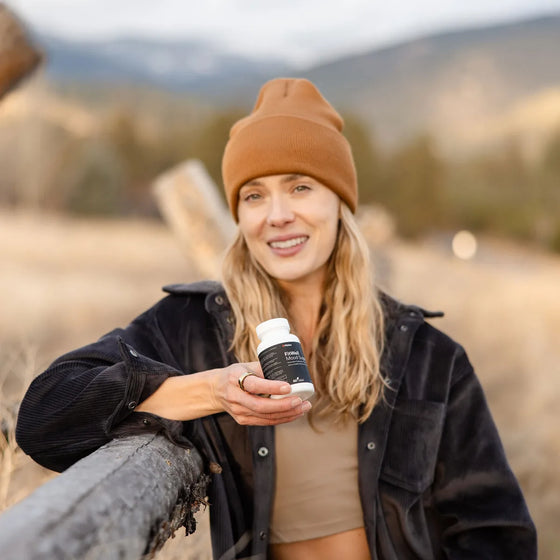
FitWell puts 100 mg of 5-HTP in a two-capsule serving, alongside 100 mg L-theanine, 100 mg GABA, and 300 mg taurine. Every amount is listed individually: no proprietary blend, no hiding the dose behind a total. Formulated to support relaxation and a healthy mood.*
Shop FitWellDoes 5-HTP work? Here is what the research shows

Honestly? The evidence is weaker than the shelf space implies, and the best-designed trial to date was negative.
Start with the largest one. In 2022, researchers ran a randomized, placebo-controlled crossover trial across 13 hospitals in 166 patients, published in Gastroenterology. Participants took 100 mg of 5-HTP twice daily for 8 weeks. Blood work confirmed the supplement was doing something biochemically: serum 5-HTP and serotonin both rose significantly against placebo. The symptom outcome did not move. Improvement rates were 35.6 percent on 5-HTP and 37.6 percent on placebo.
That is the most useful result in the whole 5-HTP literature, and not because it is discouraging. It is useful because it separates two things the category routinely conflates. The biochemistry moved. The outcome did not. "It raises serotonin" and "it does what you bought it for" are different claims, and only the first one is easy to prove.
The systematic review picture is similar. A Cochrane review of tryptophan and 5-HTP for depression located 108 trials and found only two, totalling 64 patients, of sufficient quality to include. Those two favoured the supplements over placebo, but the reviewers concluded the evidence was "of insufficient quality to be conclusive." That review is from 2002 and has not been updated, which tells you something in itself about how much rigorous work has followed.
Independent assessments land in the same place. Memorial Sloan Kettering notes that most human research on 5-HTP involves small trials with mixed results, and that studies evaluating it for insomnia are lacking. The NIH's National Center for Complementary and Integrative Health says there is very limited data on its effects on insomnia. Mayo Clinic calls the evidence early and limited. The US Department of Defense's supplement safety program describes the supporting studies as relatively weak.
None of that makes 5-HTP useless. It makes it unproven, which is a different and more honest word than the one most labels reach for.
How much 5-HTP do studies use?
There is no established recommended intake for 5-HTP. No government body, monograph, or clinical guideline publishes one. What exists is a set of doses that specific trials happened to use, in specific populations, and they span a wide range.
| Study | Daily dose | Length | Who took it |
|---|---|---|---|
| Meloni 2020 | 50 mg | 4 weeks | Adults with Parkinson's disease |
| Sutanto 2024 | 100 mg | 12 weeks | 30 older adults, average age 66 |
| Truyens 2022 | 200 mg, split twice daily | 8 weeks | 166 adults |
| Cangiano 1998 | 750 mg | 2 weeks | 25 overweight adults with type 2 diabetes |
| Cangiano 1992 | 900 mg | 12 weeks | 20 adults with obesity |
Two things jump out. The doses that produced the loudest headlines, the appetite and weight studies, were 750 mg to 900 mg per day, seven to nine times what a typical capsule contains. And the higher you go, the worse the tolerability gets: a rising-dose study found dropout from nausea and vomiting climbed from 6.6 percent at 100 mg to 45.5 percent at 300 mg. Being inside a studied range is not the same as being an effective dose, and a bigger number is not automatically a better one.
When should you take 5-HTP?
There is no controlled human study comparing morning against evening, or taken with food against fasted. Anyone telling you there is a proven optimal time is filling a gap with confidence.
What is on the record is what trials actually did. The 12-week sleep trial in older adults suggested participants take it at bedtime. So did a pediatric sleep study. The largest trial split the dose twice daily rather than taking it all at once. Plasma levels peak roughly 2 to 3 hours after an oral dose, in a small study where a decarboxylase inhibitor was co-administered.
The same pharmacology paper made a practical point that has held up for forty years: nausea and vomiting showed up mainly during dose escalation, and the authors emphasised the importance of starting slow. If you and your clinician decide 5-HTP is worth trying, starting at the low end and going up slowly is the one piece of timing advice with actual support behind it.
Who should not take 5-HTP?
This is the section that matters most, and the one the category tends to bury under a wall of benefits.
5-HTP feeds the serotonin system. Several common drug classes do too, by different mechanisms: SSRIs and SNRIs block reuptake, MAO inhibitors block breakdown, and triptans activate serotonin receptors. Stacking mechanisms is how serotonin syndrome happens, and it can be life-threatening. The National Library of Medicine notes it usually appears within a day of a serotonergic change, whether that change is a new drug, a dose increase, or a new supplement.
Memorial Sloan Kettering's guidance is direct: people taking SSRIs, MAOIs, tricyclic antidepressants, or other serotonergic drugs should avoid 5-HTP without the supervision of their treating physician. The same page documents a reported case of excess serotonin from combining 5-HTP with the antibiotic linezolid, and a case of mania following combined use with an MAOI.
Talk to your healthcare provider before taking 5-HTP if any of the following apply:
- You take any antidepressant, including SSRIs, SNRIs, MAOIs, and tricyclics, or any other medication that acts on serotonin.
- You take migraine medication. Triptans are serotonergic and fall inside the "other serotonergic drugs" caution above.
- You take carbidopa, which is used in Parkinson's disease treatment. A 1980 case report in the New England Journal of Medicine described a scleroderma-like illness in a patient treated with 5-HTP plus carbidopa.
- You are scheduled for a 5-HIAA urine test. 5-HTP can make the results inaccurate, per Memorial Sloan Kettering.
- You are pregnant, trying to conceive, or breastfeeding. Safety has not been established: Health Canada specifically identified the absence of adequate reproductive and developmental toxicity data when it declined to permit 5-HTP as a supplemental food ingredient in 2024.
Products containing 5-HTP are also not intended for children. On side effects generally, the reported ones are mainly gastrointestinal: nausea and vomiting, and they are dose-dependent. The Department of Defense's program also lists headache, insomnia, and heart palpitations among reported effects.
What is the eosinophilia-myalgia story, and does it apply to 5-HTP?
Search 5-HTP and you will eventually hit a page claiming it was banned, or that it causes a rare and sometimes fatal illness. The real story is more specific than either version, and worth getting right.
In 1989, an outbreak of eosinophilia-myalgia syndrome (EMS) was linked to L-tryptophan supplements in the United States. The CDC had 360 cases reported by 21 November 1989. NIH's complementary health center records that L-tryptophan was discontinued as a supplement in 1989 after the outbreak was traced to contaminated synthetic material from a single manufacturer. Cleveland Clinic puts the eventual toll at 5,000 to 10,000 US diagnoses and an estimated 37 deaths.
5-HTP became the market replacement. So the obvious question followed it: does the same risk carry over? Here is where the evidence genuinely splits.
On one side, FDA researchers reported one family with an EMS-related illness after 5-HTP exposure, whose supply contained an impurity absent from other samples, and concluded impurities "may be related" to it. Mayo Clinic researchers later characterised a contaminant family known as Peak X, identifying one component as a putative neurotoxin present in over-the-counter samples at 0.5 to 10.3 percent of the levels found in case-implicated material. On the other side, NIH states that extensive analyses of several sources of 5-HTP have shown no toxic contaminants similar to those associated with L-tryptophan.
The accurate summary is the one Cochrane's reviewers gave: the possible association between these substances and EMS "has not been elucidated." Not proven. Not dismissed. Unresolved, thirty-plus years on. Which is a good argument for caring a great deal about who manufactured what you are swallowing.
How to read a 5-HTP label

Given all of the above, label literacy is not a nice-to-have here. Four things to check.
The actual milligram amount, per serving, not per capsule. Serving sizes of two or four capsules are common, and the front of the bottle usually quotes the serving. Read the Supplement Facts panel and confirm which one you are looking at.
Whether it is a blend or a single ingredient. 5-HTP frequently appears alongside other compounds aimed at the same territory, and that is a legitimate formulation choice rather than a red flag. What is a red flag is a proprietary blend that lists a combined total and hides the individual doses, which makes it impossible to know how much 5-HTP you are getting or to compare it against anything in the table above.
Where it was manufactured, and to what standard. Given an unresolved contaminant question, this is the part of the label that earns the most attention. Look for a stated manufacturing standard rather than a vague quality badge.
The warning text. A 5-HTP product that does not tell you to talk to your provider about medication interactions has told you something about how carefully it was put together.
For reference, FitWell is formulated with 100 mg of 5-HTP per two-capsule serving, alongside 100 mg L-theanine, 100 mg GABA, and 300 mg taurine, with the full amounts listed individually and no proprietary blend. Its label carries the medication-interaction caution described above, and it is manufactured in the USA in a GMP compliant facility.
If you want the rest of that formula's ingredients covered properly, we have written up what L-theanine does and does not do, and a wider look at the sleep ingredients with research behind them. Whatever you decide about 5-HTP, decide it with your healthcare provider if you take any medication at all. This is one of the few supplements where that sentence is not boilerplate.
FitWell
FitWell puts 100 mg of 5-HTP in a two-capsule serving, alongside 100 mg L-theanine, 100 mg GABA, and 300 mg taurine. Every amount is listed individually: no proprietary blend, no hiding the dose behind a total. Formulated to support relaxation and a healthy mood.*
Shop FitWell