
The Fitties Journal
Suntheanine vs L-Theanine: What Differs and What the Research Shows
Key Takeaways
Here's what matters most if you're short on time.
- L-theanine is an amino acid found abundantly in tea leaves; one analysis measured about 12 to 13 mg in a 200 mL cup of black or green tea brewed for two minutes.
- Enzymatic production yields the L form of theanine, while chemical synthesis generally produces a mix of L and D forms.
- A 2025 review found the evidence on calm, focus and sleep often inconsistent and said the science does not yet match the hype.
- Reviews point to 200 to 400 mg a day in stress trials and 200 to 450 mg a day in sleep trials.
- Talk to your healthcare provider first if you are pregnant, nursing or take medication, especially with formulas that also contain 5-HTP.
L-theanine is an amino acid found abundantly in tea leaves, and Suntheanine® is a branded form of it made by enzymatic synthesis rather than extracted from tea (Hidese et al., 2019). The molecule is the same. What differs is the form you get. Enzyme-based production yields the L form, while chemical synthesis generally produces a mix of L and D (Perini et al., 2021). Research has focused on calm, focus and sleep, but a 2025 review found the results often inconsistent and concluded that the science does not yet match the hype (Dashwood and Visioli, 2025). Here is what the studies tested, how much they used, and who should check with a healthcare provider first.
What is L-theanine?
L-theanine is a non-protein amino acid most often associated with the leaves of Camellia sinensis, the plant behind white, green, oolong and black tea, where it can make up as much as half of the total amino acids (Dashwood and Visioli, 2025). It also occurs in two related Camellia species and in an edible mushroom.
A cup of tea delivers a modest amount. A 2025 laboratory analysis measured about 12 to 13 mg of L-theanine in a 200 mL cup of black or green tea brewed for two minutes at 80 °C, the highest of the six teas it tested (Ayakdaş and Ağagündüz, 2025). By comparison, the authors of one trial put their 200 mg dose at the equivalent of about eight cups of black tea (Kahathuduwa et al., 2017).
FitWell
FitWell pairs 100 mg of L-theanine (as Suntheanine) with 100 mg each of GABA and 5-HTP, 300 mg of taurine, chelated magnesium and B vitamins in each two-capsule serving. Every dose is on the label, with no proprietary blend.
Shop FitWellWhat is Suntheanine?
Suntheanine is a trademarked L-theanine ingredient; the FitWell label identifies it as a trademark of Taiyo International, Inc. The authors of a 2019 trial covered below describe the Suntheanine they used, supplied by Taiyo Kagaku of Japan, as an enzymatic synthetic product (Hidese et al., 2019). Enzymatic synthesis, in general, builds L-theanine from L-glutamine or L-glutamic acid and ethylamine using bacterial enzymes such as glutaminase, rather than extracting it from tea leaves (Perini et al., 2021).
Suntheanine vs L-theanine: what is actually different?
Suntheanine is L-theanine, so the real comparison is between production methods and the mirror-image form they deliver. Theanine is chiral, existing as an L form and a D form, and in nature it occurs predominantly as the L form (Perini et al., 2021). Even green tea carries a little D-theanine, 2.2 to 4.7% of the total according to an analysis cited in the 2025 review (Dashwood and Visioli, 2025).
There are three ways to obtain L-theanine, and they do not deliver the same thing (Perini et al., 2021).
| Route | Starting point | Which form you get |
|---|---|---|
| Extraction from tea | Tea leaves, about 1 to 3% L-theanine by dry weight | The plant's own theanine, mostly L; hard to purify away from tea's caffeine and polyphenols |
| Chemical synthesis | Glutamic acid derivatives and ethylamine | Generally a racemic mix of L and D |
| Enzymatic synthesis (the Suntheanine route) | L-glutamine or L-glutamic acid and ethylamine, with bacterial enzymes | The L form, because enzymes are stereospecific |
Does the D form matter? In rats, D-theanine was absorbed from the gut far less than L-theanine, and giving both forms together lowered blood theanine levels, which the researchers read as the two competing (Desai et al., 2005). Rat data do not settle what happens in people, and the 2025 review notes that the competition idea has been questioned (Dashwood and Visioli, 2025).
As for real products, a 2004 analysis of six commercially available L-theanine samples found significant amounts of D-theanine in five of them, and only the Suntheanine sample appeared to contain only the L form (Desai and Armstrong, 2004). That was one small analysis more than 20 years ago, so it says nothing about any product on shelves today, and none of these purity or rat studies measured how people feel.
How does L-theanine work?
L-theanine is well absorbed from the gut and can cross the blood-brain barrier (Dashwood and Visioli, 2025). It resembles the brain messengers glutamate and GABA, binds to glutamate receptors with far lower affinity than glutamate itself, and is noted for enhancing GABA activity, which may contribute to its purported calming effects. Some studies suggest it may also increase alpha waves, brain activity associated with relaxation and selective attention, though these findings are often inconsistent.
It is not a sedative. The same review notes that doses used to promote relaxation did not have hypnotic or sedative side effects. On stress, a 2020 systematic review of nine trials is cautious, noting that 200 to 400 mg a day may help reduce stress in people facing stressful conditions, but longer and larger trials are still needed (Williams et al., 2020).
What are the benefits of L-theanine and Suntheanine?
Research has concentrated on stress and calm, focus, and sleep, and the 2025 review noted that many L-theanine studies come from one geographical area and one commercial source of the ingredient (Dashwood and Visioli, 2025). Judge it by its studies, not its marketing. Anyone promising a personality transplant in a capsule is selling something.
Calm and stress
In a 2019 randomized, double-blind, placebo-controlled crossover trial, 30 adults without a major psychiatric illness took 200 mg of Suntheanine and a placebo before sleep each night, four weeks each in random order (Hidese et al., 2019). Stress-related symptom scores improved from baseline on L-theanine, but against placebo only three sleep measures improved significantly, namely time to fall asleep, sleep disturbance and use of sleep medication. The authors wrote that the results suggest the effects are not large. Taiyo Kagaku funded the trial and supplied the tablets, and two of the authors worked there.
Focus, especially with caffeine
On its own, L-theanine's record on attention is mixed. A single 200 mg dose improved a reaction-time measure of attention in 20 healthy men (Kahathuduwa et al., 2017), while the 2019 four-week trial found no overall cognitive difference from placebo (Hidese et al., 2019). With caffeine, results are steadier. In a 2008 randomized trial in 27 healthy volunteers, 100 mg of L-theanine with 50 mg of caffeine improved speed and accuracy on an attention-switching task at 60 minutes, while caffeine alone improved accuracy only at 90 minutes (Owen et al., 2008).
Sleep quality
The sleep evidence depends on which review you read. A 2026 systematic review of 13 trials, with 550 participants and doses from 50 to 900 mg a day, concluded that 200 to 450 mg a day "appears to be a safe and effective way to support healthy sleep in adults" (Cotter et al., 2026). Its authors, who work in corporate research and development, called for more high-quality trials using objective measures. A 2024 review placed L-theanine among the less-supported sleep supplements (Esquivel and Ghosn, 2024), and the 2025 review notes there are still no "gold standard" randomized, placebo-controlled trials of L-theanine on falling asleep and staying asleep (Dashwood and Visioli, 2025).
For the bigger picture, see our guide to why sleep is the most underrated performance tool and our roundup of supplements for sleep, which compares the main ingredients side by side.
How much L-theanine should you take?
L-theanine has no established Daily Value, so FDA's supplement labeling rules have labels mark it "Daily Value not established." The useful guide is what the studies used.
| Goal | Amount studied | How it was studied |
|---|---|---|
| Stress | 200 to 400 mg a day | Systematic review of 9 trials (Williams et al., 2020) |
| Nightly use | 200 mg before sleep | 4-week crossover trial in 30 adults (Hidese et al., 2019) |
| Focus with caffeine | 100 mg with 50 mg caffeine | Single doses in 27 volunteers, tested at 60 and 90 minutes (Owen et al., 2008) |
| Sleep | 200 to 450 mg a day | Systematic review of 13 trials (Cotter et al., 2026) |
Start at the lower end, and check with your healthcare provider first if you take any medication. L-theanine is absorbed quickly. In 12 healthy participants, blood levels peaked about 0.8 hours after a 100 mg dose, whether taken in capsules or in green tea (Scheid et al., 2012). Fast absorption is not the same as a fast effect, though. The caffeine study in the table tested people 60 and 90 minutes after one dose, while the 2019 trial measured its outcomes after four weeks of nightly use.
Why is L-theanine paired with caffeine?
Tea supplies both. Compared with coffee, moderate tea drinking appears to bring wakefulness without the agitation that can come with caffeine, and that has been credited in part to tea catechins and L-theanine, an attribution the 2025 review says "must be interpreted with caution" (Dashwood and Visioli, 2025).
A 2014 meta-analysis of 11 placebo-controlled studies found moderate effects in favor of combined caffeine and L-theanine on self-rated alertness and attention-switching accuracy in the first two hours after a dose, but effect sizes tended to change more with the caffeine dose than with the L-theanine dose (Camfield et al., 2014). The 2025 review adds, dryly, that this limited evidence "might stimulate marketing" of products that combine the two.
If you stack them yourself, watch the caffeine. The FDA cites 400 mg of caffeine a day as an amount not generally associated with negative effects for most adults, and it lists jitters, a faster heart rate and sleep disruption among the signs of too much.
Is L-theanine safe? Side effects and who should be careful
Most human trials are small, but the safety signals so far are reassuring. No adverse events were apparent in the 2019 four-week trial (Hidese et al., 2019), and the 2025 review describes a good safety profile from toxicology studies, including a 13-week rat study in which the highest dose tested, 4,000 mg per kg of body weight, produced no observed adverse effects (Dashwood and Visioli, 2025). FDA also had no questions about a 2006 GRAS (generally recognized as safe) notice from Taiyo International covering L-theanine as an ingredient in several food categories at up to 250 mg per serving, according to FDA's GRAS notice inventory.
Who should not take Suntheanine?
Talk to a healthcare provider before taking any L-theanine supplement if you are:
- Nursing. The NIH's LactMed database says high-dose L-theanine supplements are not necessarily safe for a breastfed infant and suggests avoiding L-theanine while nursing a newborn or preterm infant.
- Pregnant. The 2019 trial excluded pregnant women, so it offers no data on pregnancy (Hidese et al., 2019).
- Taking prescription medication. That includes sedatives, sleep medication, blood pressure medication and anything prescribed for mood.
FitWell pairs its Suntheanine with 100 mg of 5-HTP per serving. 5-HTP is a precursor of serotonin, and a 2020 review notes that an excess of 5-HTP may be responsible for serotonin syndrome, a reaction also linked to antidepressant medications (Maffei, 2020). If you take any medication that affects serotonin, such as an antidepressant, talk to your healthcare provider before using a 5-HTP formula. Our guide to what 5-HTP is and who should skip it has the details.
FitWell's label says to consult your healthcare professional prior to use, especially if you have a current medical condition or take prescription drugs, and that pregnant or lactating women should consult their healthcare professional prior to use. Its product reference sheet adds that people taking medication, particularly for migraines, Parkinson's disease, depression or other psychiatric disorders, should discuss potential interactions with their healthcare professional, and that it is not for use by children.
How do you choose a good L-theanine supplement?
This is where the supplement industry earns its bad reputation. Under FDA's supplement labeling rules, a proprietary blend can list ingredients that have no Daily Value, such as L-theanine, in order of weight with only the blend's total weight given, so a formula can name L-theanine without telling you whether it holds 50 mg or 5. A proprietary blend that hides the dose is a red flag, not a feature. Here is what actually matters.
- A disclosed dose. You should be able to read exactly how many milligrams of L-theanine are in a serving. If the label will not tell you, that tells you something.
- A stated form. Enzyme-made L-theanine is the L form, while chemically synthesized theanine is generally a mix of L and D (Perini et al., 2021). A named source with a documented production method, such as Suntheanine, tells you which route it took.
How does Fitties use Suntheanine?
Fitties uses Suntheanine as the L-theanine in FitWell. Each two-capsule serving lists 100 mg of L-theanine (as Suntheanine), 100 mg of GABA, 100 mg of 5-HTP and 300 mg of taurine, plus 70 mg of magnesium as magnesium lysinate glycinate chelate, zinc, selenium, vitamin C, vitamin B6, folate and vitamin B12. The capsules are vegetarian, and the label directions are two capsules one to two times daily, or as directed by your healthcare professional. It is a multi-ingredient formula rather than a single-ingredient capsule, and every amount is printed on the Supplement Facts panel, with no proprietary blend.
The bottom line on Suntheanine and L-theanine
Suntheanine is L-theanine made by enzymatic synthesis, the route that yields the L form. The research on calm, focus and sleep is, in the 2025 review's words, "promising, but far too preliminary to unequivocally support many of the purported health claims" (Dashwood and Visioli, 2025). Read the label for the dose and the form, and talk to your healthcare provider first if you take medication, are pregnant or nursing, or are considering a formula that also contains 5-HTP. For more ingredients broken down the same way, see all Fitties ingredient spotlights.
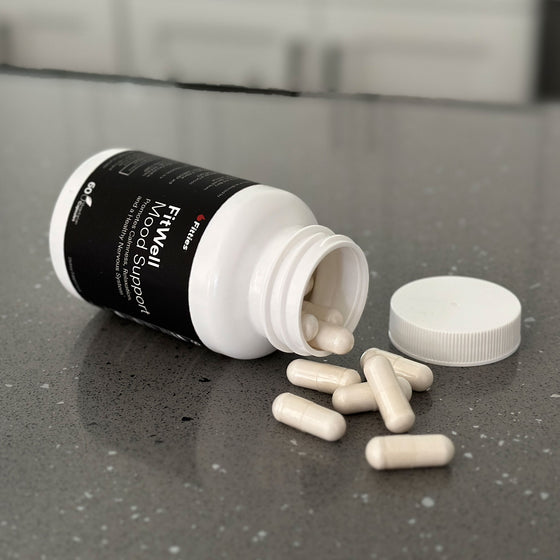
FitWell
FitWell pairs 100 mg of L-theanine (as Suntheanine) with 100 mg each of GABA and 5-HTP, 300 mg of taurine, chelated magnesium and B vitamins in each two-capsule serving. Every dose is on the label, with no proprietary blend.
Shop FitWell