
The Fitties Journal
What Is ch-OSA? Orthosilicic Acid, Absorption, and 2 Trials in Women
Key Takeaways
Here's what matters most if you're short on time.
- Orthosilicic acid is the small, water-soluble form of silicon in drinking water and beer, and the gut absorbs it readily.
- At supplement concentrations, orthosilicic acid links into larger particles that absorb poorly, which is why some supplements stabilize it, for example with choline.
- In one study of eight silicon sources, absorption ranged from about 1 percent to 64 percent of the dose.
- Two small placebo-controlled trials in women gave 10 mg of silicon a day as choline-stabilized orthosilicic acid, for 20 weeks and for 9 months.
- The National Academies set no daily requirement or upper limit for silicon, and most Western diets supply about 20 to 50 mg a day.
- Biotin in supplements can interfere with some lab tests, so tell your doctor about any biotin you take before blood work.
ch-OSA® is choline-stabilized orthosilicic acid, one of the silicon sources used in silicon supplements. Orthosilicic acid is the small, water-soluble silicon molecule the gut absorbs readily. At supplement strength it tends to link into larger particles that absorb poorly, and the choline limits how far that goes (Sripanyakorn et al., 2009). The European Food Safety Authority (EFSA) describes ch-OSA as a mixture of orthosilicic acid and choline chloride and has concluded that silicon is bioavailable from it.
That is the chemistry. The evidence is thinner than the beauty aisle suggests. In one study comparing eight silicon sources, absorption ran from about 1 percent to 64 percent depending on the source (Sripanyakorn et al., 2009). And the placebo-controlled evidence on ch-OSA for skin, hair, and nails is two small trials in women, both funded by the company that owns the ingredient (Barel et al., 2005; Wickett et al., 2007).
What is silicon, and what does it do in the body?
Silicon is the second most abundant element in Earth's crust, and it is rarely found on its own. It bonds with oxygen to form silica and silicates (Jugdaohsingh, 2007). The body holds about 1 to 2 grams of it (Jugdaohsingh, 2007), and according to the National Academies, connective tissues such as the aorta, trachea, bone, tendons, and skin contain most of it. The kidneys clear absorbed silicon into urine, which is why researchers use urinary silicon as a marker of how much was absorbed (Jugdaohsingh, 2007).
What silicon does in people is still an open question. In 1970s experiments, chicks and rats fed silicon-deficient diets developed bone and connective tissue defects, but later work has not reproduced those results to the same degree (Jugdaohsingh, 2007). The National Academies concluded that silicon appears to be involved in collagen and bone formation in animals, that no biological role has been identified in humans, and set no Recommended Dietary Allowance or Adequate Intake for it. No symptoms of silicon deficiency are known in humans (Jugdaohsingh, 2007).
FitRenew
FitRenew pairs choline-stabilized orthosilicic acid with biotin. Each vegetarian capsule provides 5 mg of silicon and 100 mg of choline from ch-OSA, plus 5,000 mcg of biotin. Every amount is on the label, with no proprietary blend.
Shop FitRenewWhat foods are high in silicon?

Plant foods and drinks, mostly. Unrefined whole grains such as barley, oats, rice bran, and wheat bran are high in silicon, much of it in the husk and hull of the grain, while animal and dairy foods are low (Jugdaohsingh, 2007). Refining lowers the silicon content of foods, according to the National Academies.
Drinks matter because their silicon is already in the absorbable form. Orthosilicic acid is the main silicon species in drinking water and other beverages, including beer, and how much a given water carries depends on the local geology (Jugdaohsingh, 2007). In the FDA Total Diet Study figures the National Academies used, beverages, including beer, coffee, and water, supplied 55 percent of dietary silicon, grains 14 percent, and vegetables 8 percent. Most Western diets provide about 20 to 50 mg of silicon a day (Jugdaohsingh, 2007).
Silicon eaten and silicon absorbed are different numbers. Bananas are high in silicon, yet in an absorption study only about 4 percent of their silicon showed up in urine, against about 44 percent for cooked green beans (Sripanyakorn et al., 2009).
Is orthosilicic acid the same as silicon dioxide?
No, though they are chemical relatives. Orthosilicic acid, Si(OH)4, is monomeric silica, a small, uncharged, water-soluble molecule that the gut absorbs readily (Sripanyakorn et al., 2009). Silicon dioxide, SiO2, is silica in its oxide form, and a 2018 EFSA opinion describes silicic acids as what forms when that oxide is hydrated. In soil, silicon is locked into minerals such as quartz, which are inert, insoluble, and barely bioavailable (Jugdaohsingh, 2007).
In food, silicon dioxide is a regulated additive. FDA regulations permit it as an anticaking agent at up to 2 percent of a food's weight, and the National Academies note that silicate anticaking and anti-foaming additives have low bioavailability.
The silica with a real hazard attached is dust. OSHA regulates respirable crystalline silica, the fine dust from cutting, grinding, and drilling stone, concrete, and brick, because workers who inhale it face a higher risk of serious silica-related disease, including lung disease. Inhaled silica stays in the lungs and does not join the body's normal silicon metabolism (Jugdaohsingh, 2007). That hazard is about breathing dust, not about the silicon in food and water.
Why do silicon supplements need a stabilizer?
Because orthosilicic acid does not stay single once it is concentrated. Drinking water and beer are dilute enough that their silicon stays mostly monomeric and absorbs well. At the higher concentrations found in most supplements, it forms larger polymers and colloids that absorb poorly (Sripanyakorn et al., 2009), since polymerization cuts its solubility and, with it, its bioavailability (Jugdaohsingh, 2007).
Makers handle that in different ways. Monomethylsilanetriol (MMST) swaps one of the molecule's hydroxyl groups for a methyl group, which keeps it small and monomeric in solution. ch-OSA uses choline. In the concentrated liquid the silicon is partly polymerized, but the choline holds it in suspension, and once diluted it starts breaking back down into orthosilicic acid (Sripanyakorn et al., 2009).
That study measured absorption in 32 healthy, fasting adults, each taking two of the eight sources a week apart, as the share of each dose recovered in urine over six hours (Sripanyakorn et al., 2009).
| Silicon source (single dose) | Silicon given | People tested | Share absorbed (urine, 6 hours) |
|---|---|---|---|
| MMST liquid | 6.9 mg | 14 | 64% |
| Alcohol-free beer | 22.9 mg | 5 | 60% |
| Cooked green beans | 6.1 mg | 5 | 44% |
| Orthosilicic acid solution | 21.4 mg | 5 | 43% |
| ch-OSA liquid, diluted in water | 20 mg | 8 | 17% |
| Bananas | 13.6 mg | 5 | 4% |
| Magnesium trisilicate (an antacid) | 200 mg | 8 | 4% |
| Colloidal silica | 780 mg | 3 | 1% |
Read it with its limits. Single doses, three to 14 people per source, and very different amounts of silicon per source. The ch-OSA tested was the liquid concentrate diluted in water, not a capsule. The authors concluded that absorption fell as polymerization rose, and they called ch-OSA less efficient than starting with monomeric silicon but partway to absorbable orthosilicic acid. Funding came from government and charitable sources, including the charitable foundation of the Institute and Guild of Brewing, and one author reported consulting on silicon supplements.
So a label that just says "silica" has named the element and skipped the part that decides absorption, the form.
What did the ch-OSA trials measure?
Two randomized, double-blind, placebo-controlled trials have tested ch-OSA on skin, hair, and nails, both in women and both at 10 mg of silicon a day (Barel et al., 2005; Wickett et al., 2007).
The skin trial. Fifty women with sun-damaged facial skin took ch-OSA pellets or a placebo for 20 weeks, 25 per group. Two roughness measures on the forearm, Rt and Rm, rose 8 and 11 percent with placebo and fell 16 and 19 percent with ch-OSA, a significant difference between groups. Serum silicon ended significantly higher than with placebo. Self-rated hair and nail brittleness scores in the ch-OSA group were significantly lower at 20 weeks than at the start, a comparison within the group rather than against placebo (Barel et al., 2005).
The hair trial. Forty-eight women with fine hair took ch-OSA beadlets or a placebo for nine months, 24 per group. Several hair-strength measures declined in both groups, but less with ch-OSA. Elastic gradient fell 4.5 percent with ch-OSA and 11.9 percent with placebo, a significant difference, and break load dropped significantly with placebo (10.8 percent) but not with ch-OSA (2.2 percent). Hair cross-sectional area, a measure of thickness, rose from baseline with ch-OSA and not with placebo (Wickett et al., 2007).
That is two small trials, positive on specific measurements, not a forecast of how anyone's skin or hair will look. Both were supported by grants from Bio Minerals, which owns ch-OSA, and both list the ingredient's developer as a co-author. Neither compared ch-OSA with another form of silicon.
Silicon or collagen: which should you take?
They are not rival versions of the same thing. Collagen is a protein and is digested like one. After healthy volunteers took 9.4 to 23 grams of gelatin (collagen) hydrolysate, their blood showed small collagen fragments, mainly the dipeptide Pro-Hyp, peaking one to two hours later (Iwai et al., 2005).
Silicon supplies no protein. Its case runs through the body's own collagen production. In lab-grown human bone-forming cells, orthosilicic acid at blood-like concentrations raised type 1 collagen synthesis 1.45 to 1.8 times, an effect that vanished when prolyl hydroxylase, an enzyme important for collagen formation, was blocked (Reffitt et al., 2003). That is a cell study, not a result in people.
The ch-OSA trials compared it with a placebo, not with collagen, so they cannot tell you which is better. Our collagen supplements guide covers the collagen research, and our hair, skin, and nails vitamins guide sets silicon beside biotin, vitamin C, and zinc.
Is orthosilicic acid safe?
At the amounts found in food and water, the evidence is reassuring. The National Academies found no evidence that silicon occurring naturally in food and water causes adverse health effects, and set no tolerable upper intake level because data showing adverse effects were lacking. EFSA judged typical intakes of 20 to 50 mg a day unlikely to cause adverse effects, and a 2018 EFSA opinion cites a safe upper level of 700 mg a day of supplemental silicon for adults, set by the UK Expert Group on Vitamins and Minerals.
For ch-OSA itself, EFSA concluded in 2009 that its use in supplements at the proposed levels is of no safety concern, provided the upper level for choline is not exceeded. ch-OSA is itself a source of choline.
Absorbed silicon leaves through the kidneys, and blood silicon runs higher when kidney function is impaired (Jugdaohsingh, 2007), so talk to your doctor before taking a silicon supplement if you have a kidney condition. Do the same if you are pregnant or nursing, take medication, or manage any other medical condition.
How does Fitties use ch-OSA in FitRenew?

FitRenew, our hair, skin, and nails formula, pairs ch-OSA with biotin, and the label shows every amount. Each capsule provides 5 mg of silicon and 100 mg of choline, both as choline-stabilized orthosilicic acid, plus 5,000 mcg of biotin. Silicon and choline get separate lines on the Supplement Facts panel because the ch-OSA supplies both. Per capsule, the choline is 18 percent of the Daily Value and the biotin is 16,667 percent; silicon has no established Daily Value. The directions are one capsule twice daily, or as directed by your healthcare professional, and each container holds 60 vegetarian capsules.
The label also gives the reason for the choline. Regular orthosilicic acid has to be stabilized to avoid polymerization, a process that decreases bioavailability. The ch-OSA trademark belongs to Bio Minerals NV of Belgium. The other ingredients are the capsule (hypromellose and water), microcrystalline cellulose, and purified water, and the full Formulated to Exclude list is printed on the label.
No proprietary blend and no pretty name hiding the doses. Three lines on the panel, three amounts.
What should you check before taking FitRenew?
Flag the biotin before any blood test. The FDA warns that biotin, often found in dietary supplements, can significantly interfere with certain lab tests and cause incorrect results that may go undetected, and it has received reports of biotin causing falsely low results on troponin, a heart test. If you take FitRenew, tell your doctor and the lab before blood work.
The label's cautions, as printed, are "Consult your healthcare professional prior to use. Individuals taking medication should discuss potential interactions with their healthcare professional. Do not use if tamper seal is damaged."
For the research behind the rest of our formulas, browse all Fitties ingredient spotlights.
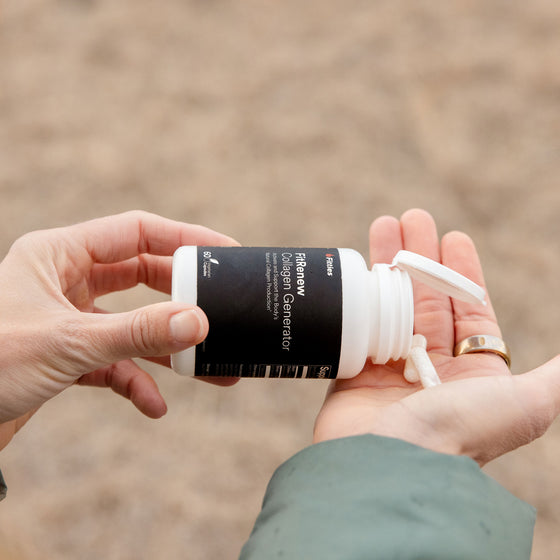
FitRenew
FitRenew pairs choline-stabilized orthosilicic acid with biotin. Each vegetarian capsule provides 5 mg of silicon and 100 mg of choline from ch-OSA, plus 5,000 mcg of biotin. Every amount is on the label, with no proprietary blend.
Shop FitRenew