The Fitties Journal
Glucoraphanin vs Sulforaphane: How Broccoli Seed Becomes Sulforaphane
Key Takeaways
Here's what matters most if you're short on time.
- Glucoraphanin is a stable, inert precursor; sulforaphane forms when myrosinase or gut bacteria convert it.
- In a 1997 analysis, 3-day-old sprouts of certain broccoli cultivars had 10 to 100 times more glucoraphanin than mature plants.
- Raw broccoli gave 37% sulforaphane bioavailability versus 3.4% for cooked in a crossover trial of eight men.
- In human trials tallied by a 2019 review, glucoraphanin doses ran from 25 to 800 micromoles a day, with a median of 190.
- Higher sulforaphane doses bring more reports of nausea, heartburn and stomach discomfort.
Glucoraphanin is the compound broccoli actually stores. It is chemically stable and biologically inert until myrosinase, an enzyme released when the plant is chewed or chopped, or bacteria in your gut convert it into sulforaphane (Yagishita et al., 2019). Sulforaphane is the reactive compound behind the headlines. More than 50 human trials had examined it by 2019. So the real question is how much of it becomes sulforaphane, and that varies widely from person to person.
That gap between what a label lists and what your body ends up with is where supplement marketing gets slippery. A 2019 review of the field said measuring broccoli-derived ingredients can be "a source of mystery, obfuscation, and confusion" that the supplement industry readily exploits (Yagishita et al., 2019).
Glucoraphanin vs sulforaphane: what is the difference?
Glucoraphanin is a glucosinolate that the broccoli plant builds from the amino acid methionine (Yagishita et al., 2019). In plants, glucosinolates are thought to serve mainly as a defense against pathogens and plant-eating animals, largely through the isothiocyanates they break down into, sulforaphane among them.
The plant keeps the two halves of the reaction apart. In intact tissue, myrosinase is physically separated from glucoraphanin. Biting or chewing brings them together, and myrosinase splits glucoraphanin into an unstable intermediate that rearranges into sulforaphane and other products. Your own cells do not make myrosinase.
Glucoraphanin is also stable, while sulforaphane is not, which has pushed researchers to develop stabilized forms of it. Labels add a naming trap. "Sulforaphane glucosinolate" is another name for glucoraphanin, the precursor, not sulforaphane itself, according to the National Library of Medicine's PubChem database.
FitNutrients+
FitNutrients+ is a daily multivitamin and mineral formula, 4 vegetarian capsules per serving. Each serving lists 5.2 mg of glucoraphanin from a Brassica oleracea seed extract, alongside vitamin B12 as methylcobalamin and folate as (6S)-5-methyltetrahydrofolic acid and calcium folinate. Each ingredient in the Supplement Facts panel is listed with its own amount.
Shop FitNutrients+How does glucoraphanin turn into sulforaphane?
In raw broccoli and sprouts, the plant's own myrosinase does the conversion. If the enzyme is missing or inactive, the job falls to your gut bacteria, and that bacterial conversion drops sharply after antibiotics (Yagishita et al., 2019).
Bacterial conversion works, but it delivers less than sulforaphane itself and varies more from person to person. In a placebo-controlled phase I trial in 12 healthy volunteers, broccoli sprout extracts were given every 8 hours for 7 days (Shapiro et al., 2006). When the extract supplied glucoraphanin, about 18 to 20% of the dose was recovered in urine as sulforaphane metabolites; when it supplied sulforaphane itself, recovery was 70.6% and much more consistent.
In a randomized, double-blind crossover study, 16 healthy adults took a single 50 mg dose of glucoraphanin as a broccoli seed extract, with vitamin C, with or without mustard seed powder as a myrosinase source (Mastaloudis et al., 2026). Without mustard seed, an average of 18.6% of the dose was recovered as sulforaphane and its metabolites, ranging from 2.2% to 38.1% between people; with it, the average was 39.8%. The extract's maker mainly funded the study, and one author worked for the company while another consulted for it.
What foods are high in glucoraphanin?

Broccoli seeds and young sprouts, by a wide margin. Glucoraphanin occurs throughout the broccoli plant, and on a weight basis it is most abundant in the seeds (Yagishita et al., 2019). In a 1997 analysis, 3-day-old sprouts of certain broccoli and cauliflower cultivars contained 10 to 100 times more glucoraphanin than the corresponding mature plants (Fahey et al., 1997).
Supermarket broccoli is a lottery. In one sampling of 31 fresh broccoli heads, each from a different Baltimore-area supermarket, glucoraphanin averaged 0.38 micromoles per gram but ranged from under 0.005 to 1.13 micromoles per gram (Yagishita et al., 2019). The same review notes that glucoraphanin is not as widespread as popular culture suggests. Just two or three other edible Brassica species contain significant amounts.
Because broccoli holds glucoraphanin rather than ready-made sulforaphane, the amount on your plate is only the starting point. What you do to the broccoli before you eat it has a big say in how much gets converted.
Does cooking broccoli destroy sulforaphane?
Cooking denatures myrosinase (Okunade et al., 2018), which leaves the conversion largely to your gut bacteria. In a randomized crossover trial, eight men ate 200 g of crushed broccoli, raw or cooked, with a warm meal (Vermeulen et al., 2008). Sulforaphane bioavailability was 37% from raw broccoli and 3.4% from cooked, and absorption peaked at 1.6 hours versus 6 hours.
You can put the enzyme back. Mustard seed carries active myrosinase, and in a randomized crossover study in 12 healthy adults, adding 1 g of powdered brown mustard to 200 g of cooked broccoli raised urinary levels of a sulforaphane metabolite from 9.8 to 44.7 micromoles per gram of creatinine, more than four times higher (Okunade et al., 2018).
In lab tests, warming florets or sprouts to 60°C (140°F) before crushing reduced the activity of a heat-sensitive protein that diverts the reaction to an inactive nitrile and raised sulforaphane formation, while 70°C (158°F) and above cut sulforaphane formation in florets (Matusheski et al., 2004). The practical read is that raw broccoli and sprouts keep their own myrosinase, and a gram of ground brown mustard can stand in for it on cooked broccoli.
Here is how form, cooking and added enzyme changed bioavailability in these trials (Shapiro et al., 2006; Mastaloudis et al., 2026; Vermeulen et al., 2008).
| What people took | Bioavailability, share of dose | Study |
|---|---|---|
| Glucoraphanin sprout extract, every 8 hours for 7 days | About 18 to 20% | Shapiro et al., 2006 |
| Sulforaphane sprout extract, every 8 hours for 7 days | 70.6% | Shapiro et al., 2006 |
| Broccoli seed extract, single 50 mg glucoraphanin dose | 18.6% (2.2 to 38.1%) | Mastaloudis et al., 2026 |
| Same dose plus mustard seed powder | 39.8% (5.3 to 76.9%) | Mastaloudis et al., 2026 |
| 200 g crushed raw broccoli | 37% | Vermeulen et al., 2008 |
| 200 g crushed cooked broccoli | 3.4% | Vermeulen et al., 2008 |
What does sulforaphane do in the body?
Researchers have tied sulforaphane to many possible cellular targets, but a 2017 review counted just one, KEAP1-NRF2 signaling, as validated (Dinkova-Kostova et al., 2017). NRF2 is a transcription factor that a sensor protein, KEAP1, normally tags for breakdown. Sulforaphane chemically modifies KEAP1's sensor cysteines, which lets newly made NRF2 build up, move into the cell nucleus and switch on its target genes.
Those genes code for a suite of antioxidant and cytoprotective enzymes, with NQO1 as the textbook example (Chien et al., 2025). In people, the evidence is indirect but measurable. As of 2019 there was no direct evidence that sulforaphane engages its target in humans, yet studies in healthy volunteers had found higher levels of NRF2-target enzymes such as NQO1 in white blood cells, skin samples, and nasal and cheek scrapings after glucoraphanin- or sulforaphane-rich preparations (Yagishita et al., 2019).
In a 2025 randomized trial of 18 healthy adults, one group of six took 450 mg of glucoraphanin a day, as a broccoli seed extract on its own, for a week. NQO1 gene expression in their skin biopsies rose 3.1-fold from baseline, while the same markers did not change significantly in blood cells (Chien et al., 2025). A Johns Hopkins research center and two foundations funded the trial, and the manufacturers donated the study products. That is a mechanism result at 450 mg a day, not an outcome you would feel.
Outcome research is thinner. By the review authors' own account, efficacy has been studied much less thoroughly than bioavailability, conversion and safety (Yagishita et al., 2019).
Does sulforaphane help with training or recovery?
The human data is thin. In a 2026 double-blind, placebo-controlled crossover trial, 14 healthy young adults took glucoraphanin capsules made with a broccoli seed extract plus mustard seed, 200 micromoles a day, or placebo for 2 weeks, then did a maximal cycling test (Ruhee et al., 2026). Endurance capacity did not change. Two blood markers of muscle damage, creatine kinase and myoglobin, were lower after exercise in the glucoraphanin phase. The company that supplied the capsules funded the study, and the authors frame it as a proof of principle. One small signal, not a recovery plan.
How much glucoraphanin do studies use?
Tens to hundreds of micromoles a day. A 2019 review that tabulated human trials of broccoli preparations found oral glucoraphanin doses from 25 to 800 micromoles per person per day, with a median of 190 micromoles (Yagishita et al., 2019). The review ties the heavier glucoraphanin dosing to how little of it converts without added myrosinase. To translate into milligrams, 25 micromoles of glucoraphanin is about 11 mg, and 100 micromoles is about 44 mg (Mastaloudis et al., 2026).
The milligrams on a label are also not the dose your body sees. Because preparations convert so differently, researchers regard the sulforaphane metabolites excreted in urine, not the amount in the product, as the more reliable measure of the actual dose (Yagishita et al., 2019). Two things a label should make plain are the amount in milligrams, and whether that amount is glucoraphanin or sulforaphane. Our guide to reading a supplement label covers the rest.
Is sulforaphane safe to take every day?
In short trials with healthy adults, it has been well tolerated. The phase I safety trial gave 12 healthy volunteers broccoli sprout extracts or placebo every 8 hours for 7 days and ran 32 types of lab tests, including liver enzymes and thyroid hormones (Shapiro et al., 2006). It found no significant or consistent toxicities. In a 12-week randomized trial, 26 women drinking a broccoli sprout beverage with 600 micromoles of glucoraphanin and 40 micromoles of sulforaphane a day showed no effect on thyroid hormones, thyroglobulin or thyroid antibody status compared with 19 women on placebo (Chartoumpekis et al., 2019).
The complaints that do show up are digestive. Higher doses bring more reports of nausea, heartburn and other stomach discomfort (Yagishita et al., 2019), and in the 450 mg-a-day skin trial, one of the six people in the glucoraphanin-only group had nausea and loose stools (Chien et al., 2025).
These trials ran one to 12 weeks, in healthy adults. They do not cover pregnancy, nursing, health conditions or medication use, so if any of those apply to you, talk to your healthcare provider before adding a concentrated broccoli seed or sprout extract. The FitNutrients+ label carries its own cautions. "Consult your healthcare professional before use. Individuals taking medication should discuss potential interactions with their healthcare professional. Do not use if tamper seal is damaged."
How does Fitties use glucoraphanin?

As one ingredient in a daily multivitamin, not as a sulforaphane protocol. FitNutrients+ lists 5.2 mg of glucoraphanin from a seed extract of Brassica oleracea, the species that includes broccoli, kale and kohlrabi, per serving of 4 vegetarian capsules. The directions are four capsules daily, or as directed by your healthcare professional. On the Supplement Facts panel, glucoraphanin carries a double asterisk. No Daily Value has been established.
At 5.2 mg, a serving sits below the bottom of the daily range in the 2019 review of human trials, 25 micromoles or about 11 mg (Yagishita et al., 2019; Mastaloudis et al., 2026), and is a small fraction of the 50 mg single dose and 450 mg daily dose in the studies above (Chien et al., 2025). The research on this page used those doses; it does not describe what a serving of FitNutrients+ does. What the label does give you is the exact amount, in milligrams, with every ingredient listed on its own line rather than hidden in a proprietary blend.
For the wider antioxidant picture, read our guide to antioxidant supplements, or browse all Fitties ingredient spotlights.
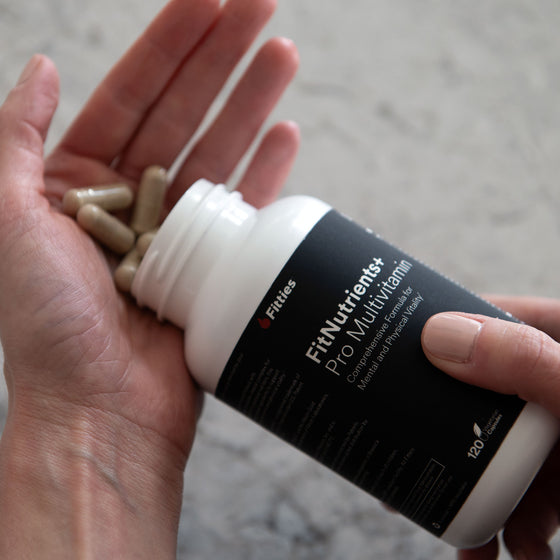
FitNutrients+
FitNutrients+ is a daily multivitamin and mineral formula, 4 vegetarian capsules per serving. Each serving lists 5.2 mg of glucoraphanin from a Brassica oleracea seed extract, alongside vitamin B12 as methylcobalamin and folate as (6S)-5-methyltetrahydrofolic acid and calcium folinate. Each ingredient in the Supplement Facts panel is listed with its own amount.
Shop FitNutrients+