The Fitties Journal
Antioxidant Supplements for Optimal Health: The Definitive Guide
Key Takeaways
Here's what matters most if you're short on time.
- Antioxidants neutralize free radicals that damage your cells. Some oxidative stress is normal, but chronic excess accelerates cellular aging and undermines health.
- Not all antioxidants work the same way. Fat-soluble ones (vitamin E, CoQ10, astaxanthin) protect cell membranes, while water-soluble ones (vitamin C, NAC) work inside cells and in circulation.
- L-ergothioneine stands apart because your body has a dedicated transporter for it (OCTN1), and it builds up most in tissues thought to face heavy oxidative stress.
- A supplement cannot replace an antioxidant-rich diet. Whole foods provide synergistic combinations of phytonutrients. Supplements fill specific gaps.
- Quality matters. Look for branded, researched ingredients (like MitoPrime® L-ergothioneine), cGMP manufacturing, and products free of unnecessary fillers.
Antioxidants are compounds that help protect cells from damage caused by free radicals. Free radicals are unstable molecules generated by normal metabolic processes, exercise, environmental exposure, and stress. In small amounts, they serve useful functions, including immune defense. In excess, they contribute to oxidative stress, which can damage cells, proteins, and DNA over time.
Antioxidant supplements can provide targeted support for managing oxidative stress, but the category is broad and the quality varies enormously. This guide covers how antioxidants work, which ones have meaningful research behind them, and how to choose wisely.
How Antioxidants Work
Free radicals are molecules missing an electron. To stabilize themselves, they steal electrons from nearby cells, which creates a chain reaction of cellular damage. Antioxidants break this chain by donating an electron to the free radical without becoming unstable themselves.
Different antioxidants work in different compartments of the body. Fat-soluble antioxidants (such as vitamin E, CoQ10, and astaxanthin) protect cell membranes. Water-soluble antioxidants (such as vitamin C and glutathione) work inside cells and in the bloodstream. Some, like L-ergothioneine, have dedicated cellular transport mechanisms that concentrate them in tissues under the most oxidative stress.
This is why a single antioxidant supplement cannot "cover everything." Different compounds protect different tissues through different mechanisms.
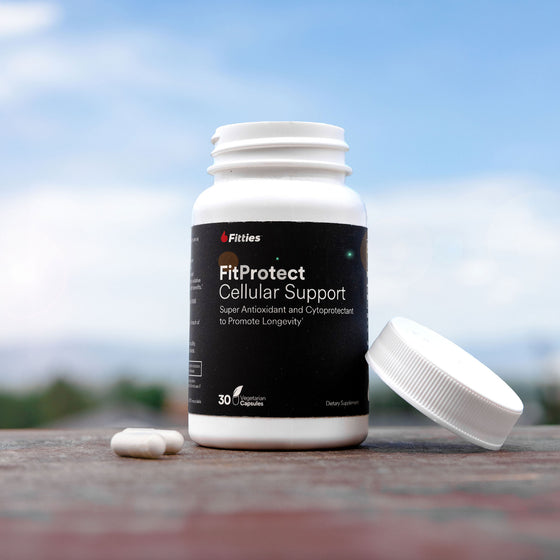
FitProtect
FitProtect provides 12.5 mg of MitoPrime L-ergothioneine per capsule, produced by fermentation. Vegetarian, with the full exclusion list on the label, and manufactured in a GMP compliant facility.
Shop FitProtectMajor Antioxidant Supplements: What the Research Supports
Vitamin C (Ascorbic Acid)
Vitamin C is the most widely recognized antioxidant. It is water-soluble, supports immune function, and plays a role in collagen synthesis. As a potent free radical scavenger, it also helps regenerate other antioxidants, including vitamin E. Vitamin C is also essential for the absorption of non-heme iron and supports a healthy inflammatory response.
Food sources include citrus fruits, bell peppers, strawberries, and broccoli. Supplementation is common because vitamin C is water-soluble and not stored in the body, meaning daily intake matters.
Vitamin E
Vitamin E is a fat-soluble antioxidant that protects cell membranes from oxidative damage. It works synergistically with vitamin C. Vitamin E neutralizes free radicals in the lipid layer of cell membranes, and vitamin C regenerates vitamin E after it has donated its electron.
Look for natural vitamin E (d-alpha-tocopherol) rather than the synthetic form (dl-alpha-tocopherol). In a study that tracked both forms in the same people, natural vitamin E had roughly twice the availability of synthetic (Burton et al., 1998). Food sources include nuts, seeds, and vegetable oils. Because vitamin E is fat-soluble, take it with a meal containing dietary fat for best absorption.
Coenzyme Q10 (CoQ10)
CoQ10 is a fat-soluble compound that plays a dual role. It is both an antioxidant and a critical component of mitochondrial energy production. Every cell in your body uses CoQ10 to generate ATP, and tissues with high energy demands (heart, brain, muscles) contain the highest concentrations.
CoQ10 levels naturally decline with age. Supplementation supports cellular energy production and provides antioxidant protection for mitochondrial membranes. Ubiquinol is the reduced (active) form and is generally better absorbed than ubiquinone, particularly in older adults.
N-Acetyl Cysteine (NAC)
NAC is a precursor to glutathione, the body's most abundant intracellular antioxidant. Glutathione is a tripeptide composed of three amino acids (cysteine, glycine, and glutamic acid) and is primarily produced in the liver. It supports immune function and neutralizes free radicals.
Supplementing with NAC provides the rate-limiting amino acid (cysteine) needed for glutathione synthesis. This makes NAC an indirect but effective way to support the body's own antioxidant defenses.
Astaxanthin
Astaxanthin is a carotenoid pigment found in microalgae and the marine organisms that consume them (salmon, shrimp, krill). In a lab study of model cell membranes, astaxanthin trapped free radicals both inside the membrane and at its surface, and it was about twice as effective as beta-carotene at limiting lipid damage (Goto et al., 2001).
Trials have looked at astaxanthin for skin and for exercise recovery. A 2021 meta-analysis found better skin moisture and elasticity but no significant change in wrinkle depth (Zhou et al., 2021), and a 2026 meta-analysis found lower creatine kinase after exercise but no performance gains (Liu et al., 2026). Like other fat-soluble antioxidants, take it with a meal containing fat for optimal absorption.
Curcumin
Curcumin is the active compound in turmeric. Its antioxidant and anti-inflammatory properties have been widely studied in the lab (Menon and Sudheer, 2007), but the NIH National Center for Complementary and Integrative Health says there is not yet enough evidence to conclude it is beneficial for any health purpose. Curcumin's primary limitation is poor bioavailability. Look for formulations that include piperine (black pepper extract) or use lipid-based delivery systems to improve absorption.
L-Ergothioneine: A Different Class of Antioxidant
L-ergothioneine is a naturally occurring amino acid derivative with its own dedicated cellular transporter, called OCTN1 (Gründemann et al., 2005). Through it, L-ergothioneine builds up most in tissues thought to face heavy oxidative stress, such as red blood cells, bone marrow, the liver, the kidneys and the eyes (Borodina et al., 2020).
Research supports L-ergothioneine's role as both an antioxidant and a cytoprotectant. In lab studies it shows strong antioxidant and cytoprotective properties (Halliwell et al., 2018). In an observational study of older adults, blood levels of L-ergothioneine fell after age 60, and people showing early cognitive decline had lower plasma levels than their age-matched peers (Cheah et al., 2016).
Mushrooms are the richest dietary source, but intake varies significantly. Individuals in the United States are estimated to consume approximately 1.1 mg per day, compared to up to 4.6 mg per day in some European countries. Supplementation provides a reliable, concentrated source.
FitProtect features MitoPrime L-ergothioneine, produced via a proprietary fermentation-based method. This process yields the stable, bioactive L-isomer in free amino acid form.
Antioxidant Supplements at a Glance
| Antioxidant | Type | Primary Role | Best Taken |
|---|---|---|---|
| Vitamin C | Water-soluble | Free radical scavenging, immune support, collagen synthesis | Any time of day |
| Vitamin E | Fat-soluble | Cell membrane protection | With a fat-containing meal |
| CoQ10 | Fat-soluble | Mitochondrial energy production, antioxidant defense | With a fat-containing meal |
| NAC | Water-soluble | Glutathione precursor | Any time; often on empty stomach |
| Astaxanthin | Fat-soluble | Skin, eye, and exercise recovery support | With a fat-containing meal |
| Curcumin | Fat-soluble | Antioxidant support, healthy inflammatory response | With fat and piperine for absorption |
| L-Ergothioneine | Water-soluble (active transport) | Targeted cytoprotection, cognitive support, glutathione maintenance | Per label directions (FitProtect) |
How to Build an Antioxidant Strategy
Start with food. A diet rich in colorful fruits, vegetables, nuts, seeds, and whole grains provides a broad spectrum of antioxidants that work synergistically. No supplement replicates the complexity of whole-food phytochemistry.
Add targeted supplementation based on your specific needs. Vitamin C and E provide broad-spectrum foundational support. CoQ10 becomes more relevant with age and for those focused on cellular energy. NAC supports glutathione production, which is particularly important during periods of high physical or environmental stress. And L-ergothioneine offers a unique mechanism of targeted cellular protection that other antioxidants do not provide.
Avoid megadosing. High doses of single antioxidants can create imbalances and may interfere with normal physiological processes. Stick to researched doses and follow product label directions.
What to Look for in an Antioxidant Supplement
Quality varies enormously in this category. Prioritize products that name their branded ingredients (like MitoPrime for L-ergothioneine), are manufactured in cGMP-compliant facilities, provide transparent labeling with specific ingredient forms and doses, and are free of unnecessary fillers, artificial colors, and artificial sweeteners. Third-party testing adds an additional layer of quality assurance. For guidance on evaluating supplement quality more broadly, see the Supplement Buyer's Guide.
For supplement labels specifically, our guide to reading supplement labels covers what to look for and what to avoid.
Next Steps
For a deeper look at the science behind L-ergothioneine and the OCTN1 transporter, read our L-Ergothioneine deep dive. For timing guidance on when to take antioxidant supplements relative to meals and training, check the Supplement Timing Guide.
As with any supplement, consult a healthcare professional before starting a new regimen, especially if you take prescription medication or have specific health concerns.
FitProtect
FitProtect provides 12.5 mg of MitoPrime L-ergothioneine per capsule, produced by fermentation. Vegetarian, with the full exclusion list on the label, and manufactured in a GMP compliant facility.
Shop FitProtect