
The Fitties Journal
L-Ergothioneine: The Antioxidant Your Cells Actively Seek Out
Key Takeaways
Here's what matters most if you're short on time.
- Ergothioneine is made by fungi and some bacteria, not by humans, so it has to come from the diet.
- Cells take it up through a dedicated transporter, OCTN1, and cells that carry it build up and retain it.
- Mushrooms are the richest food source, and estimated US intake is about 1.1 mg a day.
- Unlike ergothioneine, glutathione is made inside your own cells from three amino acids.
- Human research beyond absorption is still early, and reviewers call for larger, long-term trials.
- FitProtect provides 12.5 mg of L-ergothioneine per capsule as MitoPrime®, made via a fermentation-based method.
L-ergothioneine is a sulfur-containing antioxidant made by fungi and some bacteria and, as far as is known, not by plants or animals, so you get it only from your diet (Borodina et al., 2020). Mushrooms are typically the richest source (Tian et al., 2023). Your body absorbs and retains it using a selective transporter, OCTN1, often called the ergothioneine transporter (Halliwell, 2026). What the evidence shows so far is a large body of lab and animal data on antioxidant and cell-protective activity (Tian et al., 2023), a small human study showing it is absorbed and retained (Cheah et al., 2017), and observational links with aging that still need larger, long-term trials to test cause and effect (May-Zhang et al., 2025).
What Is L-Ergothioneine?
L-ergothioneine, usually shortened to ergothioneine or ET, is an unusual sulfur-containing derivative of the amino acid histidine, obtained exclusively through the diet (Paul and Snyder, 2010). It was first isolated in 1909 from the ergot fungus Claviceps purpurea, which gave it its name (Tian et al., 2023). The molecule is chemically stable, tasteless, odorless and highly water-soluble (Halliwell, 2026).
In 2005, researchers showed that the key substrate of a membrane transporter called OCTN1, encoded by the SLC22A4 gene, is ergothioneine (Gründemann et al., 2005). It moved ergothioneine more than 100 times more efficiently than the organic cations it was presumed to carry, so the team proposed calling it the ergothioneine transporter.
FitProtect
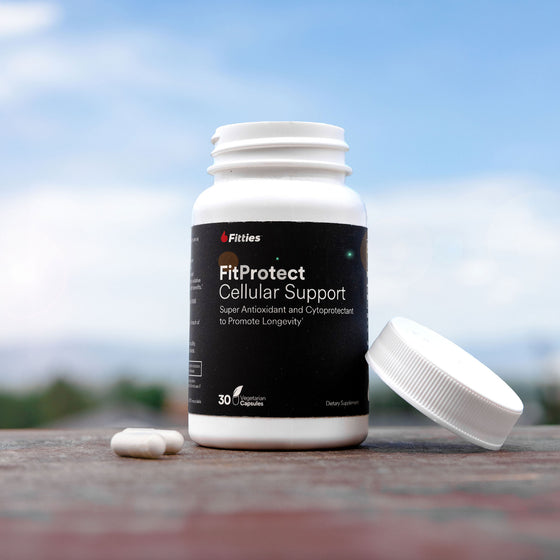
FitProtect provides 12.5 mg of L-ergothioneine per vegetarian capsule as MitoPrime, produced via a proprietary fermentation-based method. Label directions are one capsule once or twice daily, or as directed by your healthcare professional. It is formulated to exclude wheat, gluten, soy, dairy, sesame and the other items listed on its label.
Shop FitProtectHow Does Your Body Absorb and Hold On to Ergothioneine?
The fact that the body has a dedicated transporter for a single dietary compound implies a physiologic role for L-ergothioneine, and cells depleted of that transporter are more vulnerable to oxidative damage (Paul and Snyder, 2010). The transporter sits on the lining of the small intestine, where ergothioneine is absorbed, and it works in the kidney to reabsorb ergothioneine rather than lose it in urine (Tian et al., 2023). Cells that carry OCTN1 build up L-ergothioneine to high levels and hold on to it, while cells without it take up almost none (Gründemann et al., 2005).
Ergothioneine accumulates according to how much of the transporter a tissue expresses, with especially high levels in red blood cells, bone marrow, liver, kidney, seminal fluid and the lens and cornea of the eye, tissues considered to have the potential for oxidative stress (Borodina et al., 2020). In several animal species, knocking out the transporter gene increases susceptibility to oxidative stress, damage and inflammation (Tian et al., 2023).
What Happens When People Take It?
The core human data come from a placebo-controlled study in 45 healthy young men who took a placebo, 5 mg or 25 mg of ergothioneine a day for 7 days and were followed for 4 more weeks (Tian et al., 2023; Cheah et al., 2026). Ergothioneine was avidly absorbed and retained. Plasma and whole-blood levels rose significantly, and less than 4 percent of the dose appeared in urine (Cheah et al., 2017). Some markers of oxidative damage and inflammation trended down, but most of the changes were not statistically significant. It was small, short and limited to young men, so it shows absorption and retention, not long-term effects.
What Foods Are High in Ergothioneine?
Mushrooms are by far the richest dietary source. Common white button and gray oyster mushrooms carry far more L-ergothioneine than foods with the next highest documented levels, such as oats, kidney beans and chicken liver (Beelman et al., 2020). Small amounts turn up throughout the food chain, most likely because soil fungi pass it on to plants, and tempeh, a soybean food fermented with fungi, carries moderately high levels. Here are the review's figures, per kilogram of dry weight.
| Food | Ergothioneine (mg per kg, dry weight) |
|---|---|
| Gray oyster mushroom | 1,310 |
| White button mushroom | 630 |
| Tempeh | 201 |
| Chicken liver | 47 |
| Kidney beans | 2.1 |
| Oats | 1.8 |
Mushroom ergothioneine content varies wildly with strain and growing conditions, and fermented foods can also be significant sources (Tian et al., 2023). Some varieties, including porcini, have been measured well above the highest figure in the table (Borodina et al., 2020).
Americans are estimated to take in about 1.1 mg a day, compared with up to 4.6 mg a day in Italy (Beelman et al., 2020). In older adults in Singapore, blood levels tracked self-reported mushroom intake (Cheah and Halliwell, 2021).
What Does the Research Show?
Antioxidant and Cytoprotective Activity
Reviewers describe L-ergothioneine as an excellent cytoprotectant, a compound that shields cells from damage, with its chief role as an antioxidant against reactive oxygen and nitrogen species (Borodina et al., 2020). Cell studies report antioxidant-related effects, including slower telomere shortening in human fibroblasts grown under oxidative stress, in a study whose authors include employees of an ergothioneine maker (Samuel et al., 2022). Lab studies also found it could protect mitochondrial DNA from oxidative damage, though reviewers note that definitive evidence of its uptake into mitochondria is still missing (Cheah and Halliwell, 2021).
In lab-grown human skin cells exposed to UVA light, it raised glutathione and switched on antioxidant genes through the Nrf2 pathway (Hseu et al., 2015). Useful biology, not proof of an effect in people.
Aging and the Brain: What the Human Data Can and Cannot Show
In mice given oral ergothioneine for up to 28 days, it reached brain tissue, although it concentrated mainly in the liver and whole blood (Tang et al., 2018). In people, levels change with age. In older adults in Singapore, whole-blood levels fell significantly after age 60 (Cheah et al., 2016). Why is not settled; reviewers list increased turnover, dietary changes and altered transporter function as possible reasons (Cheah and Halliwell, 2021).
Studies that measure blood levels and look for patterns can show association, not cause. A 2025 review of the observational, interventional and mechanistic evidence concluded that larger, long-term interventional trials are needed to confirm causality, and its first author works for an ergothioneine maker (May-Zhang et al., 2025).
Is It Really a "Longevity Vitamin"?
The "longevity vitamin" label traces to a 2018 proposal by Bruce Ames that named ergothioneine among 10 putative longevity vitamins (Ames, 2018). Ergothioneine does not meet the classic definition of a vitamin, which requires that a shortfall in the diet quickly produces an obvious deficiency (Beelman et al., 2020). A 2023 review frames the open question as whether it should be considered a conditionally essential micronutrient (Tian et al., 2023). Proposed and debated, not settled.
Ergothioneine vs Glutathione: What Is the Difference?
Glutathione is your body's own antioxidant workhorse, a tripeptide of glutamate, cysteine and glycine, made inside your cells and present in all mammalian tissues as the most abundant non-protein thiol (Lu, 2013). Ergothioneine is the opposite on sourcing. It is obtained exclusively through the diet (Paul and Snyder, 2010) and needs its dedicated transporter to get into cells (Gründemann et al., 2005). The chemistry differs, too. At the body's normal pH, ergothioneine exists mainly in its thione form, which makes it much more resistant to autoxidation than other thiols such as glutathione (Tian et al., 2023).
They work more like partners than rivals. In lab-grown skin cells, ergothioneine raised glutathione levels (Hseu et al., 2015), and oxidized ergothioneine can be restored by vitamin C or, enzymatically, by glutathione reductase working with glutathione (Tian et al., 2023). In one cell experiment against a chemical that generates superoxide, ergothioneine was as potent as glutathione (Paul and Snyder, 2010).
| Feature | Ergothioneine | Glutathione |
|---|---|---|
| Where it comes from | Diet only; made by fungi and some bacteria | Made inside your own cells |
| Built from | The amino acid histidine | Glutamate, cysteine and glycine |
| Main form in the body | Mostly the thione form, highly resistant to autoxidation | A typical thiol, less resistant |
| How cells get it | Pulled in by a dedicated transporter, OCTN1 | Made in the cell's cytosol |
How Much Ergothioneine Do Studies Use?
No Daily Value has been set for ergothioneine, so there is no official target. The human absorption study used 5 or 25 mg a day (Tian et al., 2023). For context, estimated US intake from food is about 1.1 mg a day (Beelman et al., 2020), and the European Food Safety Authority assessment of synthetic ergothioneine covered food-supplement use of up to 30 mg a day for adults, excluding pregnant and breastfeeding women.
A proprietary blend that hides the ergothioneine amount, or a mushroom powder with no stated ergothioneine content, tells you nothing about the dose you are getting.
Is Ergothioneine Safe? Side Effects and Regulatory Status
No safety signal has emerged at the doses studied so far. A 2026 paper from the team behind the absorption study reports no adverse effects associated with supplementation in human studies to date, and good tolerance in older adults taking it for up to 12 months (Cheah et al., 2026). In the same paper, 25 mg a day for 7 days did not significantly change plasma TMAO, a compound made from a gut-microbe byproduct that had been flagged as a possible downside. In laboratory safety testing, it has shown no detectable mutagenicity or genotoxicity, even at very high doses (Borodina et al., 2020).
In 2016, the European Food Safety Authority nutrition panel assessed synthetic L-ergothioneine as a food ingredient and as a supplement at up to 30 mg a day for adults, and found the margins of safety sufficient; pregnant and breastfeeding women were excluded. A 2017 follow-up extended the safety conclusion to fortified foods for infants, young children and pregnant and breastfeeding women, but did not assess supplements for those groups. In the US, FDA said in 2018 that it had no questions about a notice concluding that ergothioneine is generally recognized as safe (GRAS) as a food ingredient at 5 mg per serving, while noting that its letter is not a GRAS affirmation (FDA response to GRAS Notice 734). Both reviews covered particular ingredients at defined intakes. That is useful context, not a blanket clearance for every ergothioneine product.
The FitProtect label carries its own cautions: "Consult your healthcare professional before use. Individuals taking medication should discuss potential interactions with their healthcare professional. Do not use if tamper seal is damaged." If you are pregnant or nursing, take medication or have a health condition, talk to your healthcare provider before starting ergothioneine or any new supplement.
What Is MitoPrime, and How Does FitProtect Use It?
Not all L-ergothioneine is produced the same way. FitProtect uses MitoPrime, which its label describes as a concentrated form of L-ergothioneine produced via a proprietary fermentation-based method. Each one-capsule serving provides 12.5 mg of L-ergothioneine, and each container holds 30 vegetarian capsules. The label directions are one capsule once or twice daily, or as directed by your healthcare professional.
The other ingredients are microcrystalline cellulose, dicalcium phosphate, the capsule itself (hypromellose and water), ascorbyl palmitate and silica. FitProtect is formulated to exclude wheat, gluten, corn, yeast, soy, animal and dairy products, fish, shellfish, peanuts, tree nuts, egg, sesame, ingredients derived from GMOs, artificial colors and artificial sweeteners. One ingredient on the Supplement Facts panel, one milligram figure, and no proprietary blend to hide behind.
Next Steps
For a broader overview of how antioxidants work and how to build an evidence-based antioxidant strategy, see our Antioxidant Supplements Guide. To see how FitProtect fits into a complete supplement routine, visit the Supplement Buyer's Guide, or browse all Fitties ingredient spotlights.
As with any supplement, consult a healthcare professional before starting a new regimen, especially if you take prescription medication or have specific health concerns.
FitProtect
FitProtect provides 12.5 mg of L-ergothioneine per vegetarian capsule as MitoPrime, produced via a proprietary fermentation-based method. Label directions are one capsule once or twice daily, or as directed by your healthcare professional. It is formulated to exclude wheat, gluten, soy, dairy, sesame and the other items listed on its label.
Shop FitProtect