
The Fitties Journal
What Is Chitin-Glucan? The Fungal Fiber Behind KiOtransine
Key Takeaways
Here's what matters most if you're short on time.
- Chitin-glucan is an insoluble fiber of chitin linked to beta-1,3-glucan, extracted from fungal cell walls.
- It is not chitosan, which is made by removing most of chitin's acetyl groups and has traditionally come from crustaceans.
- EFSA concluded in 2010 that a chitin-glucan ingredient from Aspergillus niger is safe as a food ingredient at 2 to 5 g a day.
- The human studies covered here are small. A 6-week trial in 130 adults and a 3-week study in 15 healthy adults.
- FitPlant+ lists 2.25 g of chitin-glucan from Aspergillus niger per 2-scoop serving and is formulated to exclude shellfish.
Chitin-glucan is an insoluble dietary fiber from fungal cell walls, and the form in FitPlant+ comes from the fungus Aspergillus niger. The European Food Safety Authority (EFSA) describes it as the main component of the cell walls of Aspergillus niger mycelium derived from a fermentation process. It joins two polymers, chitin and beta-1,3-glucan (Bays et al., 2013). KiOtransine® is the trademarked chitin-glucan listed in FitPlant+; the trademark belongs to KitoZyme S.A.
A trademark tells you who owns a name, not what an ingredient does. Chitin-glucan comes from a fungus, not from shellfish. EFSA assessed a chitin-glucan ingredient from Aspergillus niger as a novel food and concluded it is safe at the proposed intakes. And the human studies covered below are small and short (130 adults for 6 weeks, 15 adults for 3 weeks), measuring mostly markers in blood and stool.
What is chitin-glucan made of?
Chitin is a long polymer of N-acetylglucosamine, and beta-1,3-glucan is a chain of glucose units. In chitin-glucan the two form a single insoluble fiber (Bays et al., 2013). The glucan part is the backbone of the fungal cell wall. In almost all fungi, a branched beta-1,3/1,6 glucan forms the central core of the wall and is linked to chitin (Rodriguez et al., 2020).
In the research literature, the Aspergillus niger mycelium it comes from is described as a biomass left over after food-grade citric acid is made (Bays et al., 2013).
FitPlant+
FitPlant+ is a pea and rice protein shake mix with 15 g of protein and 2.25 g of chitin-glucan from Aspergillus niger in every 2-scoop serving, in Vanilla or Chocolate. It is formulated to exclude soy protein, animal and dairy products, gluten, shellfish and sesame, and it is sweetened with monk fruit.
Shop FitPlant+How is chitin-glucan different from chitosan and shellfish chitin?

Chitin ranks among the most abundant natural polymers after cellulose, and it forms structural parts of arthropod exoskeletons and of fungal and yeast cell walls. The main commercial sources are crab and shrimp shells, where chitin is bound up with proteins and calcium carbonate (Younes and Rinaudo, 2015). Chitosan is chitin with most of its acetyl groups stripped off under alkaline conditions, a step called deacetylation, which makes it soluble in acidic solutions. Both chitin and chitosan have traditionally been sourced from crustaceans, although mushrooms such as Agaricus bisporus offer a non-animal alternative (Almeida et al., 2025).
Chitin-glucan is the fungal version, chitin still linked to its glucan partner, extracted from the cell walls of fungi rather than from shells (Bays et al., 2013). Crustacean shellfish is one of the nine major food allergens named by the US Food and Drug Administration, so the source of any chitin-type ingredient is worth checking. The FitPlant+ label states it. Chitin-glucan from Aspergillus niger, with shellfish listed in the product's Formulated to Exclude line. Managing a food allergy? See our guide to dietary restrictions and food allergies for athletes.
| Ingredient | What it is | Where it comes from |
|---|---|---|
| Chitin | A long chain of N-acetylglucosamine | Crab and shrimp shells (main commercial source), other arthropods, fungal and yeast cell walls |
| Chitosan | Chitin with most acetyl groups removed; soluble in acidic solutions | Made from chitin, traditionally from crustaceans |
| Chitin-glucan | Chitin linked to beta-1,3-glucan; an insoluble fiber | Fungal cell walls; the FitPlant+ label lists Aspergillus niger |
What does the research on chitin-glucan show?
Less than supplement marketing tends to imply. Much of the early work was in animals (Bays et al., 2013), which says little about people.
A 6-week trial in 130 adults
This randomized, double-blind, placebo-controlled trial enrolled 130 adults aged 21 to 70 whose LDL cholesterol was in the borderline to high range, and gave them 1.5 or 4.5 g of chitin-glucan a day, 1.5 g plus an olive extract, or a placebo, for 6 weeks (Bays et al., 2013). Because it enrolled people with raised cholesterol and measured cholesterol-related blood markers, its results apply to that group, not to people whose levels are in range, and a cholesterol result is a conversation for your healthcare provider. What it adds here is tolerance data at up to 4.5 g a day, covered in the safety section below. KitoZyme, which supplied the chitin-glucan, and Stratum Nutrition sponsored the trial, and two authors were employees of those companies.
A 3-week study in 15 healthy adults
A smaller study with no placebo group looked at the gut. 15 healthy young adults, average age 21, took 4.5 g a day for 3 weeks, and each served as their own control (Rodriguez et al., 2020). The main measure was the gut microbiota. Chitin-glucan shifted its composition, with Eubacterium, Dorea and Roseburia changing most, and raised several bacterial metabolites in stool, including butyric acid. Stool frequency and consistency did not change. The study was publicly funded, one author was from KitoZyme, and the authors declared no competing interests.
How much chitin-glucan is used, and is it safe?
The two studies above used 1.5 to 4.5 g a day. In the 6-week trial, participants took their capsules three times a day with water before each main meal (Bays et al., 2013). Both human studies reported chitin-glucan as well tolerated. In the 6-week trial, adverse events did not substantively differ from placebo, digestive complaints were the most common at similar rates across groups, and no serious adverse events were reported. In the 3-week study, digestive symptom scores did not change; urgency and ease of bowel movements shifted around day 14, then returned to baseline (Rodriguez et al., 2020).
What have regulators said about chitin-glucan?
In 2010, the European Food Safety Authority assessed a chitin-glucan ingredient from Aspergillus niger as a novel food for use in food supplements at 2 to 5 g a day, and concluded it is safe as a food ingredient at the proposed conditions of use and intake levels.
Who should check with a provider first?
Both human studies excluded people who were pregnant or nursing and people with digestive conditions, and the smaller one also excluded people on regular medication, so the data do not cover those groups. If any of that applies to you, talk to your healthcare provider before adding a new fiber. The FitPlant+ label carries its own cautions. Consult your healthcare professional prior to use, discuss potential interactions with your healthcare professional if you take medication, and note that it is not a low-calorie dietary supplement. If you have a food allergy, read the full label first.
How does Fitties use chitin-glucan?

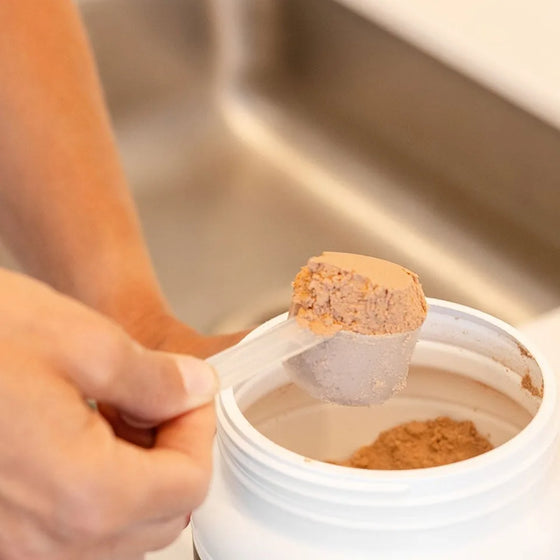
FitPlant+ is a pea and rice protein shake mix, and chitin-glucan sits in its Supplement Facts panel as "Chitin-glucan (from Aspergillus niger)" at 2.25 g per serving in both Vanilla and Chocolate. A serving is 2 scoops, about 38 g for Vanilla and about 35 g for Chocolate, and it provides 15 g of protein from pea protein isolate and rice protein concentrate. The directions are to mix 2 scoops in 8 to 10 ounces of cold water, adjusting the water for thickness.
The panel footnotes credit the trademark. KiOtransine is a registered trademark of KitoZyme S.A. The source is printed plainly, Aspergillus niger, and FitPlant+ is formulated to exclude wheat, gluten, yeast, soy protein, animal and dairy products, fish, shellfish, peanuts, tree nuts, egg, sesame, artificial colors, and artificial sweeteners.
One boundary is that the studies above tested chitin-glucan supplements, not FitPlant+, so they describe the ingredient, not the shake. For choosing among plant proteins, read how to choose a plant-based protein powder, or browse all Fitties ingredient spotlights.
FitPlant+
FitPlant+ is a pea and rice protein shake mix with 15 g of protein and 2.25 g of chitin-glucan from Aspergillus niger in every 2-scoop serving, in Vanilla or Chocolate. It is formulated to exclude soy protein, animal and dairy products, gluten, shellfish and sesame, and it is sweetened with monk fruit.
Shop FitPlant+