
The Fitties Journal
Can You Mix Creatine With Protein Powder? 4 Rules for the Shaker
Key Takeaways
Here's what matters most if you're short on time.
- Creatine and protein powder can go in the same shaker; there is no interaction that cancels either one out.
- Creatine converts to creatinine once it dissolves, and that conversion speeds up as liquid gets more acidic and warmer.
- After three days at 25C, creatine in solution lost 4% at pH 5.5 and 21% at pH 3.5, and stayed relatively stable at neutral pH.
- In a 2000 study (Steenge et al.), creatine taken with 50 g of protein and 47 g of carbohydrate was retained about 25% better than creatine taken alone.
- The ISSN position stand puts daily maintenance at 3 to 5 g, with loading at 5 g four times daily for 5 to 7 days.
Yes. Creatine and protein powder go in the same shaker without any problem, and nothing about the combination cancels either one out. If anything the research runs the other way. When creatine is taken alongside protein and carbohydrate, whole-body creatine retention goes up compared with creatine on its own (Steenge et al., 2000). The only real limits are chemistry and time. Creatine slowly converts to creatinine once it dissolves, and that conversion speeds up as the liquid gets more acidic and warmer. A scoop of protein in cold water is neither acidic nor warm, which is why the shaker is one of the better places to put your creatine, and why protein powder in coffee is a separate question with its own answer. Four rules cover everything that actually matters, and the rest of this page is the evidence behind them.
Does creatine react with protein powder?
No. Creatine monohydrate and whey or plant protein are different molecules doing different jobs, and there is no chemical interaction between them that degrades either one. Creatine feeds the phosphocreatine system that regenerates ATP during short, hard efforts. Dietary protein supplies the amino acids used for muscle protein synthesis. They sit in the same glass without touching each other.
The persistent internet claim that protein somehow blunts creatine is not backed by any study we could find. The International Society of Sports Nutrition position stand on creatine takes the opposite position, noting that "ingesting creatine with carbohydrate or carbohydrate and protein have been reported to more consistently promote greater creatine retention." Mixing them is not a compromise.
FitWhey+
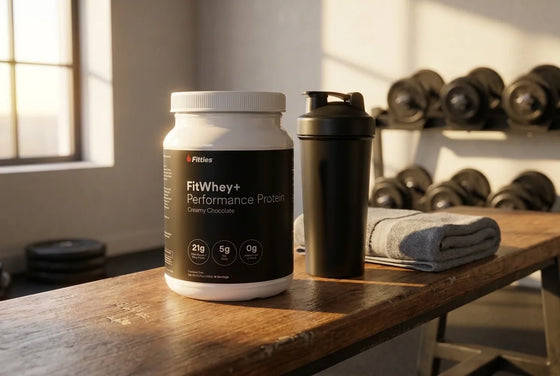
FitWhey+ is built on whey protein concentrate from New Zealand, from pastured cattle that are grass-fed and rBST and rBGH hormone free. Every two-scoop serving carries 21 g of whey protein, inulin fiber from chicory root, and fungal proteases (Aminogen). No added sugar, no stevia, sweetened with monk fruit. Commodity whey rebranded three times over is still commodity whey. Contains milk.
Shop FitWhey+Does creatine break down if it sits in your shake?
This is the one real caveat, and it is about the liquid, not the protein. Creatine is stable as a dry powder but not in water, where it slowly cyclizes into creatinine, a waste product your kidneys clear and your muscles cannot use. How fast depends almost entirely on two variables, pH and temperature.
A 2011 review in Amino Acids laid out the numbers. Jäger and colleagues reported that "after only 3 days of storage at 25°C creatine degraded significantly: 4% at pH 5.5; 12% at pH 4.5; and 21% at pH 3.5," while creatine stayed relatively stable in solution at neutral pH of 6.5 or 7.5. Their summary of the mechanism is blunt: "the lower the pH and higher the temperature, the faster is the degradation."
| pH of the liquid | Creatine lost after 3 days at 25°C (77°F) |
|---|---|
| 6.5 to 7.5 (neutral) | Relatively stable |
| 5.5 | 4% |
| 4.5 | 12% |
| 3.5 | 21% |
Read the units before you panic. That is three days, not three minutes. A shake you mix and drink loses a rounding error. Even a shaker that sits in your gym bag through a training session is nowhere near the timescale where the numbers above start to bite.
The worst case looks different. When researchers dissolved effervescent creatine powder in deionized water at pH 6.2 and tracked it, Ganguly and Dash found that "ninety percent creatine degradation was observed within 45 days for RT samples," with room temperature defined as 25°C. Refrigeration slowed it to 80% over the same period. That is what happens to creatine dissolved in something acidic and abandoned for six weeks. It is not what happens to your breakfast shake.
Does taking creatine with protein actually help?

There is reasonable evidence that it does, and the proposed mechanism is insulin (Candow et al., 2022). Insulin appears to increase muscle creatine uptake through its effect on the sodium-potassium pump, so anything that raises insulin alongside a creatine dose tends to move more of that creatine into muscle rather than out through urine.
The study everyone cites here is Steenge and colleagues, from 2000. As a 2022 review in Frontiers in Sports and Active Living reports it, when a mixture of 50 g of protein and 47 g of carbohydrate was consumed alongside creatine, researchers "found a significantly greater uptake compared to creatine alone."
Two honest caveats before you go build your shake around that. First, those are large doses. Fifty grams of protein and forty-seven grams of carbohydrate is a substantial meal replacement, not a scoop in water, and a smaller shake will not reproduce the effect at full strength. Second, the effect is on how much creatine gets retained during loading, not a promise about how much muscle you build. Once your muscles are saturated, extra retention has nowhere useful to go.
What about timing the shake around your session? The same review concludes that "the current body of research does not support timed creatine supplementation prescription in relation to long(er) term training or in combination with other ingredients" (Candow et al., 2022). Taking creatine before or after training produced similar muscle benefits in young and older adults, though the authors note the few studies available have limitations, chiefly the lack of a placebo group. Consistency beats clock-watching, which is the same conclusion we reached in our guide to when to take creatine.
How much creatine should you put in a protein shake?
The dose does not change because it is going into a shake. The ISSN position stand sets out two protocols, and the daily maintenance figure is the one most people need.
| Protocol | Dose | Duration |
|---|---|---|
| Loading | 5 g four times daily, or about 0.3 g per kg of body weight | 5 to 7 days |
| Maintenance | 3 to 5 g per day | Ongoing |
| Larger athletes | Up to 5 to 10 g per day | Ongoing |
All three figures come from the ISSN position stand, which states that "creatine stores can generally be maintained by ingesting 3-5 g/day, although some studies indicate that larger athletes may need to ingest as much as 5-10 g/day." On safety, the same document concludes that short and long term supplementation "up to 30 g/day for 5 years" has been shown to be safe and well tolerated in healthy individuals. If you are loading, split the doses across the day rather than dumping 20 g into one shake, which is a reliable way to give yourself an upset stomach. Our breakdown of how much creatine per day works through the body-weight math in more detail.
What should you not mix creatine with?
Very little, and the exceptions follow directly from the pH and temperature data above rather than from any interaction with another supplement.
- Hot liquids you plan to leave standing. Heat accelerates the conversion to creatinine. Stirring creatine into coffee you drink straight away is fine; leaving it in a thermos all morning is working against you.
- Acidic drinks you leave sitting. Citrus juice and soda sit well below neutral pH. Drink it immediately and the loss is trivial. Mix a jug on Sunday for the week and you are dosing yourself with creatinine by Wednesday.
- Anything that stops you taking it daily. The most common reason creatine underperforms is not chemistry. It is a tub sitting in a cupboard.
Caffeine is the interaction people ask about most, and the answer is more nuanced than the headline version. We covered the evidence in full in our piece on creatine and caffeine, so if your creatine already comes packaged with a stimulant, start there.
Here is one general note that applies to any supplement decision. If you are pregnant or nursing, taking prescription medication, or managing a health condition, talk to your healthcare provider before adding creatine or a protein supplement to your routine. Creatine is well studied in healthy adults, and its safety record is for that group (NIH Office of Dietary Supplements), so the qualifier matters.
What to look for in the protein you mix it into

Since the creatine is along for the ride, the protein is where the actual buying decision lives. The supplement aisle is full of commodity whey rebranded three times over, propped up by enough sucralose to hide what is underneath. A few things are worth checking on the label before the flavor name.
Check the protein per serving against the serving size, not the scoop count, because a "30 g protein" claim across three scoops is a different product from the same number across one. Check the sweetener. Check whether the carbohydrate is fiber or filler. Check the allergen line, especially if you are the one in the household with a restriction.
For reference, FitWhey+ is built on whey protein concentrate from New Zealand, from pastured cattle that are grass-fed and rBST and rBGH hormone free. Per two-scoop serving of the Chocolate, about 42 g, it provides 21 g of whey protein and 170 calories, with 0 g of added sugars, sweetened with monk fruit extract rather than stevia or artificial sweeteners. It also carries inulin fiber from chicory root and Aminogen®, a fungal protease complex. It contains milk, and it is formulated to exclude wheat, gluten, yeast, soy protein, fish, shellfish, peanuts, tree nuts, egg, sesame, artificial colors and artificial sweeteners. The label directions call for cold water, which is convenient given everything above about heat.
Per its label, FitWhey+ is not intended for use by infants, children, or pregnant or nursing women, and very low calorie protein diets below 400 calories per day may cause serious illness or death and should not be undertaken without medical supervision.
The four rules, in one place
- Mix them. There is no interaction to avoid, and creatine taken with protein and carbohydrate showed greater retention than creatine alone.
- Drink it. Degradation in solution is measured in days, not minutes. A shake you actually drink loses effectively nothing.
- Keep it cool and near neutral. Cold water is the ideal carrier. Hot and acidic liquids left standing are where creatine turns into creatinine.
- Keep the dose boring. Three to five grams a day, every day, including rest days. Consistency is doing more work than timing ever will.
FitWhey+
FitWhey+ is built on whey protein concentrate from New Zealand, from pastured cattle that are grass-fed and rBST and rBGH hormone free. Every two-scoop serving carries 21 g of whey protein, inulin fiber from chicory root, and fungal proteases (Aminogen). No added sugar, no stevia, sweetened with monk fruit. Commodity whey rebranded three times over is still commodity whey. Contains milk.
Shop FitWhey+