The Fitties Journal
Skinny Fat: The 5-Step Fix, and Why More Cardio Isn't It
Key Takeaways
Here's what matters most if you're short on time.
- Skinny fat means a normal body weight with low muscle mass and a relatively high body fat percentage, which BMI cannot detect.
- The fix is adding muscle, not losing more weight, so resistance training comes before anything else.
- Research puts the plateau for training-induced lean mass gains at about 1.6 grams of protein per kilogram of body weight per day (Morton et al., 2018).
- A smaller calorie deficit leaves room to gain lean mass; an aggressive one does not.
- Cardio supports cardiovascular health but gives the body no reason to build muscle, so it cannot fix this on its own.
- Progress shows up in body fat measurements and strength numbers long before it shows up on the scale.
Skinny fat is not a weight problem. It is a body composition problem, a normal body weight carrying too little muscle and a relatively high percentage of body fat. That is why the scale reads fine, the BMI chart reads fine, and the mirror disagrees with both.
Which means the standard advice, eat less and do more cardio, is aimed at the wrong target. The fix is not losing more weight. It is adding muscle while holding fat loss to a pace your body can support. Five things do it. Resistance training, protein at roughly 1.6 g per kilogram of body weight, calories near maintenance, cardio kept in its lane, and progress measured by body composition instead of scale weight.
What Does Skinny Fat Really Mean?
"Skinny fat" is gym slang for something researchers call normal weight obesity, a body mass index in the normal range paired with a high percentage of body fat. In the NHANES III analysis that put the term on the map, researchers classified 6,171 normal-BMI adults and defined normal weight obesity as the highest sex-specific third of body fat, above 23.1% in men and above 33.3% in women. Metabolic syndrome was roughly four times more common in that group than in the lowest body fat group, 16.6% versus 4.8% (Romero-Corral et al., European Heart Journal, 2010). It is worth noting that those percentages were the boundaries within that specific cohort, not a clinical diagnosis.
The reason nobody flags it is that the screening tool most people are measured with cannot see it. The CDC states plainly that "BMI does not distinguish between fat, muscle, and bone mass" (CDC, About Body Mass Index), and the NHLBI notes that BMI "is a screening tool and does not necessarily diagnose body fatness" (NHLBI, Overweight and Obesity). Two people at the same height and weight can have wildly different amounts of muscle on them. One gets called healthy. The other gets called skinny fat. The scale cannot tell them apart, so it stops being a useful instrument the moment body composition is the actual question.
FitWhey+
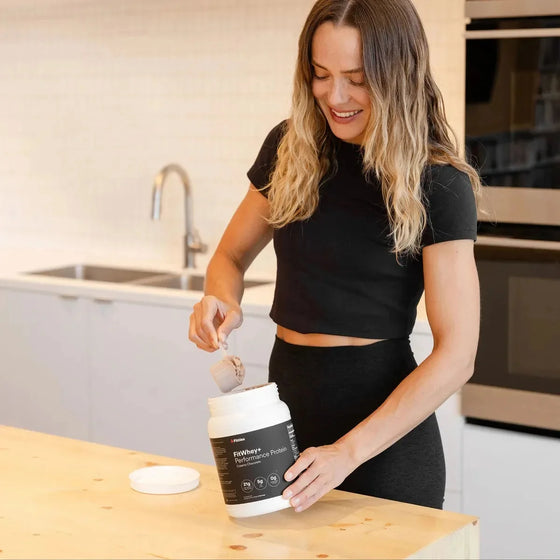
FitWhey+ has 21 g of protein per two-scoop serving from New Zealand grass-fed whey protein concentrate, more than 2,300 mg of it leucine, with zero added sugar and no stevia or artificial sweeteners. No proprietary blend, no serving-size games, just clean raw material for the number that matters most.
Shop FitWhey+How Do I Know If I Am Skinny Fat?
You measure body fat instead of body weight. The usual signs are a normal or low body weight, soft midsection, little visible muscle definition anywhere, and strength numbers that have never really moved. But signs are not measurements, so get a number.
The reference ranges most often cited come from a 2000 analysis of 1,626 adults using four-compartment modeling and DXA, which proposed body fat ranges by age and sex (Gallagher et al., American Journal of Clinical Nutrition, 2000). The authors called these provisional, and they are derived from BMI relationships rather than health outcomes, so treat them as a map, not a verdict. The table below uses the paper's figures for white adults; the same analysis predicted higher body fat at a given BMI for Asian adults and slightly lower body fat for African American adults.
| Age | Men, healthy range | Women, healthy range | Overfat begins at (men / women) |
|---|---|---|---|
| 20 to 39 | 8.0% to 20.9% | 21.0% to 32.9% | 21.0% / 33.0% |
| 40 to 59 | 11.0% to 22.9% | 23.0% to 34.9% | 23.0% / 35.0% |
| 60 to 79 | 13.0% to 24.9% | 25.0% to 37.9% | 25.0% / 38.0% |
Here is the part the ranges do not capture. Skinny fat is defined as much by what is missing as by what is there. Someone at 22% body fat who squats their body weight and someone at 22% who has never trained look nothing alike, because one of them has muscle under the fat. So run two measurements, not one. A body fat estimate and a strength baseline. Skinfold calipers and the US Navy tape method are cheap and consistent enough to track change over time, and a DEXA scan gives you a harder starting number if you want one. Our guide to measuring body fat walks through each method and its error margin.
Why Is More Cardio the Wrong Lever?

Because cardio is very good at the thing you do not need and mediocre at the thing you do. Running burns energy. It does not give your body a compelling reason to build or keep muscle tissue, and muscle is the entire missing ingredient in a skinny fat physique.
Stack a large calorie deficit on top of it and the problem compounds. In a trial of 24 elite athletes all doing four resistance sessions per week, one group cut calories about 19% and lost weight at roughly 0.7% of body weight per week, while the other cut about 30% and lost at roughly 1.0% per week. Both groups lost near-identical total body weight, around 5.5%. The difference was what that weight was made of. Lean body mass rose 2.1% in the slower group and did not change in the faster one, while fat mass fell 31% versus 21% (Garthe et al., International Journal of Sport Nutrition and Exercise Metabolism, 2011). Small study, elite population, and the two groups also dieted for different lengths of time, so read it as directional rather than definitive.
The honest read is that the faster group did not melt their muscle away, they just failed to gain any. That is the skinny fat trap in one sentence. Months of effort, real weight lost, and the body composition problem is exactly where it started because nothing in the plan was ever asking the body to add tissue.
Does Muscle Really Burn That Many Calories?
No, and the supplement industry has been quietly leaning on this one for years. When researchers measured organ and tissue metabolic rates in 131 healthy adults using MRI and indirect calorimetry, skeletal muscle came in at about 13 kcal per kilogram per day, against about 4.5 kcal per kilogram per day for adipose tissue (Wang et al., American Journal of Clinical Nutrition, 2010). Muscle is roughly three times more metabolically active than fat at rest, not the ten or twenty times the "a pound of muscle burns 50 calories a day" line implies. Adding a kilogram of muscle buys you something in the neighborhood of 13 extra calories per day at rest.
Build muscle anyway. Just build it for the right reasons. How you look, what you can lift, how you handle glucose, and how well you hold onto function as you age. Not as a metabolism hack, because the metabolism math does not carry that story.
What Is the 5-Step Fix for Skinny Fat?
Step 1: Lift, and Count Weekly Sets Rather Than Sessions
Resistance training is the non-negotiable one. Everything else on this list is support. Anchor the program on compound movements that load a lot of muscle at once. Squat, hinge, press, row, and a carry or a core pattern.
Count hard sets per muscle group per week, because weekly volume is what drives growth. A 2019 meta-analysis of 25 studies found no significant difference between higher and lower training frequency once weekly volume was matched, concluding that people "can choose a weekly frequency per muscle group based on personal preference" (Schoenfeld, Grgic and Krieger, Journal of Sports Sciences, 2019). So splitting a muscle group across two sessions is a practical way to accumulate volume without one brutal session, not a magic frequency. Three to four sessions per week is enough structure for most people starting out.
Step 2: Get Protein to About 1.6 g per Kilogram
A meta-analysis of 49 studies covering 1,863 healthy adults found that gains in fat-free mass from resistance training plateaued at a total protein intake of about 1.62 g per kilogram of body weight per day, with a confidence interval running from 1.03 to 2.20 (Morton et al., British Journal of Sports Medicine, 2018). For a 70 kg person that is roughly 113 g per day. The upper bound is not a target, it is the edge of the estimate, so 1.6 is the number to build around.
Protein matters more, not less, when calories are down. A four-week trial of 40 young men held to a 40% calorie deficit while training six days a week compared 2.4 g per kilogram against 1.2. The higher-protein group gained 1.2 kg of lean mass and lost 4.8 kg of fat; the lower-protein group gained 0.1 kg and lost 3.5 kg (Longland et al., American Journal of Clinical Nutrition, 2016). The authors called it a proof-of-principle trial. Four weeks, young men, supervised training six days a week. Do not project those exact numbers onto yourself. Do take the direction seriously. More on hitting the number in our protein intake guide.
Step 3: Eat Near Maintenance, Not in a Crash Deficit
The instinct is to slash calories. Resist it. A skinny fat body needs building material, and aggressive deficits leave nothing to build with. In the Garthe trial above, the group that gained lean mass was the one that cut intake by about 19% and lost roughly 0.7% of body weight per week, while the group cutting about 30% gained none (Garthe et al., 2011). Maintenance calories or a deficit in that gentler neighborhood is the working range, and it is the opposite of what most people do when they decide to get serious.
One safety line is worth stating plainly, because it appears on our own label and on every reputable protein product. Very low calorie protein diets, below 400 calories per day, may cause serious illness or death, and should not be used for weight reduction without medical supervision. If you are considering an aggressive deficit, if you are pregnant or nursing, or if you take prescription medication, talk to your healthcare provider before changing anything.
Step 4: Keep Cardio, but Cap It
Cardio is not the villain here, it is just badly cast. It supports cardiovascular health, it helps manage energy balance, and it makes you better at recovering between hard sets. The CDC puts the adult target at "150 minutes of moderate-intensity physical activity a week" alongside "at least 2 days of muscle-strengthening activity each week" working all major muscle groups (CDC, Adult Activity: An Overview). Note the structure of that. Aerobic work and resistance work are two separate requirements, not substitutes. What cardio should not do is crowd out lifting, eat into recovery, or become the thing you add more of when progress stalls. When progress stalls, the answer is almost always more protein or more weekly sets, not more minutes on a machine.
Step 5: Track Composition and Strength, Not Scale Weight
Fixing skinny fat means gaining one kind of tissue while losing another, which is the exact scenario where scale weight tells you nothing. It can stay flat for months while everything underneath it changes.
Track three things instead. A body fat estimate taken the same way every four weeks, a waist measurement, and your working weights on two or three main lifts. When body fat and waist drop while the bar goes up, the plan is working, whatever the scale says. Our body recomposition guide goes deeper on running the two processes at once.
How Long Does It Take to Fix Skinny Fat?
Longer than the internet promises, and it varies enormously between individuals. The controlled trials that measure this run short. Longland's ran four weeks and Garthe's ran roughly five to nine weeks, and both recorded measurable body composition change inside that window (Longland et al., 2016; Garthe et al., 2011). But read the fine print on both. Supervised training four to six days per week, controlled diets, and participants who were young men or elite athletes. Those are not the conditions most people train under, so those timelines are a ceiling, not a forecast.
The more useful framing is what moves first. Strength numbers change before the mirror does, and the mirror changes before anyone else notices. That order is why step 5 matters. If you only look at the scale and the mirror, you will conclude nothing is happening during the exact stretch when the most is. Anyone promising you a specific result in a specific number of weeks is selling the one thing they cannot deliver, and results vary by individual.
Where Do Supplements Fit?

Below training and food, and a long way below. Nothing on a supplement shelf substitutes for weekly sets and a daily protein number. That said, hitting 1.6 g per kilogram from whole food alone is where a lot of people quietly fail, especially at the higher body weights where the target crosses 140 g per day. A protein powder is not a magic lever, it is a logistics tool that makes a hard number easy.
Read the label rather than the front of the tub. Check protein per serving against the scoop size, check what the sweetener is, and check whether the ingredient list is short enough to read out loud. The industry standard is a serving size engineered to flatter the protein number and a proprietary blend hiding how little of anything is really in there.
FitWhey+ is built the opposite way. In the vanilla, two scoops deliver 21 g of New Zealand grass-fed whey protein concentrate, 2,350 mg of it leucine, at 130 calories and 5 g net carbs. Both flavors carry zero added sugar and are sweetened with monk fruit, not stevia and not artificial sweeteners. It is formulated to exclude wheat, gluten, soy protein, egg, sesame, tree nuts, and peanuts, and it contains milk, since it is whey. Beyond protein, creatine is the one other ingredient worth reading up on before you spend money anywhere else, and our creatine guide walks through the research.
None of that changes the order of operations. Lift, eat the protein, keep the deficit small, and give it long enough to matter. The supplement aisle is the last 5% of this problem, and the first 95% is free.
FitWhey+
FitWhey+ has 21 g of protein per two-scoop serving from New Zealand grass-fed whey protein concentrate, more than 2,300 mg of it leucine, with zero added sugar and no stevia or artificial sweeteners. No proprietary blend, no serving-size games, just clean raw material for the number that matters most.
Shop FitWhey+