
The Fitties Journal
Body Recomposition: 6 Rules to Lose Fat and Build Muscle at the Same Time
Key Takeaways
Here's what matters most if you're short on time.
- Body recomposition means losing fat and building muscle over the same period, so the scale can stay flat while your body changes.
- Set calories at maintenance or a small deficit; aggressive cuts make it harder to hold on to muscle.
- Protein is the biggest nutrition lever. A 2018 meta-analysis of 49 trials (Morton et al.) found muscle gains plateau around 1.6 grams per kilogram of body weight per day, with a confidence range up to about 2.2.
- Progressive resistance training, hitting each muscle at least twice a week, provides the muscle-building signal.
- Track measurements, photos, strength, and body-fat estimates instead of body weight alone.
Body recomposition means losing body fat and building muscle over the same stretch of time, instead of picking one and scheduling the other for next year. Researchers define it as reducing fat mass while maintaining or increasing lean mass, often with little or no change in total body weight (PMC, 2024). It is not a pill protocol or a 30-day challenge. It is a short list of unglamorous levers held consistently. They are calories near maintenance, protein high enough to build with, progressive resistance training, real sleep, and a smarter scoreboard than a bathroom scale.
That last part matters most. During a successful recomp, the scale often barely moves, because fat is leaving while muscle arrives. Judge the next three months by body weight alone and you will fire a plan that is working. Here are the six rules that decide whether it works.
What Is Body Recomposition, and Who Does It Work Best For?
Fat loss and muscle growth run on different signals, which is why they can happen in the same season. Muscle needs a building stimulus (training) and raw material (protein). Fat loss needs an energy shortfall. During a recomp, stored body fat helps cover the energy gap while training and protein direct resources toward muscle.
The effect is strongest in three groups. They are people new to lifting, people returning after a long break, and people carrying higher body fat. Their muscle-building response to training is at its peak, and their fat stores can fund it. Advanced lifters are not excluded, just slower. A 2020 review in the Strength and Conditioning Journal concluded that trained individuals can gain muscle and lose fat simultaneously, provided training and nutrition are dialed in (Barakat et al., 2020). So the old "recomp is only for beginners" line is outdated. It just gets harder to see, and harder to earn, as you advance.
FitWhey+
FitWhey+ is 21 grams of 100 percent New Zealand grass-fed whey per two-scoop serving, with 130 calories and 5 grams of net carbs in the Vanilla (170 and 10 in the Chocolate), and zero added sugar. Sweetened with monk fruit, no stevia, no artificial sweeteners, no proprietary blends. When protein is the job, this is clean raw material.
Shop FitWhey+Should You Cut, Bulk, or Recomp?
Pick based on where you are standing, not on what sounds most impressive.
| Approach | Calories | Scale Weight | Best For | Trade-Off |
|---|---|---|---|---|
| Cut | Below maintenance | Drops | Higher body fat, or a hard deadline | Muscle is at risk if protein and training slip |
| Bulk | Above maintenance | Climbs | Lean lifters chasing maximum muscle | Some fat comes along for the ride |
| Recomp | At maintenance or slightly under | Roughly flat | Beginners, returners, moderate body fat | Each goal moves more slowly than it would alone |
If you are well into the overweight range, a straightforward fat-loss phase with high protein will feel like a recomp anyway, because beginners in a deficit routinely add muscle while losing fat. If you are already lean and experienced, committing to one goal at a time is usually more efficient. The recomp lane belongs to everyone in the middle, including anyone who is skinny fat at a normal body weight. They have enough fat to fund the project, enough untapped training response to build with.
Rule 1: Hold Calories at Maintenance or a Small Deficit
The most common recomp mistake is running the aggressive deficit of a crash diet and expecting muscle to grow in the rubble. Building tissue is expensive, and a body in a deep energy hole starts triaging. Holding onto what you already built becomes the priority, which is where the research on HMB and muscle preservation is focused. The International Society of Sports Nutrition's 2013 position stand says HMB may help athletes avoid losing lean mass in catabolic situations such as calorie restriction (Wilson et al., 2013).
The evidence favors patience. In a study of elite athletes, the group losing about 0.7 percent of body weight per week gained lean mass, while the group cutting twice as fast at 1.4 percent per week did not (Garthe et al., 2011). Slower loss left room to build.
In practice, estimate your maintenance calories, then eat at that level or a few hundred calories under it. Carrying more body fat buys you a deeper deficit; being leaner means staying closer to maintenance. Hold the target for two weeks, watch your measurements and average weight, and adjust from data instead of vibes.
Rule 2: Eat Protein Like It Is the Whole Job

If recomposition has one non-negotiable, this is it. Protein supplies the amino acids that new muscle is built from, it is the most filling macronutrient, and it costs the most energy to process. Roughly 20 to 30 percent of protein calories are burned during digestion and processing (Westerterp, 2004).
The target range is well mapped. A meta-analysis of 49 resistance-training studies found muscle-gain benefits plateau around 1.6 grams of protein per kilogram of body weight per day, with the upper confidence range extending to about 2.2 (Morton et al., 2018). For an 80 kg (176 lb) person, that is roughly 130 to 175 grams a day.
Push toward the top of that range when your deficit is real and your training is hard. In a four-week trial of young men training intensely in a steep deficit, the group eating 2.4 grams per kilogram gained lean mass and lost more fat than the group at 1.2 (Longland et al., 2016). Spread it over three or four meals, lead with whole foods, and if the daily total is the sticking point, our guide to how much protein you need per day breaks the math down further.
Rule 3: Train Like Muscle Is the Point (Because It Is)
Without a training stimulus, a calorie deficit is just a diet, and a diet does not tell your body to keep muscle, let alone add it. Progressive overload does. That means tracking your lifts and gradually adding weight, reps, or sets over time, mostly through compound movements, like squats, hinges, presses, rows, pulls.
Two evidence-backed dials matter most. For volume, a dose-response meta-analysis found a graded relationship, with each additional weekly set per muscle adding a little more growth (Schoenfeld et al., 2017). For frequency, training each muscle at least twice per week beat once-a-week routines for hypertrophy (Schoenfeld et al., 2016). Three to five sessions a week covers both dials for most people.
The standard is effort with a logbook. If your numbers have not moved in a month, the muscle side of your recomp is idling.
Rule 4: Use Cardio as a Tool, Not a Punishment
Cardio widens your energy gap, supports recovery, and keeps your engine healthy. What it does not do is build the muscle half of a recomposition, and enough of it, badly placed, can interfere with the training that does.
Keep it boring and deliberate. A high daily step count does quiet work on energy balance. Two or three easy-to-moderate sessions a week add capacity without draining your lifting. If something has to give on a busy week, protect the weights and let cardio flex.
Rule 5: Sleep Is Half the Program
Sleep is where the recomp is decided, not just supported. In a controlled study of dieters, sleeping 5.5 hours instead of 8.5 cut the share of weight lost as fat by 55 percent and increased lean tissue loss by 60 percent (Nedeltcheva et al., 2010). Same diet, opposite outcome. The short sleepers lost muscle and kept fat, which is a recomposition running in reverse.
The CDC recommends adults get at least 7 hours a night (CDC). Treat that as a training variable with the same status as your protein target. That means a consistent schedule, a dark cool room, and caffeine cut off early enough to matter.
Rule 6: Track Body Composition, Not Body Weight
Recomposition is designed to keep the scale flat, so the scale is a terrible referee for it. Fat leaves, muscle arrives, and the number in the morning shrugs. That same blind spot is why so many people ask does protein powder make you gain weight after adding a shake and watching the number climb. You need instruments that can see the trade happening.
Use several, and repeat them under the same conditions.
- Tape measurements, especially the waist, every two weeks
- Progress photos, monthly, same light and poses
- A strength log, because climbing lifts at a flat body weight is recomposition in plain sight
- Body-fat estimates, repeated the same way each time; our guide to how to measure body fat covers the methods and their error bars
Give any judgment an 8-to-12-week window. Shorter than that, you are mostly measuring water, carbs, and mood.
How Long Does Body Recomposition Take?
Months, not weeks, and that is not a hedge. Strength tends to move first, within a few weeks. Visible changes in measurements and photos commonly take 8 to 12 weeks of consistent execution. Well-trained lifters should expect the slower end of everything (Barakat et al., 2020).
The encouraging part is that because you are not slashing calories, a recomp is far easier to live with than a hard cut. There is no rebound scheduled, no finish line to fall apart after. It is the quiet, compounding version of the goal, which is exactly why it works.
Where Do Supplements Fit in a Recomp?

Behind calories, protein, training, and sleep. Nothing in a tub outranks those four, and the corner of the industry that says otherwise, the fat-burner aisle, the "shredding stacks," is selling a shortcut to a road that does not have one.
Two things earn their place by serving the fundamentals. The first is a protein powder, which is logistics, not magic. Hitting 1.6 to 2.2 grams per kilogram from whole food every single day is where most recomps quietly die. If a shake keeps your number honest, use one built like food instead of dessert. FitWhey+ is 21 grams of 100 percent New Zealand grass-fed whey per two-scoop serving, with zero added sugar. It has 130 calories and 5 grams of net carbs in the Vanilla, 170 calories and 10 grams of net carbs in the Chocolate.
The second is creatine monohydrate, among the most extensively studied performance supplements in sports nutrition, with more than 500 peer-reviewed publications (Antonio et al., 2021). The International Society of Sports Nutrition's position stand reports that 3 to 5 grams daily supports high-intensity training capacity and lean-mass gains during training (Kreider et al., 2017). Our creatine buyer's guide covers forms, dosing, and what to ignore.
If you take medication or manage a health condition, talk with your healthcare provider before changing your diet, training, or supplements. Then go move some iron.
FitWhey+
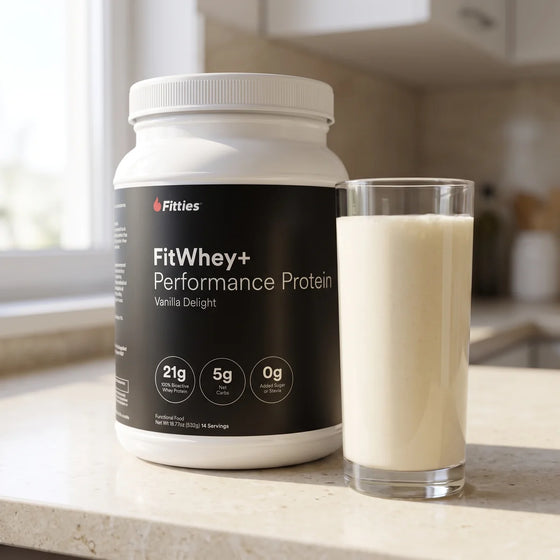
FitWhey+ is 21 grams of 100 percent New Zealand grass-fed whey per two-scoop serving, with 130 calories and 5 grams of net carbs in the Vanilla (170 and 10 in the Chocolate), and zero added sugar. Sweetened with monk fruit, no stevia, no artificial sweeteners, no proprietary blends. When protein is the job, this is clean raw material.
Shop FitWhey+