The Fitties Journal
Does Protein Powder Make You Gain Weight? 5 Reasons the Scale Moves
Key Takeaways
Here's what matters most if you're short on time.
- Protein powder does not cause weight gain on its own. A sustained calorie surplus does.
- A plain scoop is a small calorie load. A FitWhey+ Vanilla serving is 130 calories for 21 grams of protein.
- What you mix into the shake usually costs more calories than the powder itself.
- A shake added on top of your normal meals adds calories. A shake that replaces something does not.
- Mass gainers are a separate product category built to add calories, and the Supplement Facts panel shows it.
- Water weight and new muscle both register on a scale, so judge a four to six week trend rather than a daily number.
No. Protein powder does not make you gain weight on its own. Weight gain comes from a sustained calorie surplus, and a scoop of plain protein powder is one of the smallest calorie loads in the supplement aisle. FitWhey+, for example, is 130 calories for 21 grams of protein per serving of the Vanilla. The scale moves for other reasons. The shake gets added on top of everything you already eat, the shaker quietly turns into a smoothie full of oats and nut butter and whole milk, or the tub you bought was a mass gainer, which exists to add calories and says so on the panel. There is also the version of weight gain you were probably after, where you train hard, eat enough, and some of that number is muscle. Below are the five reasons the number moves, and what to do about each one.
How many calories are in a scoop of protein powder?
Fewer than most people assume, and far fewer than the meal the shake is supposed to stand in for. A serving of FitWhey+ Vanilla is 130 calories, with 21 grams of protein, 5 grams of net carbs, and zero added sugar (Chocolate has 170 calories, 10 grams of net carbs). That is the entire calorie cost of the powder. Everything else in your shake is a choice you made after the scoop went in.
This is where the industry gets slippery. A tub marketed as a protein powder and a tub marketed as a mass gainer can sit on the same shelf in the same size container, and only one of them is engineered to push your daily total up. The Supplement Facts panel settles it in about four seconds. If you never look, the tub decides for you.
| What goes in the shaker | What it does to the calorie total | Best for |
|---|---|---|
| Powder and water | Nothing beyond the scoop itself | Cutting, or holding steady |
| Powder and whole milk | Adds the milk's calories on top of the scoop | Gaining on purpose |
| Powder, banana, oats, nut butter | Turns a shake into a full meal | Replacing a meal, not adding one |
| Mass gainer powder | Built to add calories, and the panel shows it | Deliberate weight gain |
FitWhey+
FitWhey+ is 21 grams of New Zealand grass-fed whey per serving, with 130 calories and 5 grams of net carbs in the Vanilla (170 and 10 in the Chocolate), and 0 grams of added sugars. Sweetened with monk fruit, never stevia or artificial sweeteners, with the full amino acid profile printed on the panel. Built for people who read the label before they buy the tub.
Shop FitWhey+Why did the scale go up when you started drinking protein shakes?

Because in almost every case the shake was an addition, not a substitution. People start a protein habit for good reasons, then keep eating exactly as they did before and drink a few hundred extra calories a day on top. That is not a protein problem. That is arithmetic, and it would do the same thing if the extra calories arrived as orange juice.
The first week or two also flatters the story in a misleading way. If you started training at the same time you started the shakes, your muscles are holding more water and glycogen than they were, and connective tissue is carrying more fluid while it adapts. The scale registers that as weight because a scale cannot tell the difference between water, muscle, and fat. It weighs you. That is the whole job.
Give it four to six weeks before you draw a conclusion, and judge it on more than one number. How your training is going, how clothes fit, and where your waist measurement sits will tell you more in that window than a daily weigh-in ever will.
5 reasons protein powder makes you gain weight
1. You added the shake instead of swapping something out
The most common one by a distance. A shake between lunch and dinner is only free if it replaces something. If it slots in beside your existing meals, its calories go straight into your daily total. Decide up front whether the shake is a meal, part of a meal, or an extra, and then let the rest of the day reflect that decision.
2. You are drinking a smoothie and calling it a shake
Powder and water is a shake. Powder, whole milk, a banana, a scoop of oats, a spoonful of peanut butter, and a handful of frozen berries is a meal that happens to be liquid. Both are fine. They are just not the same thing, and treating the second as if it were the first is how a "light" habit quietly outweighs lunch.
3. You bought a mass gainer without realizing it
Mass gainers are a legitimate product for people who genuinely struggle to eat enough. They are also easy to buy by accident, because the packaging language overlaps almost entirely with regular protein. Read the serving size and the calories per serving before the first scoop, not after the first month.
4. Liquid calories do not register the way food does
A shake takes ninety seconds to drink and rarely gets logged with the same honesty as a plate of food. Reviews of protein and appetite report that protein tends to increase feelings of fullness compared with the same calories from carbohydrate or fat (Paddon-Jones et al., American Journal of Clinical Nutrition), which is a point in its favor, but fullness only helps if the shake is displacing something. If you drink it and eat the same dinner anyway, the calories still count.
5. You are gaining muscle, which was the point
If you are lifting seriously, eating enough, and hitting your protein target, some of the weight you are adding is lean mass. That is a result, not a side effect. It is also the one version of "gaining weight" that shows up as better training numbers and a smaller waist at the same time, which is why the scale alone is a poor referee. Our guide to losing fat and building muscle at the same time goes deeper on how to tell the two apart.
Does protein powder cause belly fat?
No, and nothing you eat targets a specific area of your body for storage. Fat is stored and released across the whole body, with distribution shaped mostly by genetics, sex, age, and hormones. A surplus of calories from any source, protein powder included, adds fat over time; a deficit removes it. Neither one takes instructions about where.
What is fair to say is that protein is a poor choice of macronutrient to overshoot on if fat gain is your worry, because it is the one most people are short of rather than swimming in. Federal guidance puts protein at 10 to 35 percent of daily calories for healthy adults (MedlinePlus, National Library of Medicine), and plenty of people sit near the bottom of that band. If you want to set an actual number rather than guess, start with how much protein you actually need.
How do you use protein powder without gaining fat?

Treat the shake as food, because it is food. That single reframe fixes most of the problem, because nobody eats a second dinner by accident and then wonders why the scale moved.
Work out your daily protein target first, then look at how much of it your meals already cover. The shake fills the gap that is left. If the gap is 20 grams, one scoop closes it. If the gap is zero, you do not need the shake that day, and no amount of marketing changes that. Then keep the build simple, with water or unsweetened almond milk on training days, and save the banana-and-nut-butter version for days when it is genuinely replacing a meal.
Here are a few practical rules that survive contact with real life.
- Swap, do not stack. The shake replaces something, or its calories come out of somewhere else.
- Log it the way you would log a sandwich, including whatever you blended into it.
- Weigh yourself on the same day of the week under the same conditions, and read the four-week trend rather than the daily number.
- Track your waist measurement alongside weight, so muscle and fat do not get counted as the same thing.
If you are using protein specifically to support a fat-loss phase, our six rules for choosing a protein powder for weight loss covers what to look for before you buy.
What should you check on the label before you buy?
Four lines, in this order. Calories per serving, protein per serving, added sugars, and serving size in scoops. Those four settle whether the tub in your hand is a lean protein source or a calorie delivery system, and they take longer to explain than to read.
Serving size is the one that catches people, because a "serving" can be one scoop or three depending on who is selling it, and the calorie figure is only meaningful next to it. Added sugars matter for the same reason. A powder that leans on sugar to taste good is spending your calorie budget on flavor rather than protein. For reference, a FitWhey+ Vanilla serving is two scoops, 130 calories, 21 grams of protein, 5 grams of net carbs, and zero added sugars, sweetened with monk fruit rather than stevia or artificial sweeteners. Whatever you buy, the panel should be able to survive that four-line check without any help from the front of the tub.
Two safety notes worth having. FitWhey+ contains milk, so it is not an option if you avoid dairy. And very low calorie protein diets, below 400 calories a day, may cause serious illness or death, so do not use any protein product for weight reduction in such a diet without medical supervision. It is not intended for infants, children, or pregnant or nursing women. If you take medication or manage a health condition, talk to your healthcare provider before changing what you supplement with.
FitWhey+
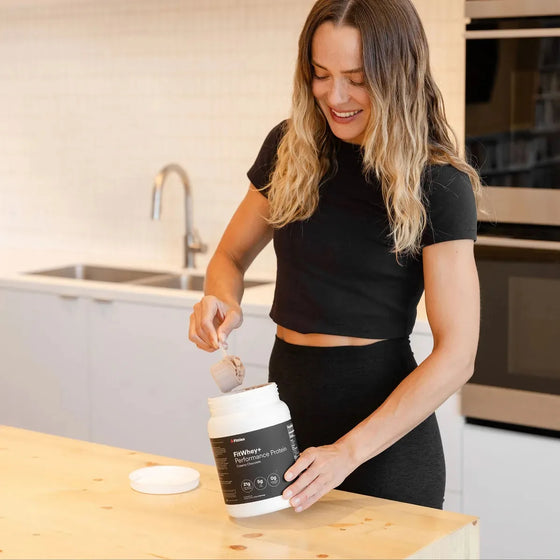
FitWhey+ is 21 grams of New Zealand grass-fed whey per serving, with 130 calories and 5 grams of net carbs in the Vanilla (170 and 10 in the Chocolate), and 0 grams of added sugars. Sweetened with monk fruit, never stevia or artificial sweeteners, with the full amino acid profile printed on the panel. Built for people who read the label before they buy the tub.
Shop FitWhey+