The Fitties Journal
What Is Aminogen? The Protease Blend and What 2 Human Studies Found
Key Takeaways
Here's what matters most if you're short on time.
- Proteases are enzymes that break proteins into peptides and amino acids, and the stomach and pancreas make their own.
- The protease blend in this article comes from two food-grade fungi, Aspergillus niger and Aspergillus oryzae.
- Two published human studies have tested this specific blend, and the company that made it funded both.
- In a 2008 open-label study of 41 healthy young men, blood amino acids rose more over four hours when 2.5 g or 5 g of the blend was mixed into 50 g of whey.
- FitWhey+ and FitPlant+ list fungal proteases in their ingredients but no amount, so no dose comparison with the studies is possible.
- FitWhey+ contains milk and is not for use by infants, children, or pregnant or nursing women.
Aminogen® is a branded blend of protease enzymes, the enzymes that break proteins into peptides and amino acids (Huang et al., 2025). It comes from two food-grade fungi, Aspergillus niger and Aspergillus oryzae (Oben et al., 2008). On the FitWhey+ and FitPlant+ labels it appears simply as "fungal proteases."
Enzyme blends are where supplement hype loves to hide. A lab-sounding name and a promise nobody measured. Here is what was measured. Two published human studies have tested Aminogen by name, and the company that made it funded both.
What is Aminogen?
Aminogen is a blend of digestive proteases from Aspergillus niger and Aspergillus oryzae, supplied by Triarco Industries for the 2008 study (Oben et al., 2008) and the 2013 study (Anderson, 2013). The current Fitties labels identify Aminogen as a registered trademark of Innophos Nutrition, Inc., and the FitWhey+ labels cite U.S. patent 5,387,422. That patent, published in 1995, describes a fungal enzyme food supplement that combines at least one acid protease with at least one semi-alkaline protease (U.S. patent 5,387,422).
FitWhey+
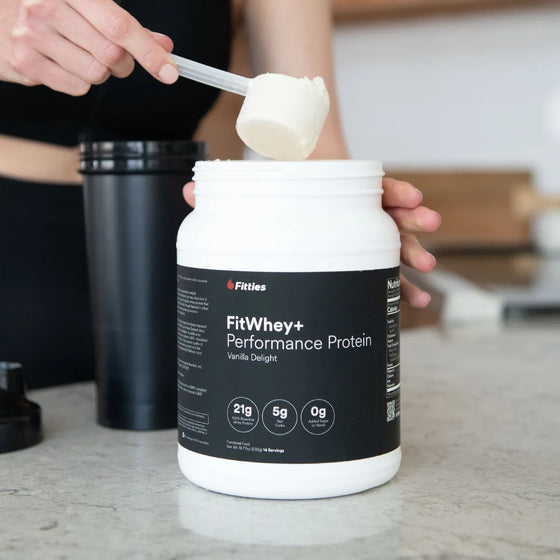
FitWhey+ is a whey protein shake mix with 21 g of protein per 2-scoop serving in both flavors, and New Zealand whey protein concentrate is its first ingredient. Its ingredient list also includes fungal proteases (Aminogen) and inulin from chicory. Mix two scoops into 10 to 14 oz of cold water.
Shop FitWhey+How does protein digestion work, and where do proteases fit?

Your body already runs a serious protease operation. In the stomach, acid activates pepsinogen into pepsin, which cuts protein into smaller fragments, peptides, and amino acids. In the small intestine, pancreatic enzymes, secreted as precursors such as trypsinogen and chymotrypsinogen, break those down further into amino acids, dipeptides, and tripeptides (Kiela and Ghishan, 2016).
Enzymes on the intestinal lining keep freeing amino acids, and small peptides can also be pulled into intestinal cells and split there. The peptide transporter has such high capacity that very little dietary peptide gets past the end of the small intestine (Kiela and Ghishan, 2016). Or, as the NIH digestive system guide puts it, proteins break into amino acids.
Adding proteases to a shake puts extra enzyme activity in the same drink, an approach researchers suggest may enhance protein digestion (Huang et al., 2025). In lab digestion models, microbial proteases worked under stomach-like acidity and sped the release of amino acids and peptides. In people, trials measuring blood amino acids after a protein dose have shown either a larger rise or no difference compared with placebo (Huang et al., 2025).
What does the research on Aminogen show?
What did the 2008 blood amino acid study find?
In an open-label study, 41 healthy, lean young men drank 50 g of whey protein concentrate (42.5 g of protein) after an overnight fast, then nine days later the same whey with 2.5 g or 5 g of Aminogen blended in (Oben et al., 2008). Over four hours, the rise in total blood amino acids above baseline, measured as area under the curve, was 2.2 times larger with 2.5 g and 3.5 times larger with 5 g than with whey alone, and the two enzyme doses did not differ significantly. Average 24-hour urinary nitrogen was lower after the enzyme drinks, about 7 g versus 10 to 11 g.
The limits matter. It was open label, with only the lab analysis blinded, and the whey-only drink always came first. Some amino acid measures already differed between the two legs at baseline, and nitrogen lost in sweat and stool went unmeasured. Triarco funded the study through a contract research organization; one author worked for Triarco and another for that firm.
What did the 2013 four-week tolerance study find?
Forty healthy, resistance-trained men were randomized, double-blind, to 40 g of whey twice a day, blended with 3% Aminogen or plain, during a four-week training program, and 36 finished (Anderson, 2013). The paper reported no adverse events and no significant changes in heart rate, blood pressure, or liver and kidney blood markers compared with whey alone. It was designed to check safety, not digestion or muscle. Triarco funded it, and its single author worked there.
What did trials of other protease blends find?
A different fungal protease blend, not Aminogen, was tested in two randomized, double-blind, placebo-controlled crossover trials funded by its supplier, which employed some of the authors. With 25 g of pea protein isolate in 24 healthy adults, one capsule of it (31,875 HUT, a unit of enzyme activity) raised total blood amino acids more than placebo over five hours (Paulussen et al., 2024). With whey supplying 25 g of protein in another 24 adults, a 50,000 HUT dose gave 14% and 15% larger early rises in essential and branched-chain amino acids but no difference in total amino acids or leucine (Huang et al., 2025). When 10 resistance-trained men took 250 mg of a third blend with 26 g of whey, amino acid area under the curve did not differ from whey alone, in a trial that blend's maker funded (Townsend et al., 2020).
How much Aminogen did the studies use, and when?
The doses tested in people were 2.5 g or 5 g in one 50 g serving of whey protein concentrate after an overnight fast (Oben et al., 2008), and whey blended with 3% Aminogen twice a day, taken around training or at breakfast and bedtime on rest days (Anderson, 2013). Neither study gave the enzyme on its own.
Aminogen vs bromelain and papain: how do they compare?
Bromelain and papain are plant proteases, which a 2024 analysis calls the most studied and used cysteine proteases in drugs, supplements, and food (Benito-Vázquez et al., 2024). Bromelain is a group of protein-digesting enzymes from the stem and fruit of the pineapple plant (NIH National Center for Complementary and Integrative Health). It is mainly extracted commercially from the stem, while papain comes from papaya fruit and latex (Giangrieco et al., 2024).
The fruit enzyme aisle is also where fairy dust gets literal. The same 2024 analysis notes that plant protease supplements are measured for enzyme activity in inconsistent ways, which makes them hard to compare, and in the four commercial pineapple extracts it tested, most of the bromelain was inactive (Benito-Vázquez et al., 2024).
| Enzyme | Where it comes from | What it is | Common uses |
|---|---|---|---|
| Aminogen | Fungi: Aspergillus niger and Aspergillus oryzae | A blend of fungal proteases | Blended into protein powders |
| Bromelain | Pineapple stem and fruit | A group of cysteine proteases | Food and drink processing, meat tenderizing, dietary supplements |
| Papain | Papaya fruit and latex | A cysteine protease | Food, pharmaceutical, chemical, and cosmetic uses |
Which Fitties proteins contain Aminogen, and how much?

Both flavors of FitWhey+, a whey protein shake mix, list fungal proteases (Aminogen) in the ingredients, with whey protein concentrate first. A serving of FitWhey+ Vanilla is 2 scoops (about 38 g) and a serving of FitWhey+ Chocolate is 2 scoops (about 42 g), each with 21 g of protein, mixed into 10 to 14 oz of cold water. Weighing whey types? Here is how whey isolate compares with concentrate.
Both flavors of FitPlant+, a pea and rice protein shake mix, list fungal proteases (Aminogen) too, with 15 g of protein per 2-scoop serving from pea protein isolate and rice protein concentrate. FitPlant+ is formulated to exclude animal and dairy products. For the wider picture, see how whey and plant protein compare.
Neither product's label lists an Aminogen amount. So no scoop of either can be compared with the doses in the studies above, the other enzyme trials did not test Aminogen at all, and none of those results should be read as results for FitWhey+ or FitPlant+.
Is Aminogen safe? Side effects and label warnings
In the four-week study, whey with Aminogen was well tolerated, and the occasional upset stomach, nausea, and headache also showed up with whey alone (Anderson, 2013). That study excluded anyone with a known allergy to Aminogen or whey ingredients, so it says nothing about allergies.
FitWhey+ contains milk (whey protein concentrate). Its label warning reads, "Very low calorie protein diets (below 400 calories per day) may cause serious illness or death. Do not use for weight reduction in such diets without medical supervision. Not for use by infants, children, or pregnant or nursing women. Do not use if tamper seal is damaged." Both the FitWhey+ and FitPlant+ labels say to consult your healthcare professional prior to use, and that individuals taking medication should discuss potential interactions with their healthcare professional.
Talk to your healthcare provider before using any enzyme product if you are pregnant or nursing, take medication, or have a digestive or other medical condition.
Who might care about Aminogen?
Aminogen matters most if you read ingredient lists and want to judge "fungal proteases" on evidence, or if you are choosing between fungal and fruit enzymes. With a food allergy or a medical condition, the label warnings matter more than any enzyme; FitWhey+, for example, contains milk. Either way, keep the scale in view. Two human studies of Aminogen by name, both in healthy men and both funded by its maker. See all Fitties ingredient spotlights for more breakdowns like this one.
FitWhey+
FitWhey+ is a whey protein shake mix with 21 g of protein per 2-scoop serving in both flavors, and New Zealand whey protein concentrate is its first ingredient. Its ingredient list also includes fungal proteases (Aminogen) and inulin from chicory. Mix two scoops into 10 to 14 oz of cold water.
Shop FitWhey+