The Fitties Journal
Best Protein Powder for Women: 5 Specs That Beat a Pink Label
Key Takeaways
Here's what matters most if you're short on time.
- Protein requirements scale with body weight and training load. A 2023 study in endurance-trained athletes (Williamson et al., Medicine & Science in Sports & Exercise) found no effect of sex on the per-kilogram requirement.
- The ISSN puts daily protein for exercising adults at 1.4 to 2.0 g per kg of body weight, well above the 0.8 g per kg RDA.
- A single effective dose is about 0.25 g per kg, or 20 to 40 g of high-quality protein, ideally every 3 to 4 hours.
- What genuinely differs by sex and age is micronutrient need, such as iron and calcium, not protein per kilogram.
- Collagen lacks tryptophan, so it is an incomplete protein and does not count toward a daily protein target.
- Consumer Reports' 2025 testing found lead above its level of concern in most protein powders tested, with plant-based products averaging higher than dairy-based.
The best protein powder for women is decided by five things on the label, and none of them is the word "women." Protein requirements scale with body weight and training load, not sex. When researchers measured protein requirements directly in trained athletes, the recommended intake came out at 1.81 g per kg of body weight per day for males and 1.89 g per kg for females, with no effect of sex on the underlying measurement. So the real question is not whether a tub is aimed at you. It is whether it delivers enough protein per scoop, in a complete form, without a pile of added sugar, at a price that makes sense per gram, from a company willing to say what is inside. Those five specs are the entire decision.
Do women need a different protein powder than men?
Not on the protein itself. The clearest evidence comes from a small 2023 study in Medicine & Science in Sports & Exercise that used indicator amino acid oxidation, a noninvasive stable isotope method for estimating protein requirements, in eight endurance-trained men and seven women. It found no effect of sex and concluded that athletes eating toward the upper end of consensus recommendations, around 1.85 g per kg per day, maximize whole-body protein synthesis after training regardless of sex.
A 2020 systematic review in Nutrients that looked specifically at pre-menopausal female athletes landed in the same place. It put the estimated average requirement for resistance-training women at 1.49 g per kg per day and the recommended intake at 1.85 g per kg per day, squarely inside the general sports nutrition range. The same review is blunt that very limited research has been conducted on female athletes specifically, which is a fair caveat and also the reason nobody has produced a credible sex-specific protein formula.
What does differ is micronutrients, and that has nothing to do with the protein. The iron RDA is 18 mg per day for women aged 19 to 50 and 8 mg from 51 onward, against 8 mg for adult men. Calcium rises from 1,000 mg to 1,200 mg per day for women at 51. Those are real, sourced differences. They are also a job for your overall diet and, if needed, a multivitamin. They are not a reason to pay more for the same whey in a softer color.
FitWhey+
FitWhey+ is built on 100% New Zealand whey protein concentrate from grass-fed, rBST and rBGH free herds. It has 21 g of protein per two-scoop serving with the full typical amino acid profile printed on the panel, plus 3 to 6 g of fiber depending on flavor, mostly chicory inulin. Sweetened with monk fruit extract, 0 g added sugar, no stevia and no artificial sweeteners. Contains milk.
Shop FitWhey+How much protein do you actually need per day?

Start with the floor, then ignore it. The Recommended Dietary Allowance for protein is 0.8 g per kg of body weight per day, which works out to 46 g per day for adult women and 56 g for adult men. An RDA is defined as the intake that meets the needs of 97 to 98 percent of healthy people. It is a floor built to cover basic nutritional needs, not a target for anyone running a training program.
For anyone lifting, the numbers move up. The International Society of Sports Nutrition position stand states that 1.4 to 2.0 g of protein per kg of body weight per day is sufficient for most exercising individuals. The National Institutes of Health Office of Dietary Supplements gives athletes a similar range of 1.2 to 2.0 g per kg, citing the joint position of the Academy of Nutrition and Dietetics, Dietitians of Canada, and the American College of Sports Medicine.
Run the math on a real person. A woman weighing 145 lb, which is about 66 kg, who strength trains three or four times a week lands somewhere between 92 g and 132 g of protein a day. A 21 g scoop covers a slice of that, not the job. Anyone selling you a powder as the whole answer is selling you the wrong thing.
Distribution matters too. The ISSN puts a single effective dose at 0.25 g per kg of body weight, or an absolute dose of 20 to 40 g, ideally spread every 3 to 4 hours. A 2018 review by Schoenfeld and Aragon reached a compatible conclusion, which is to target 0.4 g per kg per meal across a minimum of four meals to land at 1.6 g per kg per day or better. Four sensible meals beats one heroic shake.
The 5 specs that decide a good protein powder
1. Grams of protein per scoop, and what a "serving" really is
Read the serving size before the protein number, every time. Plenty of tubs quote an impressive protein figure that turns out to be two or three scoops. Then check protein against total calories. If a 200 calorie serving carries 15 g of protein, you are buying a carbohydrate drink with protein in it. For a straight protein powder, aim for a serving that delivers 20 to 40 g and lets you hit your per-meal target in one scoop or two, not four.
2. A complete amino acid profile, including leucine
Muscle protein synthesis responds to essential amino acids, and leucine is the one most often singled out. The ISSN position stand recommends that an acute protein dose contain 700 to 3,000 mg of leucine alongside a balanced spread of the other essential amino acids. A higher threshold near 3 g has been proposed for older adults, though a systematic review of the leucine trigger hypothesis found the picture is not settled. A brand that publishes a full amino acid profile is telling you it has nothing to hide. A brand that does not is asking you to take its word.
3. What else is riding along in the scoop
This is where most of the category quietly falls apart. Added sugar, maltodextrin, gums stacked three deep, artificial sweeteners, and "proprietary blends" that hide the real doses. None of it makes the protein work better and all of it makes the tub cheaper to produce. Check the added sugars line, check the sweetener, and check whether the ingredient list reads like food or like a chemistry set.
4. Third-party testing, and what it actually covers
Certification programs are useful, as long as you know their scope. NSF Certified for Sport screens finished products for substances banned by major athletic organizations. Informed Sport tests every production batch for substances prohibited in sport. Both certify banned-substance absence and label accuracy. Neither certifies that a product works, and neither is a general heavy-metal safety seal. A brand claiming a certification confers more than that is stretching it.
5. Cost per gram of protein, not cost per tub
Divide the price by the total grams of protein in the container, not by the number of scoops. A $60 tub with 40 servings at 25 g beats a $35 tub with 20 servings at 15 g, and it is not close. This one calculation exposes most of the value marketing in the category in about fifteen seconds.
| Protein source | Dairy | Complete protein | Where it fits |
|---|---|---|---|
| Whey concentrate | Contains milk | Yes | Everyday protein and post-training |
| Whey isolate | Contains milk, less lactose | Yes | Tighter carb and lactose budgets |
| Casein | Contains milk | Yes | A slower option between meals |
| Pea and rice blend | Dairy-free | Blended to complement each other | Vegan and dairy-free diets |
| Soy | Dairy-free | Yes | A single-source dairy-free option |
| Collagen | Dairy-free | No, it lacks tryptophan | Skin and joint routines, not a protein target |
Whey or plant protein: which should you pick?

Closer than the internet suggests. A 2025 systematic review and meta-analysis in Nutrition Reviews pooled randomized controlled trials comparing plant and animal protein and found no significant difference for muscle strength or physical performance. For muscle mass it found a small edge for animal protein overall, a standardized mean difference of 0.20, but that effect was driven entirely by non-soy plant proteins. Soy and milk protein were statistically indistinguishable, and in adults aged 60 and over there was no meaningful difference at all.
The practical read is that total daily protein is the variable that moves the needle. Source is a distant second, and it mostly comes down to what you tolerate and what you will actually drink every day. If dairy sits fine with you, whey is a straightforward, well-studied choice. If it does not, a plant blend gets you there.
For the dairy route, FitWhey+ is built on 100% New Zealand whey protein concentrate from grass-fed, rBST and rBGH free herds. A two-scoop serving gives 21 g of protein, 3 g of fat, and 11 to 13 g of carbohydrate including 3 to 6 g of fiber from chicory inulin, with 0 g of added sugars. It is sweetened with monk fruit extract, with no stevia, and the label publishes the full typical amino acid profile rather than hiding it in a blend. Its label lists Contains: Milk, and it is formulated to exclude wheat, gluten, yeast, soy protein, fish, shellfish, peanuts, tree nuts, egg, sesame, artificial colors, and artificial sweeteners. For a dairy-free option, FitPlant+ uses a pea and rice blend. If you want the longer version of this comparison, we broke it down in whey vs plant protein.
What changes after 40, 50, and beyond?
The protein target goes up, not down. The ESPEN Expert Group recommends at least 1.0 to 1.2 g of protein per kg of body weight per day for healthy older adults, and 1.2 to 1.5 g per kg for those with acute or chronic illness, alongside exercise. That is well above the 0.8 g per kg RDA, and it runs directly counter to the assumption that protein needs shrink with age. The per-meal number moves too, and we ran the full arithmetic in our guide to protein powder for seniors.
The micronutrient picture flips around the same time. Iron drops from 18 mg per day to 8 mg at 51, while calcium climbs from 1,000 mg to 1,200 mg. Worth knowing when you are reviewing what else is in your routine, and worth raising with your healthcare provider rather than solving with a protein tub.
On the muscle question specifically, the Nutrition Reviews meta-analysis found no significant difference between plant and animal protein in adults aged 60 and over. Pick the one you will keep drinking.
Does protein powder help if fat loss is the goal?
Only in the sense that any food helps. It depends what it replaces and what it costs you in calories. A shake is not a free pass, and a 300 calorie "meal replacement" drunk on top of three meals is just 300 more calories.
Where protein does earn its keep is in a deficit. Among the studies reviewed in the ISSN position stand, participants in a 30 percent calorie reduction who ate 1.6 or 2.4 g of protein per kg per day preserved lean mass better than those eating 0.8 g per kg. Eating less while keeping protein high is a different outcome from eating less across the board.
Here is one hard limit, straight off the FitWhey+ label and worth repeating for any protein powder. Very low calorie protein diets (below 400 calories per day) may cause serious illness or death, so do not use a protein powder for weight reduction in such diets without medical supervision. Protein powder is a tool inside a sensible diet, not a replacement for one.
How do you know a protein powder is clean and honestly labeled?
Start from the regulatory reality. The FDA does not approve dietary supplements before they are marketed. Manufacturers are responsible for safety and for substantiating their claims, and the agency is largely limited to acting after a product is already on shelves. Supplements are regulated, but not pre-approved, and that distinction is the whole reason label scrutiny is on you.
Contaminants are the live issue. Consumer Reports tested 23 protein powders and shakes in 2025 and found more than two thirds exceeded its level of concern for lead, and that lead levels in plant-based products averaged nine times those in dairy-based ones and twice those in beef-based ones. The 0.5 microgram per day benchmark it used is California's Proposition 65 Maximum Allowable Dose Level for lead, set by the state's Office of Environmental Health Hazard Assessment as a reproductive-toxicity warning threshold rather than a federal safety limit.
For balance, a peer-reviewed risk assessment in Toxicology Reports concluded that heavy metal exposure from typical protein powder use did not pose an increased health risk, with a hazard index below 1.
The practical takeaway is not panic. It is that the burden of proof sits with the brand, and you should expect a straight answer about sourcing, manufacturing and testing before you hand over $60. Fitties formulas are manufactured in a GMP compliant facility. If you want to get faster at reading any label in this category, start with our guide to reading supplement labels.
When to check with your doctor first
Talk to your healthcare provider before adding any protein supplement if you are pregnant or nursing, take prescription medication, or manage an existing health condition. The FitWhey+ label states it is not intended for use by infants, children, or pregnant or nursing women, and that individuals taking medication should discuss potential interactions with a healthcare professional. Those are label instructions, not suggestions, and nothing here is a substitute for advice from someone who knows your history.
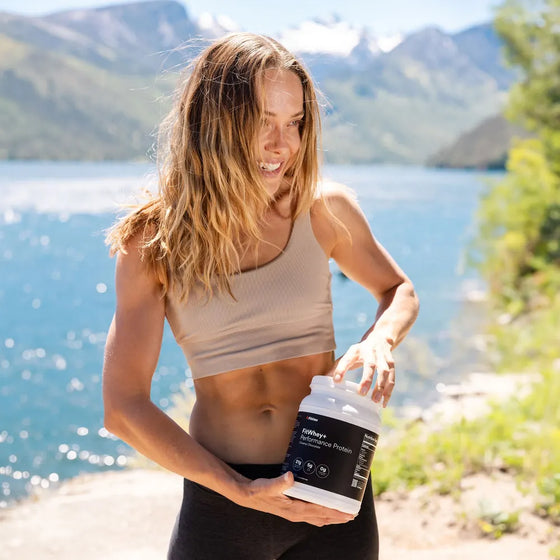
FitWhey+
FitWhey+ is built on 100% New Zealand whey protein concentrate from grass-fed, rBST and rBGH free herds. It has 21 g of protein per two-scoop serving with the full typical amino acid profile printed on the panel, plus 3 to 6 g of fiber depending on flavor, mostly chicory inulin. Sweetened with monk fruit extract, 0 g added sugar, no stevia and no artificial sweeteners. Contains milk.
Shop FitWhey+