The Fitties Journal
DEXA Scan Guide for Body Composition
Key Takeaways
Here's what matters most if you're short on time.
- DEXA (dual-energy X-ray absorptiometry) provides a regional breakdown of fat mass, lean mass, and bone mineral density, making it one of the most detailed body composition tools available.
- The scan takes 10 to 20 minutes, uses very low radiation, and requires almost no preparation beyond wearing metal-free clothing.
- T-scores and Z-scores reflect bone mineral density relative to reference populations. Body composition results break down fat and lean tissue by region.
- DEXA is most valuable when used for serial tracking over time, not as a single snapshot. Consistency in scan conditions improves accuracy between tests.
- Understanding your DEXA results can help you fine-tune nutrition, training, and supplementation strategies around real data rather than guesswork.
If you are serious about tracking your progress, you need data you can trust. Bathroom scales tell you one number. The mirror tells you something subjective. Neither tells you where your body is actually carrying fat, how much lean tissue you have built, or whether your bones are holding up.
A DEXA scan (dual-energy X-ray absorptiometry, also written as DXA) fills those gaps. It is one of the most detailed body composition assessment tools available in a clinical setting, and a methodology review describes it as rapidly becoming more accessible and popular for monitoring body composition, especially in athletes (Nana et al., 2015).
This guide covers what a DEXA scan actually measures, how the technology works, how to prepare, how to read your results, and how to put that information to work in your training and nutrition plan.
What a DEXA Scan Measures
A DEXA scan uses two low-energy X-ray beams at different energy levels. Because bone, lean tissue, and fat tissue each absorb these beams differently, the scanner can distinguish between them and map their distribution across your entire body.
The scan produces three primary data sets.
- Bone mineral density (BMD): A measurement of calcium and mineral content in your bones, reported as T-scores and Z-scores.
- Fat mass: Total body fat and its distribution by region (arms, legs, trunk, android/gynoid zones).
- Lean mass: Muscle and organ tissue by region, giving you visibility into symmetry and overall lean tissue development.
This regional breakdown is what separates DEXA from simpler tools. A bioelectrical impedance scale gives you a single body fat percentage. DEXA shows you that your left leg carries more lean mass than your right, or that your trunk holds a disproportionate share of your fat tissue. That level of detail changes how you train and eat.
FitNutrients+
A premium multivitamin/mineral formula, four capsules a day, with metabolically active B vitamins such as methylcobalamin and methylfolate, 12.5 mcg (500 IU) of vitamin D3 and Albion mineral chelates. It contains no iron.
Shop FitNutrients+How the Scan Works
The DEXA machine consists of a flat table and a scanning arm that passes over your body. You lie still on the table while the arm moves from head to toe, emitting two X-ray beams at different energy levels. Detectors on the other side of the arm measure how much radiation passes through at each point.
Dense tissue (bone) absorbs more radiation. Lean tissue absorbs a moderate amount. Fat tissue absorbs the least. By analyzing the differential absorption at thousands of points, the software builds a detailed composition map of your body.
The radiation exposure is minimal. A full-body DEXA scan exposes you to roughly 1 to 10 microsieverts, which is comparable to or less than the background radiation you absorb during a normal day. For context, a standard chest X-ray delivers about 20 microsieverts.
What to Expect During the Procedure
A DEXA scan is quick, non-invasive, and painless. Here is what the process typically looks like.
Before the Scan
Wear comfortable, metal-free clothing. No zippers, buttons, belt buckles, or underwire. Athletic wear works well. Remove jewelry and anything else metallic.
If you take calcium supplements, stop them at least 24 hours before the scan. Some facilities ask you to avoid heavy meals and intense exercise in the hours leading up to the scan, particularly if body composition is the focus. If you have recently had a procedure involving contrast dye (barium exam, CT contrast, MRI contrast), let the technician know; you may need to wait several days.
During the Scan
You will lie flat on the table, face up, with your arms at your sides and legs straight. For hip-specific scans, your foot may be placed in a brace to rotate the hip slightly for a clearer view.
The scanning arm passes over your body. You will not feel anything. The primary requirement is to stay still. The whole process takes 10 to 20 minutes depending on whether it is a full-body or site-specific scan.
After the Scan
There is no recovery time and no side effects. You can return to normal activity immediately. Results are typically reviewed by a physician or radiologist and shared with you at a follow-up appointment, though some facilities provide preliminary results on the spot.
How to Read Your DEXA Results
DEXA results include both bone density metrics and body composition data. Understanding what each number means is the difference between useful data and confusing noise.
Bone Mineral Density Scores
Bone density is expressed through two scores.
T-score compares your bone density to the average peak bone density of a healthy 30-year-old adult of the same sex. The World Health Organization classifies T-scores as follows.
| T-Score Range | Classification |
|---|---|
| Above -1.0 | Normal bone density |
| -1.0 to -2.5 | Low bone density (osteopenia) |
| Below -2.5 | Very low bone density (osteoporosis range) |
Z-score compares your bone density to the average for people of your same age, sex, and body size. A Z-score below -2.0 may suggest that something beyond normal aging is affecting bone health and typically warrants further evaluation by a healthcare provider.
If your results flag bone density concerns, your provider may also use the FRAX tool (Fracture Risk Assessment Tool), which combines DEXA data with other risk factors to estimate 10-year fracture probability.
Body Composition Data
The body composition report typically includes the following.
- Total body fat percentage and fat mass in grams or kilograms
- Regional fat distribution: arms, legs, trunk, android (midsection) and gynoid (hip/thigh) regions
- Lean mass by region: useful for identifying asymmetries between left and right sides
- Android-to-gynoid ratio (A/G ratio): a marker that reflects where your body preferentially stores fat. A higher ratio indicates more midsection-concentrated fat storage.
- Visceral adipose tissue (VAT) estimate: some scanners provide this metric, which reflects fat stored around internal organs in the abdominal cavity
For athletes and fitness-focused individuals, the regional lean mass data is often the most actionable. It reveals whether your training is producing balanced development or if one side is lagging. The fat distribution data helps contextualize your body fat percentage beyond a single number.
Using DEXA Results to Guide Your Strategy
A single DEXA scan gives you a baseline. Serial scans, taken every 3 to 6 months under consistent conditions, give you a trendline. The trendline is where the real value lives.
Here is how to act on what the data tells you.
If lean mass is lower than expected: Evaluate whether your protein intake is adequate for your training volume. A 2018 meta-analysis of 49 trials found that gains in lean mass from resistance training leveled off at about 1.6 grams of protein per kilogram of body weight a day, and its authors suggest about 2.2 g/kg for anyone trying to maximize those gains (Morton et al., 2018). If you use a protein powder to get there, FitWhey+ has 21 grams of whey protein per serving and FitPlant+ has 15 grams of pea and rice protein.
If fat mass is concentrated in the android region: In a study of 592 adults, more fat in the abdominal (android) region on DEXA was linked with less favorable glucose, cholesterol, triglyceride, and blood pressure readings (Wiklund et al., 2008), so it is worth discussing with a healthcare professional. From a training perspective, it reinforces the value of resistance training and a well-structured nutrition plan.
If lean mass asymmetry shows up between sides: This is a signal to incorporate unilateral training (single-leg squats, single-arm rows, lunges) to address the imbalance. Reassess at your next scan.
If bone mineral density scores are a concern: Consult a healthcare professional for guidance. Resistance training, adequate calcium and vitamin D intake, and targeted nutritional support all play roles in supporting bone health.
Tips for Consistent DEXA Tracking
DEXA accuracy depends partly on consistent testing conditions. Small variables, such as hydration level, time of day, and recent food intake, can influence the results enough to obscure real changes between scans.
Here is how to get the most reliable comparisons over time.
- Use the same facility and the same machine for every scan. Different machines can produce slightly different readings.
- Schedule scans at the same time of day, ideally in the morning.
- Maintain similar hydration. Avoid testing after a heavy training session or after significant fluid loss.
- Avoid large meals right before the scan.
- Wear the same type of clothing (or as close to it as possible).
- Space scans 3 to 6 months apart. Shorter intervals rarely show meaningful changes and introduce noise.
DEXA vs. Other Body Composition Methods
DEXA is not the only option for measuring body fat and tracking composition. Here is how it stacks up against the most common alternatives.
| Method | Accuracy | Regional Data | Cost | Accessibility |
|---|---|---|---|---|
| DEXA | High | Yes (detailed) | $75-$300 | Clinics, hospitals, some gyms |
| Hydrostatic weighing | High | No | $50-$150 | Universities, specialty labs |
| Bod Pod (air displacement) | Moderate-High | No | $50-$100 | Universities, specialty labs |
| Bioelectrical impedance (BIA) | Low-Moderate | Limited | $0-$50 | Home scales, gyms |
| Skinfold calipers | Moderate (user-dependent) | Site-specific only | $0-$30 | Gyms, self-administered |
| MRI | Very High | Yes (detailed) | $500+ | Hospitals, research settings |
For most fitness-focused individuals, DEXA offers the best balance of accuracy, regional detail, and practicality. BIA scales are convenient for daily trending but lack the precision and regional breakdown that DEXA provides. Skinfold calipers are inexpensive but highly dependent on the skill of the person taking the measurements. If you want deeper detail on each method, our guide to measuring body fat walks through the full landscape.
Who Should Consider a DEXA Scan
DEXA is not something everyone needs, but it is worth considering if you fall into one of these categories.
- You are tracking body recomposition (losing fat while building muscle) and want precise, objective data.
- You have hit a plateau and need to determine whether you are actually losing fat, gaining muscle, or both.
- You are an athlete who needs to monitor lean mass and regional symmetry for performance.
- Your healthcare provider has recommended bone density screening based on age, family history, or other risk factors.
- You are postmenopausal or have other factors that may affect bone mineral density and want baseline data.
For anyone investing serious effort into their training and nutrition, DEXA replaces guessing with knowing. And when you know where you stand, you can make smarter decisions about what to do next.
Conclusion
A DEXA scan is one of the most informative tools available for understanding what your body is made of and how it is changing over time. It goes beyond a single number on a scale or a rough body fat estimate, giving you a regional map of fat, lean tissue, and bone density that you can act on.
The scan itself is fast, safe, and painless. The results are most useful when tracked consistently over time, using the same machine and the same preparation routine. Combined with a structured training program, adequate nutrition plan, and targeted supplementation where it makes sense, DEXA data can sharpen every decision you make about your body.
If you have never had a DEXA scan, consider scheduling one to establish a baseline. If you have had one before, schedule your next scan 3 to 6 months out and compare the trendline. The numbers do not lie, and the more data points you have, the clearer the picture becomes.
As with any health-related decision, consult a healthcare professional to discuss whether DEXA scanning is appropriate for your individual situation, particularly if bone density is a concern.
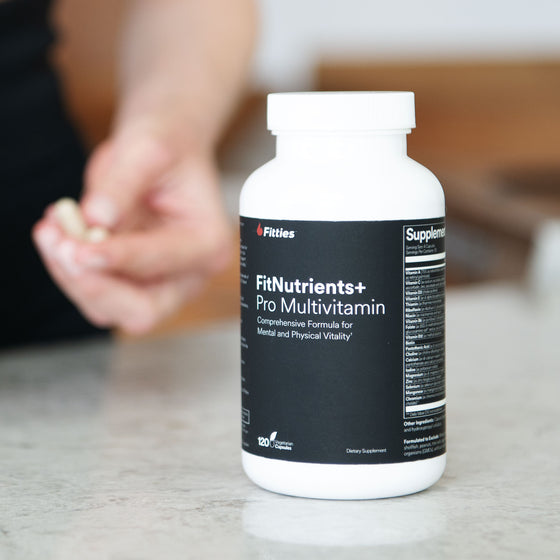
FitNutrients+
A premium multivitamin/mineral formula, four capsules a day, with metabolically active B vitamins such as methylcobalamin and methylfolate, 12.5 mcg (500 IU) of vitamin D3 and Albion mineral chelates. It contains no iron.
Shop FitNutrients+