The Fitties Journal
Protein Powder for Muscle Gain: 5 Numbers That Decide If It Works
Key Takeaways
Here's what matters most if you're short on time.
- Training builds muscle. Protein powder is a delivery method for hitting a daily protein total, not the cause of the result.
- The International Society of Sports Nutrition supports 1.4 to 2.0 g of protein per kg of body weight per day, and a 2018 meta-analysis found no further gains in fat-free mass past about 1.62 g/kg.
- A useful serving lands 20 to 40 g of protein carrying 700 to 3,000 mg of leucine.
- Most labels print total protein and leave leucine off, so the number that decides the dose cannot be checked.
- Timing matters far less than the daily total, because the anabolic effect of training lasts at least 24 hours.
Protein powder does not build muscle. Training does. Protein powder is a convenient way to hit a daily protein total, and the research is specific about what that total needs to be. The International Society of Sports Nutrition position stand on protein and exercise puts it at 1.4 to 2.0 g of protein per kg of body weight per day, delivered in servings of 20 to 40 g. So the question is not which tub has the loudest marketing. It is whether the tub in your hand delivers a real dose. Five numbers on the label answer that, and most brands only print three of them.
Does protein powder actually build muscle?
It supports the process. It is not the process. The most rigorous look at this is a 2018 systematic review and meta-analysis in the British Journal of Sports Medicine, which pooled 49 randomized controlled trials covering 1,863 participants. Protein supplementation on top of resistance training produced an additional 0.30 kg of fat-free mass compared with training alone.
Read that number honestly. It is real, it is repeatable, and it is modest. It also only appears alongside a training stimulus. A scoop of anything, drunk on the couch, is expensive food. A 2015 review in Sports Medicine reached the same conclusion from a different angle, that protein supplements enhance muscle mass and performance when the training stimulus is adequate.
This is where the supplement industry earns its reputation. The category sells the powder as the cause and the training as a detail. It is the other way around. Powder is a delivery mechanism for a nutrient you could get from food, and its entire value is convenience and dose accuracy. Which is exactly why the dose has to be worth checking.
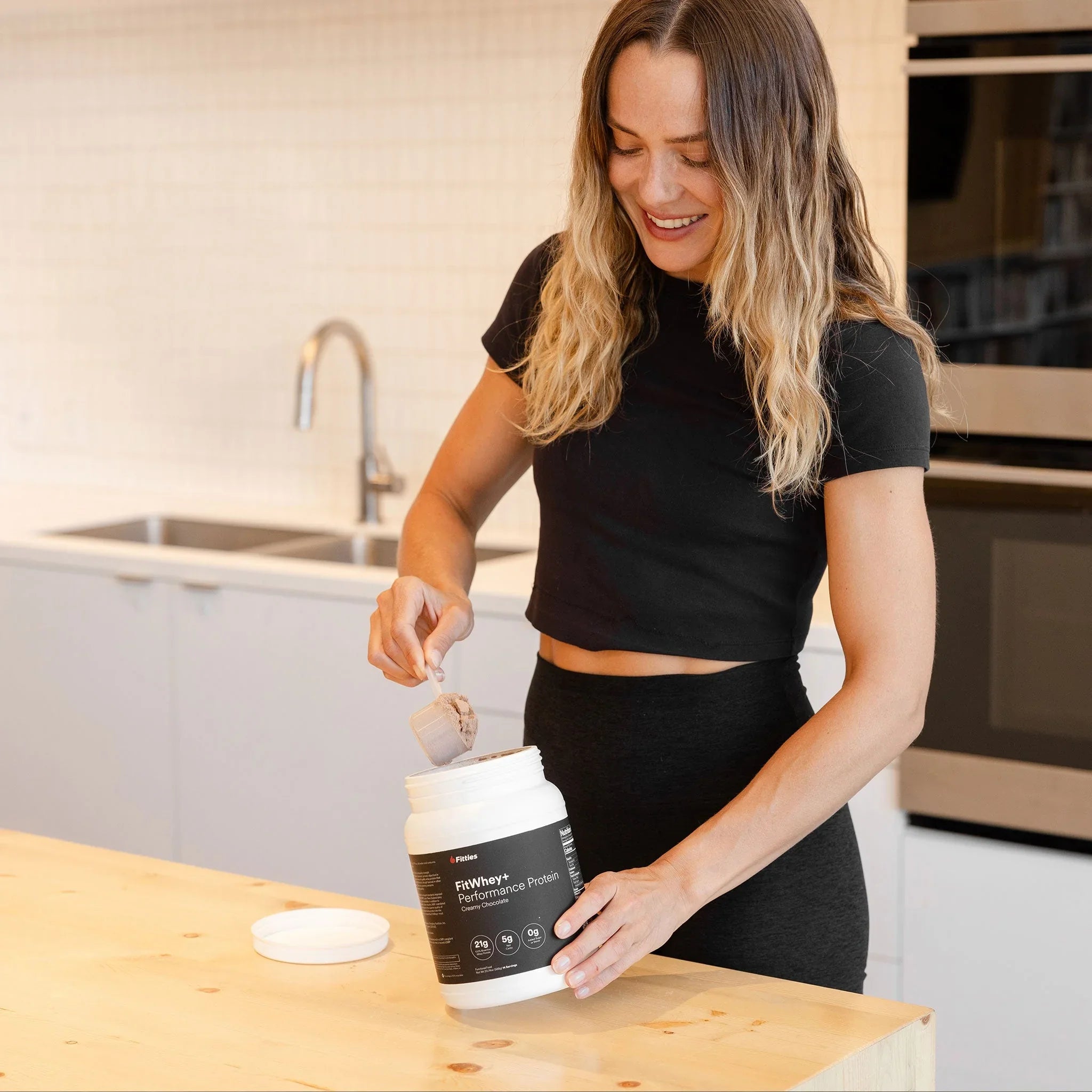
FitWhey+
FitWhey+ is built on New Zealand grass-fed whey protein concentrate. It has 21 g of protein and more than 2,300 mg of leucine per serving, with the full amino acid profile printed on the panel. Sweetened with monk fruit extract, 0 g added sugar, no stevia and no artificial sweeteners. Contains milk.
Shop FitWhey+How much protein do you need per day to build muscle?

Start with the daily total, because that is the number that decides the outcome. The ISSN position stand recommends 1.4 to 2.0 g of protein per kg of body weight per day for building and maintaining muscle. The meta-analysis above (Morton et al., 2018) sharpened the ceiling. Protein intake beyond 1.62 g/kg/day produced no further training-induced gains in fat-free mass, though the estimate was imprecise, with a 95% confidence interval from 1.03 to 2.20 g/kg/day.
Run it for a real person. A 180 lb lifter is 81.6 kg. That is 114 to 163 g of protein a day, and the point of diminishing returns sits near 132 g. Not 300 g. Not "as much as possible." A number you can actually hit and then stop thinking about.
Per serving, the guidance is 0.25 g of high-quality protein per kg of body weight, or an absolute dose of 20 to 40 g. Three solid whole-food meals get most people two thirds of the way there. One shake closes the gap. That is the whole job. If you want the full breakdown by body weight and training goal, we covered it in how much protein you actually need.
What are the 5 numbers that decide if a protein powder works?
Every tub on the shelf claims to build muscle. Almost none of them let you verify it. These five numbers do, and they are all on the label if the brand is willing to print them.
1. Protein per serving
You are looking for 20 to 40 g. The trap is the serving size sitting directly above it. Plenty of tubs quote their protein figure per two scoops, so the 25 g on the front of the pack is really 12.5 g in the scoop you just used. Check the grams per serving and the scoop count together, always.
2. Leucine per serving
Leucine is the amino acid that flips the switch on muscle protein synthesis, and it is the number the industry works hardest to avoid printing. The ISSN position stand is specific. An acute protein dose should contain 700 to 3,000 mg of leucine alongside a balanced array of the essential amino acids. Total protein grams tell you nothing about whether that threshold is met.
3. Scoops per serving and servings per container
Cost per tub is a marketing number. Cost per serving is the real one, and the two diverge fast when a "60 serving" tub turns out to be 30 servings at the dose you actually need. Divide the price by the servings, then sanity check the servings against the scoop size.
4. Added sugars
The Nutrition Facts panel breaks out "Includes Xg Added Sugars" as its own line. A gainer that hits its calorie claim with 30 g of added sugar is selling you sugar with a protein garnish. Read the line, not the front of the pack.
5. Whether the amino acid profile is printed at all
This is the tell. A brand that publishes the full amino acid breakdown is handing you the tools to audit its own dose. A brand that hides everything behind a proprietary blend is asking you to take its word for it. There is only one reason to withhold that panel, and it is not that the numbers are impressive.
| The number | What to look for | The red flag |
|---|---|---|
| Protein per serving | 20 to 40 g | The claim is per 2 scoops |
| Leucine per serving | 700 to 3,000 mg | Not printed anywhere |
| Servings per container | Price divided by real servings | Serving count assumes a half dose |
| Added sugars | The dedicated Nutrition Facts line | Calories padded with sugar |
| Amino acid profile | Full panel, printed | Proprietary blend, no breakdown |
Is whey or plant protein better for muscle gain?
Both work when the dose lands. Whey carries more leucine per gram of protein, so a plant blend generally needs a larger serving to reach the same place. That is a scoop-size difference, not a verdict. The deciding factor for most people is whether they tolerate dairy, and the honest answer is to pick the one you will drink every day.
Here is what that looks like when a brand prints the panel. These are label figures for FitWhey+ and FitPlant+, per two-scoop serving.
| Per serving | FitWhey+ Chocolate | FitWhey+ Vanilla | FitPlant+ Vanilla |
|---|---|---|---|
| Protein source | NZ whey concentrate | NZ whey concentrate | Pea and rice |
| Protein | 21 g | 21 g | 15 g |
| Leucine | 2,400 mg | 2,350 mg | 1,550 mg |
| Calories | 170 | 130 | 150 |
| Added sugars | 0 g | 0 g | 0 g |
| Dairy | Contains milk | Contains milk | Excludes dairy |
All three land inside the 700 to 3,000 mg leucine window from the ISSN position stand, and the plant blend does it on a smaller protein serving. You can only run a comparison like this when the numbers are printed. Try it on the last tub you bought. For a deeper look at how the two protein types differ, read whey vs plant protein.
When should you take protein powder for muscle gain?

Whenever it helps you hit the daily total. The 30 minute anabolic window sold an enormous amount of powder and did not survive contact with the evidence. In a meta-analysis of the training trials, timing made no significant difference once total protein was accounted for (Schoenfeld et al., 2013). The ISSN position stand states that the anabolic effect of exercise is long-lasting, at least 24 hours, though it likely diminishes as time post-exercise increases.
Practically, that means a post-training shake is convenient rather than magic, and a shake at breakfast counts exactly as much if that is the meal where your protein is thinnest. Spread your intake across the day in 20 to 40 g servings, hit your total, and stop optimizing a variable that barely moves the needle. We went deeper on the timing question in protein shake before or after your workout.
The one timing rule worth keeping is consistency. Hitting 1.6 g/kg on four days out of seven averages out to well under the target, and the 1.62 g/kg figure in the meta-analysis came from average daily intakes across trials of at least six weeks of training (Morton et al., 2018), not from occasional high days.
Who should skip protein powder?
Whey protein is made from milk, so anyone with a dairy allergy needs a plant-based option instead. FitWhey+ contains milk. FitPlant+ is formulated to exclude animal and dairy products, along with wheat, gluten, soy protein, egg, fish, shellfish, peanuts, tree nuts, and sesame.
Read the warning panel too, because it is there for a reason. The FitWhey+ label states that very low calorie protein diets, below 400 calories per day, may cause serious illness or death, and that the product should not be used for weight reduction in such diets without medical supervision. It is not intended for infants, children, or pregnant or nursing women.
If you take prescription medication, or you have a kidney or liver condition, talk to your healthcare provider before raising your protein intake or adding any supplement. That is not a formality. Protein load is one of the few dietary variables a clinician will genuinely want to know about, and this article is not a substitute for that conversation.
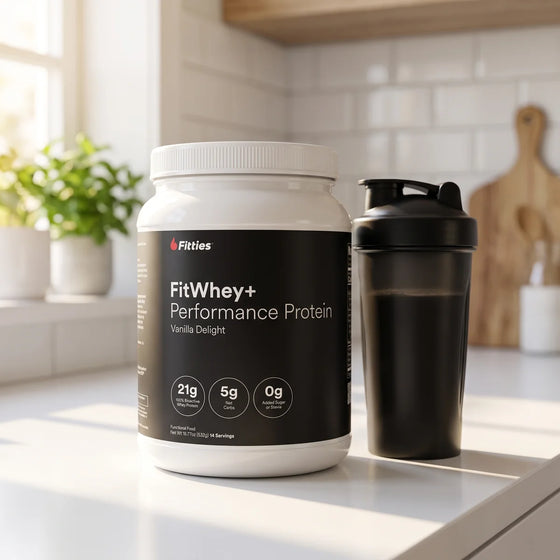
FitWhey+
FitWhey+ is built on New Zealand grass-fed whey protein concentrate. It has 21 g of protein and more than 2,300 mg of leucine per serving, with the full amino acid profile printed on the panel. Sweetened with monk fruit extract, 0 g added sugar, no stevia and no artificial sweeteners. Contains milk.
Shop FitWhey+