
The Fitties Journal
Whey Protein and Lactose Intolerance: How Much Lactose Is in a Scoop?
Key Takeaways
Here's what matters most if you're short on time.
- A whey concentrate scoop delivering 20g of protein carries roughly 1 to 2.5 grams of lactose; whey isolate carries under a quarter of a gram.
- Most people diagnosed with lactose intolerance tolerate about 12 grams of lactose in one sitting, the amount in a cup of milk.
- A Contains: Milk statement is triggered by milk protein, not lactose, so it tells you nothing about how much lactose is in the tub.
- Total Sugars on the Nutrition Facts panel does not break out lactose, so a low number there is not proof of low lactose.
- Hydrolysis cleaves protein bonds rather than lactose, so hydrolyzed whey is not automatically lower in lactose than its source.
- Lactose intolerance and cow's milk protein allergy are different. Whey is a milk protein, so no whey product suits a milk allergy.
Yes. Most people who are lactose intolerant can drink whey protein without a problem, and the arithmetic is what settles it. A standard sports-grade whey concentrate runs roughly 5 to 9 percent lactose, judging by two WPC 80 powders analyzed in recent studies (Haas et al., 2024; Ryan and McDougal, 2026), and ADPI's typical range for WPC 80 tops out at 10 percent, so a scoop delivering 20 grams of protein carries roughly 1 to 2.5 grams of lactose. Whey isolate runs about 1 percent, which puts it under a quarter of a gram. The evidence review the NIH commissioned on lactose intolerance found that most people diagnosed with it tolerate up to 12 grams in a single sitting, the amount in a cup of milk, with minimal or no symptoms.
Your scoop is not close to your limit. The genuine exceptions are a cow's milk protein allergy, which is a different problem with different stakes, and everything else in the tub that can upset a stomach.
How Much Lactose Is in a Scoop of Whey Protein?
Whey is what is left over when milk is separated for cheese. By dry weight, cheese whey is roughly 66 to 77 percent lactose and only 8 to 15 percent protein, according to a 2025 review in Foods. Filtration is what flips that ratio. The membranes hold back the whey protein while the lactose passes through, per the ISSN position stand on protein. So the word "whey" on a tub tells you almost nothing on its own. The grade does.
The American Dairy Products Institute publishes the specification ranges the industry works to. Whey protein concentrate covers everything from WPC 34, a food-ingredient powder that is roughly half lactose, up to WPC 80, the grade nearly every sports protein is built on. Whey protein isolate sits at 90 to 92 percent protein and 0.5 to 1.0 percent lactose, because the extra diafiltration step exists specifically to strip out lactose and soluble minerals.
| Whey grade | Protein (typical) | Lactose (typical) | Lactose in a 20g protein serving |
|---|---|---|---|
| WPC 34 (a food ingredient, not a sports powder) | 34 to 36% | 48 to 55% | About 28 to 31 g |
| WPC 80 (the standard sports concentrate) | 80 to 82% | 4 to 10% | About 1.0 to 2.5 g |
| Whey protein isolate | 90 to 92% | 0.5 to 1.0% | About 0.1 to 0.2 g |
| Hydrolyzed whey | Depends on the base | Depends on the base | Whatever its source concentrate or isolate carried |
That last column is arithmetic, not a printed figure, so here is the working. To pull 20 grams of protein out of a WPC 80 at 81 percent protein you need about 24.7 grams of powder. At the 5.5 to 9.2 percent lactose listed for two WPC 80 powders in recent studies (Haas et al., 2024; Ryan and McDougal, 2026), that is about 1.4 to 2.3 grams. Even at 10 percent, the top of the typical range in the ADPI specification, you land at 2.5 grams. Run the same math on isolate and you are working with 22 grams of powder at 0.5 to 1.0 percent lactose, so roughly a tenth to a fifth of a gram.
For scale, a cup of whole milk carries about 12 grams of lactose, calculated from the USDA's figure of 5.05 grams per 100 grams and its 244 gram cup. A concentrate shake is roughly a tenth of that glass. An isolate shake is closer to a rounding error.
FitPlant+
FitPlant+ takes the dairy question off the table. Pea protein isolate and rice protein concentrate, 15g of protein per serving, sweetened with monk fruit and no added sugar or stevia. It is formulated to exclude gluten, dairy, lactose, and soy protein, and its Formulated to Exclude list also covers animal products and artificial sweeteners.
Shop FitPlant+How Much Lactose Can You Handle Before Symptoms Start?

This is the number the lactose-free aisle would rather you did not have. The AHRQ evidence report prepared for the NIH Consensus Development Conference reviewed the dose-response literature and concluded that most people diagnosed with lactose intolerance can ingest 12 grams of lactose, the equivalent of one cup of milk, as a single dose with no or minor symptoms, and that tolerance is better still when it is taken alongside other food.
Push past that and the picture changes. The same review found symptoms became more prominent above 12 grams, appreciable at 24 grams taken in one hit, and present in the vast majority of people at 50 grams. But a divided daily dose of 24 grams was generally tolerated, and two trials showed that 20 to 24 grams spread through the day with meals was fine for many people who malabsorb lactose (AHRQ evidence report).
Now read that against the table above. A concentrate scoop at 1 to 2.5 grams is not a borderline case. You would need somewhere between five and twelve shakes in a single sitting to reach the 12 gram mark most people handle without trouble. If one scoop is wrecking you, the dose numbers say lactose is unlikely to be the whole story, and the rest of this post is about what else is in the tub.
The NIDDK is also clear that this is a spectrum rather than a switch, and that symptoms may be mild or severe depending on how much lactose you have, and they typically show up within a few hours. Different people tolerate different amounts before anything happens. Your own threshold is the one that matters, and the only way to find it is to test it deliberately rather than write off an entire protein source on a hunch.
How Common Is Lactose Intolerance, Really?
Here is where almost every article on this topic is quietly wrong, and it is worth knowing before you take any of them at face value.
The figures you have seen everywhere, that 68 percent of the world and 36 percent of Americans have lactose malabsorption, trace back to a single 2017 meta-analysis in The Lancet Gastroenterology & Hepatology (Storhaug et al., 2017), which the NIDDK cites for both numbers. That paper was retracted in January 2025, following an expression of concern issued the previous September, and the commentary published alongside it was retracted too. As of this writing, the NIDDK page that popularized those percentages still lists both retracted papers as its only references.
What can be said with a straight face comes from the AHRQ review, which stated plainly that evidence is insufficient to accurately assess US population prevalence. It also found rates are likely to stay low among populations of Northern European descent and to run higher among African American, Hispanic, Asian, and American Indian populations, while noting that smaller doses of lactose are generally well tolerated across most groups.
So it is common, unevenly distributed, and not precisely quantified. Anyone selling you a percentage to two significant figures is reading off a retracted paper.
Why "Contains: Milk" Tells You Nothing About Lactose
Every whey product on the shelf carries a "Contains: Milk" statement. Concentrate, isolate, hydrolysate, the expensive one, the cheap one. People read that line, assume it is flagging lactose, and put the tub back.
It is not flagging lactose. The FDA's allergen guidance for industry is explicit. Allergen labeling is triggered by a food or ingredient that is or contains protein from a major food allergen, and ingredients derived from an allergen that do not contain protein are not subject to the requirement at all. Whey is milk protein. That is the entire reason the statement is there. It is a protein declaration, not a sugar one, and it reads identically on a product carrying 30 grams of lactose and one carrying a fifth of a gram.
The Total Sugars line will not rescue you either. Under 21 CFR 101.9, Total Sugars is defined as the sum of all free mono- and disaccharides, which lumps glucose, fructose, lactose and sucrose into one figure with no breakdown. The FDA confirms Total Sugars includes sugars naturally present, such as sugar in milk, alongside anything added. A powder showing 2 grams of Total Sugars might be carrying 2 grams of lactose, 2 grams of something else, or a mix. The panel does not say, and a low number on that line is not proof of low lactose.
What does tell you something is the ingredient list. "Whey protein isolate" listed first means isolate. "Whey protein concentrate" listed first means concentrate, and since the grade is almost never printed, you are back to the protein-per-serving math above. If you want more on reading past the front of a tub, we wrote a full guide to reading supplement labels.
Which Whey Is Best if You Are Lactose Intolerant?
Isolate, if you want the lowest number and you are willing to pay for it. At 0.5 to 1.0 percent lactose, it is the lowest-lactose grade in the ADPI specifications for whey protein concentrate and isolate. That is a real gap from concentrate in percentage terms, and a gap of roughly two grams in the shaker.
Concentrate is fine for most people, and that is not a consolation prize. A WPC 80 scoop sits an order of magnitude below the 12 gram threshold, in the same lactose range as the splash of milk that goes in a coffee. Our breakdown of isolate versus concentrate goes deeper on what else separates the two, because lactose is not the only difference and it is rarely the most interesting one.
Hydrolysate is where the marketing gets ahead of the chemistry. Hydrolyzed whey is defined by the ADPI as protein obtained through chemical or enzymatic cleavage of peptide bonds. Peptide bonds are protein bonds. Hydrolysis acts on the protein and leaves the sugar exactly where it was, and every hydrolysate starts life as a concentrate or an isolate, so its lactose is inherited from whatever it was made from. "Pre-digested" sounds like it ought to mean gentler on lactose. It is not a lactose claim, and paying a premium expecting one is how the industry keeps winning.
What Are the Signs of Whey Intolerance, and Is It the Lactose?
The NIDDK lists the symptom set as bloating, diarrhea, gas, nausea, abdominal pain, stomach rumbling and vomiting, typically within a few hours of consuming milk or milk products. That is a fairly generic list, which is precisely the problem. Half the things in a protein tub can produce it.
Sugar alcohols are the usual suspect. So are the gums and thickeners that give a cheap powder body. So is putting 50 grams of protein down in ninety seconds on an empty stomach before a session, which will test anyone's gut regardless of what the powder is made of. Before you write off dairy entirely, run two tests. The same brand at half a scoop with food, and a different brand at a full scoop. If the pattern follows the brand rather than the dose, it was never the lactose.
For the record on our side of it, FitWhey+ is built on New Zealand whey protein concentrate and carries a Contains: Milk declaration, because that is what whey is. Its label lists 21 grams of protein and 0 grams of added sugars per two-scoop serving, with 2 grams of total sugars, and by the rule above that total-sugars figure does not tell you the lactose content, ours included. Its Formulated to Exclude list covers wheat, gluten, yeast, soy protein, fish, shellfish, peanuts, tree nuts, egg, sesame, artificial colors and artificial sweeteners. Dairy is not on that list and never will be, because it is a milk protein. The label also carries the standard warning that it is not for use by infants, children, or pregnant or nursing women, and not for weight reduction on a very low calorie diet without medical supervision.
What Protein Works if Whey Does Not?

Switch to isolate. The cheapest fix if concentrate is genuinely the issue. You drop from roughly 1 to 2.5 grams of lactose per serving to a fifth of a gram, and keep everything else about whey that you liked in the first place.
Add lactase. A randomized, double-blind, placebo-controlled crossover trial in 47 people with lactose intolerance found supplemental lactase improved clinical scores and cut cumulative hydrogen breath levels by 55 percent against placebo. Useful, with a limit worth knowing. The AHRQ review found lactase products reduced symptom scores at a 20 gram lactose load but did not help symptomatic people at a 50 gram load. It is a tool, not a switch.
Go plant. Lactose is a sugar naturally found in milk and milk products. Pea and rice are neither, so the question never comes up. The amino acid profile is the honest trade-off, and it is better understood than the internet lets on. An analysis of 35 commercial protein isolates, 27 of them plant-based, published in Amino Acids found pea protein is low in methionine while brown rice is low in lysine, and that combining a lysine-poor source with a methionine-poor source at a 50/50 ratio produces a far more complete composition than either alone. That is exactly why pea and rice get formulated together rather than sold separately. The same paper puts pea at 30 percent essential amino acids and brown rice at 28 percent against 43 percent for whey, so a plant blend still asks you to eat more total protein to hit the same essential amino acid target. Worth knowing, not a dealbreaker.
FitPlant+ is our pea and rice option, with pea protein isolate and rice protein concentrate, 15 grams of protein per two-scoop serving, and a Formulated to Exclude list covering animal and dairy products alongside wheat, gluten, yeast, soy protein, fish, shellfish, peanuts, tree nuts, egg, sesame, artificial colors and artificial sweeteners. In short, FitPlant+ is formulated to exclude gluten, dairy, lactose, and soy protein. If you would rather not run the arithmetic every time you buy a tub, that is the shortcut. For the wider comparison, we put whey up against plant protein on the things that actually differ.
When Whey Is Off the Table Completely
There is one situation where none of the above applies, and it needs separating cleanly from everything else on this page.
Lactose intolerance and a cow's milk protein allergy are different conditions. The NIAID's food allergy guidelines state that food intolerances do not involve the immune system, and give lactose intolerance as the example, a missing enzyme for a sugar found in milk. A milk allergy is an immune response to milk proteins, and the NIDDK notes that a serious allergic reaction to milk can be life threatening. The FDA adds that a mild reaction in the past does not mean the allergy itself is mild.
Whey is a milk protein. That holds for concentrate, isolate and hydrolysate alike, and no amount of filtration changes it. If you have a diagnosed cow's milk allergy, no whey product is appropriate for you regardless of how little lactose it contains, and a plant protein is the category to look at instead.
If you are not sure which of the two you are dealing with, or you are managing a medical condition, taking medication, or pregnant or nursing, talk to your healthcare provider before you change what you take. This is information, not a diagnosis, and the difference between an enzyme shortfall and an immune response is not one to settle by trial and error at the kitchen counter.
FitPlant+
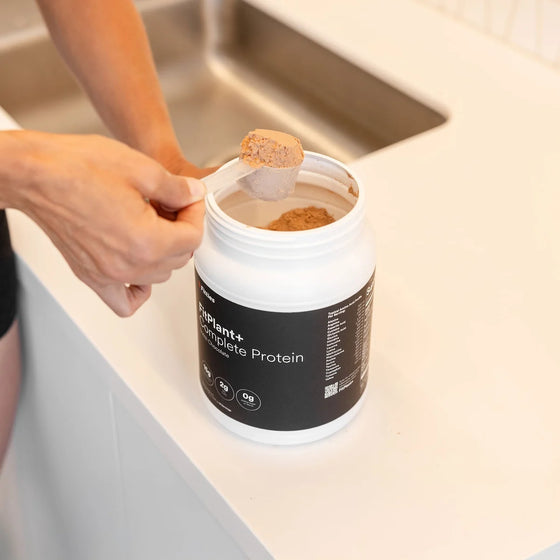
FitPlant+ takes the dairy question off the table. Pea protein isolate and rice protein concentrate, 15g of protein per serving, sweetened with monk fruit and no added sugar or stevia. It is formulated to exclude gluten, dairy, lactose, and soy protein, and its Formulated to Exclude list also covers animal products and artificial sweeteners.
Shop FitPlant+