
The Fitties Journal
Quatrefolic and Methylfolate vs Folic Acid: 5 Folate Forms Explained
Key Takeaways
Here's what matters most if you're short on time.
- Methylfolate (5-MTHF) is the main form of folate in blood; supplements supply it as a calcium or glucosamine salt.
- The CDC says folic acid is the one type of folate shown in studies to lower the chance of neural tube defects.
- The CDC advises 400 mcg of folic acid daily for anyone who could become pregnant, including people with MTHFR variants.
- A review by CDC scientists found no trials, or even less rigorous studies, of any other folate form for neural tube defects.
- An EFSA-reviewed human study found no biologically relevant bioavailability difference between the glucosamine and calcium salts.
- EFSA applies the 1,000 mcg a day adult upper limit to folic acid and 5-MTHF salts combined.
Methylfolate, also written 5-MTHF (5-methyltetrahydrofolate), is the main form of folate in your blood (Crider et al., 2022). Quatrefolic® is one supplement form of it, the glucosamine salt of (6S)-5-methyltetrahydrofolic acid, a registered trademark of Gnosis S.p.A. It does not replace the folic acid advice for anyone who could become pregnant.
Per the CDC, folic acid is the one type of folate shown in studies to lower the chance of neural tube defects (NTDs), serious birth defects of the brain and spine, and anyone who could become pregnant should get 400 mcg of folic acid every day (CDC folic acid guidance). That holds for people with MTHFR gene variants too (CDC guidance on MTHFR and folic acid). Talk to your healthcare provider about what fits you.
What is methylfolate (5-MTHF), and what is Quatrefolic?
Folate is the general name for all the different types of vitamin B9 (CDC folic acid guidance), so Quatrefolic is a folate, not a form of vitamin B6 or B12. Inside cells, 5-MTHF passes its methyl group to homocysteine through methionine synthase, an enzyme that uses vitamin B12, as methylcobalamin, as its cofactor (EFSA NDA Panel, 2023).
Supplement 5-MTHF is a synthetic salt (EFSA NDA Panel, 2023), and it has been modified to be more stable for commercial production (Crider et al., 2022). EFSA's reviews cover two of these salts, calcium L-methylfolate and the glucosamine salt of (6S)-5-MTHF (EFSA NDA Panel, 2022). Quatrefolic is the glucosamine salt. Fitties labels note it is produced under U.S. Patent 7,947,662, which claims folate salts made with D-glucosamine or D-galactosamine and describes its compounds as having long-lasting stability and high water solubility (U.S. Patent 7,947,662). Stability and solubility are manufacturing properties, not health results.
FitNutrients+
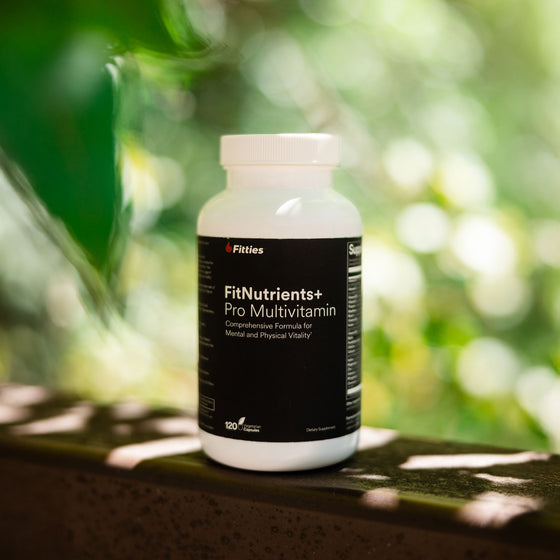
FitNutrients+ is a four-capsule daily multivitamin and mineral formula. Each serving lists 289 mcg DFE of folate from Quatrefolic, the glucosamine salt of (6S)-5-MTHF, together with calcium folinate. Take four capsules daily or as directed by your healthcare professional.
Shop FitNutrients+How do food folate, folic acid, 5-MTHF and folinic acid compare?

Food folate is the natural kind, found in asparagus, Brussels sprouts, dark leafy greens such as spinach, oranges, beef liver, walnuts, and beans and peas (FDA folate labeling guide). Natural folates usually exist as polyglutamates, which are unstable, so some is lost to light, oxygen and high heat (EFSA NDA Panel, 2023). Food does contain 5-MTHF, but bound into the food matrix, so it has to be released by digestion before it can be absorbed (EFSA NDA Panel, 2022).
Folic acid is the synthetic form added to enriched breads, flours, pastas, rice and cornmeal and to certain breakfast cereals, and it is found in certain dietary supplements (FDA folate labeling guide). EFSA describes it as fully oxidized and the most chemically stable form, with vitamin activity after the body reduces it to tetrahydrofolate (THF) through the enzyme dihydrofolate reductase (EFSA NDA Panel, 2023). 5-MTHF is already a reduced form, so it does not need that step. Folinic acid (5-formyl-THF) is another reduced folate and a natural constituent of food (EFSA NDA Panel, 2022); Fitties labels list it as calcium folinate.
| Form | What it is | Where you find it | Shown in studies to lower NTD chance? |
|---|---|---|---|
| Food folate | Natural reduced folates, mostly polyglutamates | Leafy greens, asparagus, beans and peas, oranges, liver | Not shown in intervention studies |
| Folic acid | Synthetic, fully oxidized | Enriched grains, certain supplements | Yes |
| 5-MTHF, calcium salt | Synthetic reduced folate (calcium L-methylfolate) | Supplements | Not studied |
| 5-MTHF, glucosamine salt (Quatrefolic) | Synthetic reduced folate, patented salt | Supplements | Not studied |
| Folinic acid (calcium folinate) | Reduced folate (5-formyl-THF) | Naturally in food; supplements | Not studied |
The last column follows the CDC (CDC folic acid guidance) and a review by CDC scientists that found no trials, or even less rigorous studies, of any other folate form for NTDs (Crider et al., 2022).
Is methylfolate better than folic acid?
Not on the evidence that matters most for pregnancy. "Active folate" on a front label describes chemistry, not a proven result. A review by CDC scientists sums up the claims made for 5-MTHF, that it is more bioavailable, more "natural" and less affected by MTHFR gene variants than folic acid (Crider et al., 2022). Yet most folic acid is converted to 5-MTHF during absorption and first-pass metabolism in the liver anyway, and on MTHFR the CDC is direct (CDC guidance on MTHFR and folic acid).
- People with an MTHFR gene variant can process all types of folate, including folic acid.
- 400 mcg of folic acid daily can increase blood folate regardless of MTHFR genotype.
- On the same intake, people with the TT genotype average only about 16% lower blood folate than people with the CC genotype.
- Anyone who could become pregnant should get 400 mcg of folic acid daily, even with an MTHFR variant.
The same review states that no randomized controlled trials, or even less rigorous studies, have examined any other folate form for NTDs, and that trials on effectiveness, timing, dosage, stability and safety would be needed before 5-MTHF could be recommended (Crider et al., 2022). A 2024 review likewise notes a lack of clinical studies of 5-MTHF supplementation and NTDs (Samaniego-Vaesken et al., 2024). Timing matters too. NTDs happen in the first few weeks of pregnancy, often before a person knows they are pregnant (CDC folic acid guidance).
So methylfolate is a real form of folate, not a stand-in for folic acid when a pregnancy is possible. If that is you, the FDA says to check the label for folic acid in mcg in parentheses (FDA folate labeling guide), and your healthcare provider can help you choose what to take.
What does the research show on Quatrefolic and 5-MTHF?
Glucosamine salt vs calcium salt
A common selling point for the glucosamine salt is better absorption than the calcium salt. The human comparison EFSA relied on is one unpublished randomized crossover study in 24 male and female volunteers, each given a single oral dose of 400 mcg of 5-MTHF as each salt, with 400 mcg of folic acid alongside, and serum folate tracked for up to 12 hours. Serum folate did not differ significantly, and EFSA concluded the study indicates no biologically relevant difference in bioavailability (EFSA NDA Panel, 2022). EFSA considers the cation paired with 5-MTHF unlikely to greatly affect bioavailability, even though solubility may differ.
A 2016 rat study (six per group, one oral dose) reported peak blood 5-MTHF 1.8 times higher with the glucosamine salt than the calcium salt, and eight-hour exposure about 1.12 times higher (Miraglia et al., 2016). Rats are not people.
5-MTHF vs folic acid on blood folate
Against folic acid, results depend on dose and on the marker measured.
- In a 24-week trial in 144 healthy women aged 19 to 33, red blood cell folate rose significantly more with 416 mcg of (6S)-5-MTHF a day than with 400 mcg of folic acid (Lamers et al., 2006).
- In a 24-week trial in 167 healthy volunteers at lower doses, plasma folate ended 52% above placebo with 100 mcg of folic acid and 34% above with 113 mcg of 5-MTHF, while homocysteine was 9.3% below placebo with folic acid and 14.6% below with 5-MTHF (Venn et al., 2003). Homocysteine is a sensitive but non-specific marker of folate status (EFSA NDA Panel, 2022).
EFSA's systematic review, based on one trial below 400 mcg a day and three at or above it, proposes counting 5-MTHF the same as folic acid below 400 mcg a day and found it more bioavailable at 400 mcg a day (EFSA NDA Panel, 2022). None of these studies measured NTDs. Blood folate is a status marker, and the NTD outcome behind the CDC's advice has been shown with folic acid alone (CDC folic acid guidance).
What does mcg DFE mean on a supplement label?
Supplement Facts panels list folate in micrograms of dietary folate equivalents (mcg DFE) with a %DV. If any of it comes from folic acid, that amount is listed in mcg in parentheses, and no parentheses means no folic acid was added (FDA folate labeling guide).
DFEs, defined by the Institute of Medicine in 1998, account for how differently food folate and folic acid are absorbed (EFSA NDA Panel, 2022). One mcg DFE equals 1 mcg of food folate, 0.6 mcg of folic acid from fortified food or a supplement taken with food, or 0.5 mcg of folic acid on an empty stomach, so 240 mcg of folic acid covers the same 400 mcg DFE as 400 mcg of food folate (Crider et al., 2022).
For 5-MTHF the math is less settled. EFSA proposes the folic acid factor of 1.7 for supplements providing under 400 mcg a day and 2.0 at 400 mcg or more (EFSA NDA Panel, 2022). In the US, a 2020 perspective noted that the folic acid recommendation aimed at NTDs and the upper limit are written in micrograms of folic acid, not DFE, and that the recommendations do not cover 5-MTHF salts, though more than 25% of prenatal supplements contained them (Saldanha et al., 2020).
Is methylfolate safe, and how much is too much?
The Daily Value for folate is 400 mcg DFE, and the FDA says people who are pregnant should get 600 mcg DFE a day and people who are breastfeeding 500 mcg DFE (FDA folate labeling guide). The adult upper limit for folic acid from supplements and fortified foods is 1,000 mcg a day, including during pregnancy and lactation, in both US Institute of Medicine and European values (EFSA NDA Panel, 2023).
Does that limit cover methylfolate? In Europe, yes. EFSA applies it to the combined intake of folic acid and both 5-MTHF salts and says no statement can be made about either salt's safety above it, noting most of the data it reviewed concern folic acid (EFSA NDA Panel, 2023).
The limit exists because of vitamin B12. High folic acid intake can clear the blood signs of a B12 deficiency while its nerve effects keep progressing, so the deficiency can go unnoticed; a similar blood effect was reported with folinic acid (EFSA NDA Panel, 2023). B12 also explains the "methyl-folate trap." Methionine synthase, the enzyme that uses 5-MTHF, depends on B12, so when B12 is short, folate becomes trapped as 5-MTHF and blood folate can read normal or high (Parakh and Dewan, 2026). Methylfolate works alongside B12. It does not replace it.
Some medicines, especially folate antagonists such as methotrexate, interfere with folate metabolism, and folate supplements alongside them need specific medical advice (EFSA NDA Panel, 2023). Talk to your healthcare provider before starting any folate supplement if you are pregnant, planning a pregnancy or nursing, take prescription medication, have been told your B12 is low, or already take another product with folate. The FitNutrients+ label reads, "Consult your healthcare professional before use. Individuals taking medication should discuss potential interactions with their healthcare professional. Do not use if tamper seal is damaged."
Which Fitties products use Quatrefolic, and how much?

FitNutrients+, FitWell, FitPlant+ and FitBoost+ each list the glucosamine salt of (6S)-5-MTHF on their Supplement Facts labels, and FitNutrients+ and FitWell pair it with calcium folinate. None of the four lists folic acid, so none provides the 400 mcg of folic acid the CDC advises for anyone who could become pregnant. The figures below come from the FitNutrients+, FitWell, FitPlant+ and FitBoost+ labels.
FitNutrients+ is a four-capsule daily multivitamin and mineral formula. Its label lists 289 mcg DFE of folate per serving from Quatrefolic and calcium folinate combined, without stating the split. FitWell's label does split it. 510 mcg DFE per two-capsule serving, 255 mcg DFE from each form, with directions of two capsules one to two times daily. FitPlant+ lists 170 mcg DFE per two-scoop serving in both flavors, and FitBoost+ lists 68 mcg DFE per scoop, each from the glucosamine salt alone.
| Product | Serving | Folate per serving | Folate form on the label |
|---|---|---|---|
| FitNutrients+ | 4 capsules | 289 mcg DFE | (6S)-5-MTHF glucosamine salt and calcium folinate |
| FitWell | 2 capsules | 510 mcg DFE | 255 mcg DFE glucosamine salt, 255 mcg DFE calcium folinate |
| FitPlant+ | 2 scoops | 170 mcg DFE | (6S)-5-MTHF glucosamine salt |
| FitBoost+ | 1 scoop | 68 mcg DFE | (6S)-5-MTHF glucosamine salt |
Read each product's full label cautions before use. FitWell's label says pregnant or lactating women should consult their healthcare professional prior to use, and FitBoost+ contains a total of 95 mg of caffeine per scoop from its blend. If you use more than one of these, add up the folate and check the total with your provider.
Related reading: whether athletes need a multivitamin, how to read supplement labels, and all Fitties ingredient spotlights.
FitNutrients+
FitNutrients+ is a four-capsule daily multivitamin and mineral formula. Each serving lists 289 mcg DFE of folate from Quatrefolic, the glucosamine salt of (6S)-5-MTHF, together with calcium folinate. Take four capsules daily or as directed by your healthcare professional.
Shop FitNutrients+