The Fitties Journal
How to Build a Supplement Stack, Step by Step
Key Takeaways
Here's what matters most if you're short on time.
- A strong supplement stack starts with two non-negotiables, adequate protein and comprehensive micronutrient coverage.
- Performance supplements like creatine and HMB should match your training demands, not your Instagram feed.
- Targeted support (gut health, sleep, cognition) belongs in your stack only after the foundation and performance layers are covered.
- Timing matters less than consistency, but grouping supplements correctly can improve absorption and convenience.
- The most common stacking mistake is chasing targeted supplements while underdosing the basics.
Most people build their supplement stack the same way they build a junk drawer, one impulse at a time. A protein powder from a gym buddy's recommendation. A pre-workout because an influencer swore by it. A random multivitamin from the grocery store checkout. Six months later, they have a cabinet full of half-used bottles, overlapping ingredients, and no clear strategy.
The problem is not supplementation itself. The problem is supplementing without a framework. When you buy products in isolation, you end up with redundancies (three sources of B12 and no magnesium), gaps in coverage (skipping foundational nutrition to chase the latest trending ingredient), and money spent on products that do not match your actual goals.
This guide gives you a system. We will walk through a three-layer approach to building a supplement stack. Start with the foundation everyone needs, add performance support matched to your training, then layer in targeted supplements for your specific concerns. By the end, you will have a clear framework for making smarter supplement decisions, and a tool to build your personalized stack.
Why Stacking Matters (and Why Most People Get It Wrong)
The concept behind supplement stacking is straightforward. Different supplements serve different physiological roles, and combining them strategically can support multiple aspects of performance, recovery, and health simultaneously. Protein supports muscle protein synthesis. Micronutrients support the enzymatic processes that make everything else work. Performance ingredients support the specific demands of your training. Each layer builds on the one beneath it.
The issue is that most people skip straight to the flashy stuff. They will spend $60 on a pre-workout but not invest in a quality protein that covers their daily intake gap. They will buy five individual vitamins but skip the comprehensive multivitamin that would cover all of them plus a dozen others. The supplement industry encourages this behavior because single-ingredient hype products are easier to market than boring fundamentals.
A well-built stack follows a hierarchy. You lock in the foundation first, because nothing else in the stack performs optimally if your protein intake is inadequate or your micronutrient status has gaps. Then you add performance support that matches how you actually train. Finally, you address specific needs, whether that is gut health, sleep quality, cognitive performance, or something else.
Think of it like building a house. The foundation is not exciting, but everything sits on top of it. Skip it, and the rest is unstable.
FitWhey+
FitWhey+ delivers 21g of New Zealand whey per serving, sourced from grass-fed, rBST/rBGH hormone-free cattle. Sweetened with monk fruit. Includes Aminogen, listed on the label as fungal proteases.
Shop FitWhey+The Foundation Layer: What Everyone Needs
Regardless of your goals, training style, or experience level, two categories, protein and micronutrient coverage, form the base of any supplement stack.
Protein
Protein is one of the most impactful supplements for anyone who trains. Resistance exercise and protein both stimulate muscle protein synthesis, and 1.4 to 2.0 g of protein per kilogram of body weight a day is enough for most exercising people to build and maintain muscle, according to the International Society of Sports Nutrition. The challenge is that most active people fall short of optimal intake through food alone, especially on busy days, during a caloric deficit, or when meal timing is constrained.
A quality protein supplement closes that gap. FitWhey+ delivers 21g of protein per serving from New Zealand whey protein concentrate, sourced from grass-fed, rBST/rBGH hormone-free cattle. It includes Aminogen®, listed on the label as fungal proteases. For those who prefer plant-based options, FitPlant+ provides 15g of protein per serving from pea protein isolate and rice protein concentrate, and is formulated to exclude soy protein, gluten, and dairy products.
Both are sweetened with monk fruit, with zero added sugar or stevia. That detail matters when you are consuming protein daily; sweetener quality compounds over time. For a deeper look at how much protein you actually need, see our protein intake guide.
Micronutrient Coverage
Here is the uncomfortable truth about modern diets. Even people who eat well tend to have micronutrient gaps. Data from national nutrition surveys consistently show widespread insufficiency in vitamins A, C, D, E, and zinc, nutrients that play key roles in immune function, energy production, and recovery. Active individuals have even higher demands due to increased metabolic activity and nutrient losses through sweat.
A comprehensive multivitamin is one of the most practical ways to close these gaps. FitNutrients+ goes beyond basic coverage. It features metabolically active B vitamins, such as methylcobalamin and pyridoxal 5'-phosphate, and Albion chelated minerals, plus 500 mg of acetyl-L-carnitine, 200 mg of N-acetyl-L-cysteine and 100 mg of alpha-lipoic acid in each four-capsule serving. For an in-depth look at why micronutrients matter for active people, read our micronutrients guide.
These two products, protein and a quality multivitamin, form the foundation of your stack. Lock them in before adding anything else.
Build Your Stack
You have the foundation layer. The rest of this guide covers the performance and targeted layers, the timing, and the mistakes that quietly waste money, but you do not have to read it in order to get started.
The Fitties Stack Builder asks a few quick questions about your goals, training, diet and safety, then builds your stack from your answers. The sections that follow explain the thinking behind each layer.
Takes about 2 minutes. No account required.
The Performance Layer: Matching Supplements to Your Training
Once your foundation is solid, the performance layer addresses the specific demands of how you train. This is where supplementation starts to diverge based on individual goals.
Pre-Workout Support for Strength and Power Training
If you train with heavy loads, high intensity, or explosive movements, a well-formulated pre-workout may support your training performance. The key word is "well-formulated." Most pre-workouts on the market rely on stimulant overload, with a wall of caffeine covering for underdosed everything else. Our pre-workout label guide breaks down exactly what to look for and what to avoid.
FitBoost+ takes a different approach. It includes 3g of creatine monohydrate per serving. Creatine supports muscular energy production by replenishing ATP stores during high-intensity efforts. FitBoost+ also includes 400mg of Peak ATP® (adenosine 5'-triphosphate disodium) per serving. Add in bioactive B vitamins, electrolytes, Albion chelated minerals, and s-acetyl-L-glutathione, and caffeine is far from the only thing on the label. The total caffeine content is 95mg per serving, roughly equivalent to a cup of coffee, from a blend that includes a caffeine pterostilbene co-crystal.
For more on how ATP supports athletic performance, see our ATP deep dive.
Recovery Support for High-Volume Training
If your training involves high volume, frequent sessions, or periods of intensified loading, recovery support becomes a priority. This is where HMB (beta-hydroxy-beta-methylbutyrate) enters the picture.
HMB is a natural metabolite of the essential amino acid leucine. In a study of eight healthy young men, a single 3.42 g dose of free-acid HMB raised muscle protein synthesis by about 70 percent and cut muscle protein breakdown by 57 percent (Wilkinson et al., 2013), though a 2020 meta-analysis found HMB did not significantly improve gains in fat-free mass or strength from resistance training in young adults (Jakubowski et al., 2020). FitRestore pairs 3g of calcium HMB (calcium beta-hydroxy-beta-methylbutyrate monohydrate) with 12.5 mcg of vitamin D3 in each six-capsule serving.
HMB is particularly relevant for individuals training at high frequency, those in a caloric deficit where muscle preservation is a concern, and older adults looking to maintain muscle health. For a detailed look at the research behind HMB, see our HMB guide.
The Targeted Support Layer: Addressing Your Specific Needs
With the foundation and performance layers covered, the targeted support layer lets you customize your stack for specific concerns. Not everyone needs every product here. Pick the one or two that match your actual gaps.
Probiotics: FitProbio+ features HOWARU® Bifidobacterium animalis subsp. lactis B420, a probiotic strain. Each DRcaps™ gastro-resistant capsule holds 10 billion CFU and is sealed in a nitrogen-purged blister pack. For more on probiotics, see our B420 deep dive and our probiotics guide.
Mood and relaxation: Training hard is only half the equation. If your nervous system is constantly running hot, recovery suffers. FitWell combines key B vitamins, chelated minerals, taurine, L-theanine (Suntheanine®), GABA, and 5-HTP in one formula. L-theanine has been studied for stress and relaxation, though a 2026 meta-analysis of 31 trials found only a modest effect on acute stress, largely driven by studies at high risk of bias (Gerolymos et al., 2026). For more on the connection between sleep, stress, and performance, see our sleep and wellbeing guide.
L-ergothioneine: FitProtect features MitoPrime® L-ergothioneine, a concentrated form produced via a proprietary fermentation-based method, at 12.5 mg per capsule. In healthy adults, oral L-ergothioneine was readily absorbed and raised blood levels, but most changes in markers of oxidative damage and inflammation were not statistically significant (Cheah et al., 2017). Our L-ergothioneine article covers the research in detail.
Cognitive performance: Magnesium is a cofactor in more than 300 enzyme systems (NIH Office of Dietary Supplements), yet more than half of US adults take in less than their estimated average requirement from food and drinks (USDA survey data, 2017 to March 2020). FitNeuro provides 200mg of magnesium per three-capsule serving from three forms, Magtein® (magnesium L-threonate), di-magnesium malate and magnesium lysinate glycinate chelate. For a comprehensive look at magnesium forms and their functions, see our magnesium guide.
Collagen and connective tissue: FitRenew features ch-OSA® (choline-stabilized orthosilicic acid) with biotin. Each capsule lists 5 mg of silicon and 100 mg of choline from ch-OSA, plus 5,000 mcg of biotin.
Berberine: FitFast combines 500 mg of berberine HCl with 250 mg of InSea2®, a polyphenol blend from wildcrafted brown seaweed, in each capsule, and its label directs one capsule twice daily before meals.
Timing Your Stack
Supplement timing is less critical than consistency, but grouping products logically can improve absorption, reduce the chance of interactions, and make the routine easier to stick with. Here is a practical timing framework.
| Time of Day | Supplements | Why This Timing |
|---|---|---|
| Morning | FitNutrients+, FitFast (if applicable) | A simple daily slot for the four-capsule FitNutrients+ serving; FitFast's label directs one capsule twice daily before meals |
| Pre-workout | FitBoost+ (30 min before training) | It is the label's own direction for workout days |
| Post-workout | FitWhey+ or FitPlant+ | A convenient time for a serving; total daily protein matters more than exact timing (Schoenfeld et al., 2013) |
| Evening | FitWell, FitProbio+ | FitWell's label directs two capsules one to two times daily, so one serving fits an evening routine; FitProbio+ can be taken any time of day |
FitRestore can be taken at any consistent time with food. FitNeuro and FitProtect are flexible; just pick a time you will remember daily. FitRenew is typically taken in the morning or with a meal.
For a comprehensive breakdown of supplement timing principles, including what to take on rest days, see our supplement timing guide.
Common Stacking Mistakes
Even thoughtful supplement users make avoidable errors. Here are the most common ones.
Redundancy without awareness. Taking a comprehensive multivitamin alongside a B-complex, a standalone vitamin D, and a zinc supplement creates overlap that wastes money and can push certain nutrients into excessive ranges. Before adding any individual vitamin or mineral, check what your multivitamin already covers.
Underdosing protein while overdosing everything else. This is the most backward priority in supplement culture. Protein is one of the highest-impact supplements for active individuals, yet it is often the one people are least consistent with. If you are spending more on specialty supplements than on ensuring adequate daily protein, your stack is upside down.
Buying based on brand loyalty instead of ingredient quality. A recognizable brand name does not guarantee clinical doses, bioavailable ingredient forms, or transparent labeling. Read supplement facts panels. Look for a specific dose of every ingredient you are buying it for, and the total caffeine per serving. Our supplement labels guide and buyer's guide will teach you exactly what to look for.
Ignoring the foundation to chase targeted supplements. This is the stacking equivalent of putting a spoiler on a car with bald tires. Targeted supplements like probiotics, cognitive support supplements, and specialty antioxidants are valuable, but only after your protein, micronutrient, and performance needs are met. Build the base first.
Putting It All Together
Building a supplement stack is not about buying the most products or chasing the latest trend. It is about being strategic. Start with the foundation of adequate protein and comprehensive micronutrient coverage. Add performance support that matches your actual training demands. Then, and only then, layer in targeted supplements for your specific needs.
The best stack is the one you take consistently. Keep it simple enough to maintain, quality-driven enough to matter, and structured enough that every product earns its place. If something in your cabinet does not clearly serve one of the three layers, it probably does not belong there.
As with any change to your nutrition or supplementation routine, consult a healthcare professional, especially if you are taking medications, managing a health condition, or pregnant or nursing. For guidance on evaluating the quality of any supplement, start with our buyer's guide.
FitWhey+
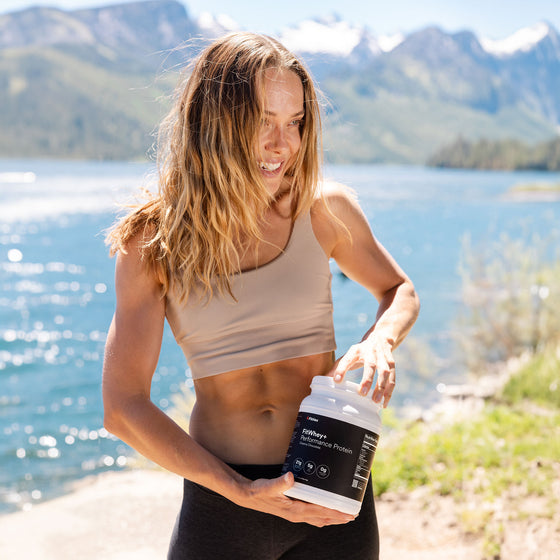
FitWhey+ delivers 21g of New Zealand whey per serving, sourced from grass-fed, rBST/rBGH hormone-free cattle. Sweetened with monk fruit. Includes Aminogen, listed on the label as fungal proteases.
Shop FitWhey+